Real Estate Underwriting & Fund Administration: Why They Work Better Together
- June 23, 2026
- Tajinder Malhotra
In commercial real estate (CRE), the most successful investment funds share one common trait: they treat real estate underwriting and real estate fund administration as a single, unified discipline rather than separate back-office functions.
At OHI, we have spent years refining how real estate financial analysis connects to fund-level operations. The firms that get this right do not just manage capital more efficiently — they build trust with investors, close deals faster, and scale without the operational drag that breaks most growing funds.
This blog explains why integrating fund administration with real estate underwriting is no longer optional in 2026. It is a structural advantage.
“The funds that win in the next decade will be the ones that stop treating underwriting and administration as separate departments.”
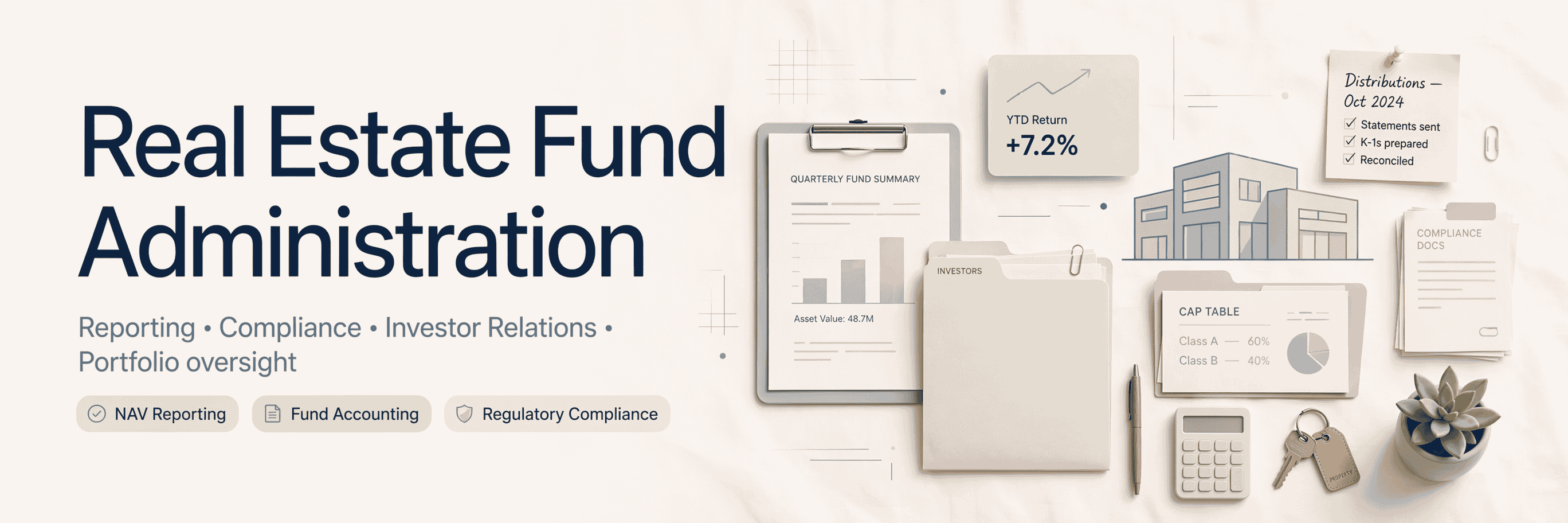
Real estate fund administration is the engine that keeps an investment fund running. It covers the full operational backbone:
The global fund administration market is projected to reach $17.4 billion by 2034, growing at over 8% annually. That growth is not accidental. As real estate funds become more complex — cross-border structures, mixed asset classes, ESG requirements — the operational load on fund managers has multiplied.
For real estate specifically, fund administration is harder than for liquid assets like equities. Properties are illiquid. Valuations require judgment. Lease structures vary. And investors want property-level detail, not just fund-level summaries.
This is where the connection to underwriting in real estate becomes critical.
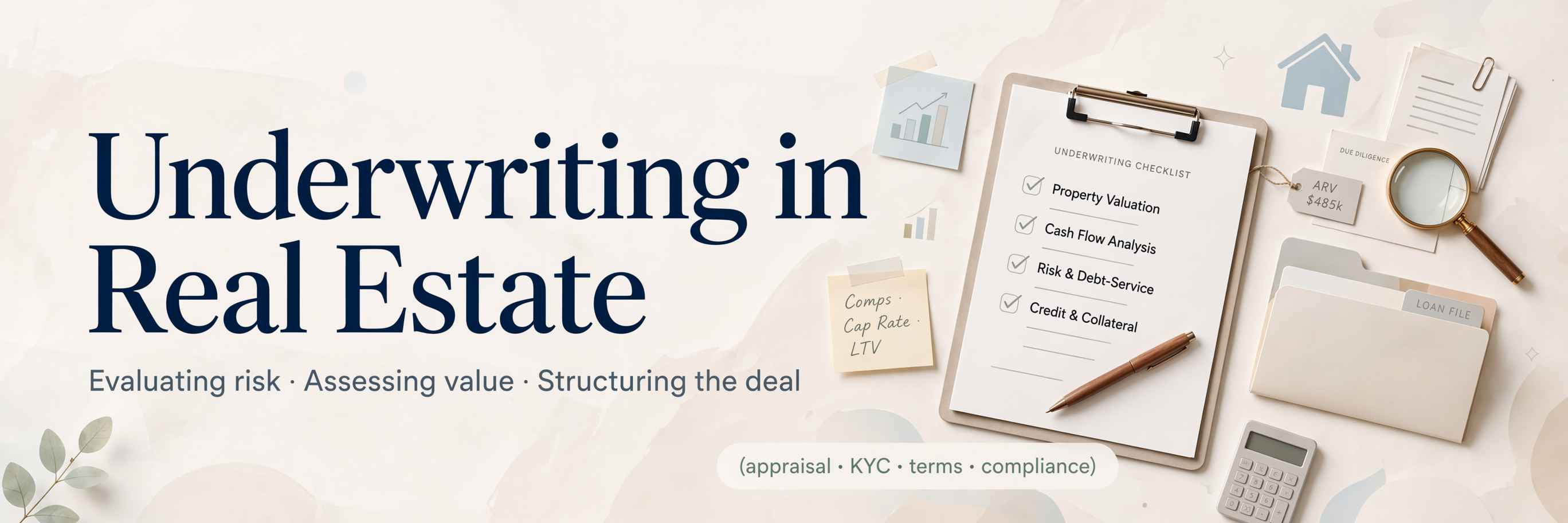
Real Estate Underwriting is the process of determining whether a property investment or loan meets the risk and return standards of the fund or lender. It is where real estate financial analysis becomes actionable.
Every underwriting exercise evaluates five core dimensions:
| Component | What It Covers | Key Metrics |
|---|---|---|
| Market Analysis | Local supply, demand, employment trends, rent growth | Vacancy rates, absorption, job growth |
| Property Analysis | Physical condition, tenant quality, lease terms, capex needs | NOI, Cap Rate, DSCR, occupancy |
| Financial Analysis | Cash flow projections, return scenarios, sensitivity testing | IRR, Equity Multiple, NPV, yield on cost |
| Risk Assessment | Downside scenarios, exit risks, refinancing exposure | Stress-tested DSCR, LTV, break-even occupancy |
| Legal & Compliance | Title, zoning, environmental, regulatory requirements | Phase I/II reports, permits, entitlements |
Financial analysis for real estate is the thread that runs through every component. Without rigorous numbers, underwriting is opinion. With it, underwriting becomes a repeatable, defensible process.
The challenge most funds face is not the quality of their underwriting — it is what happens to that real estate underwriting data after the deal closes.
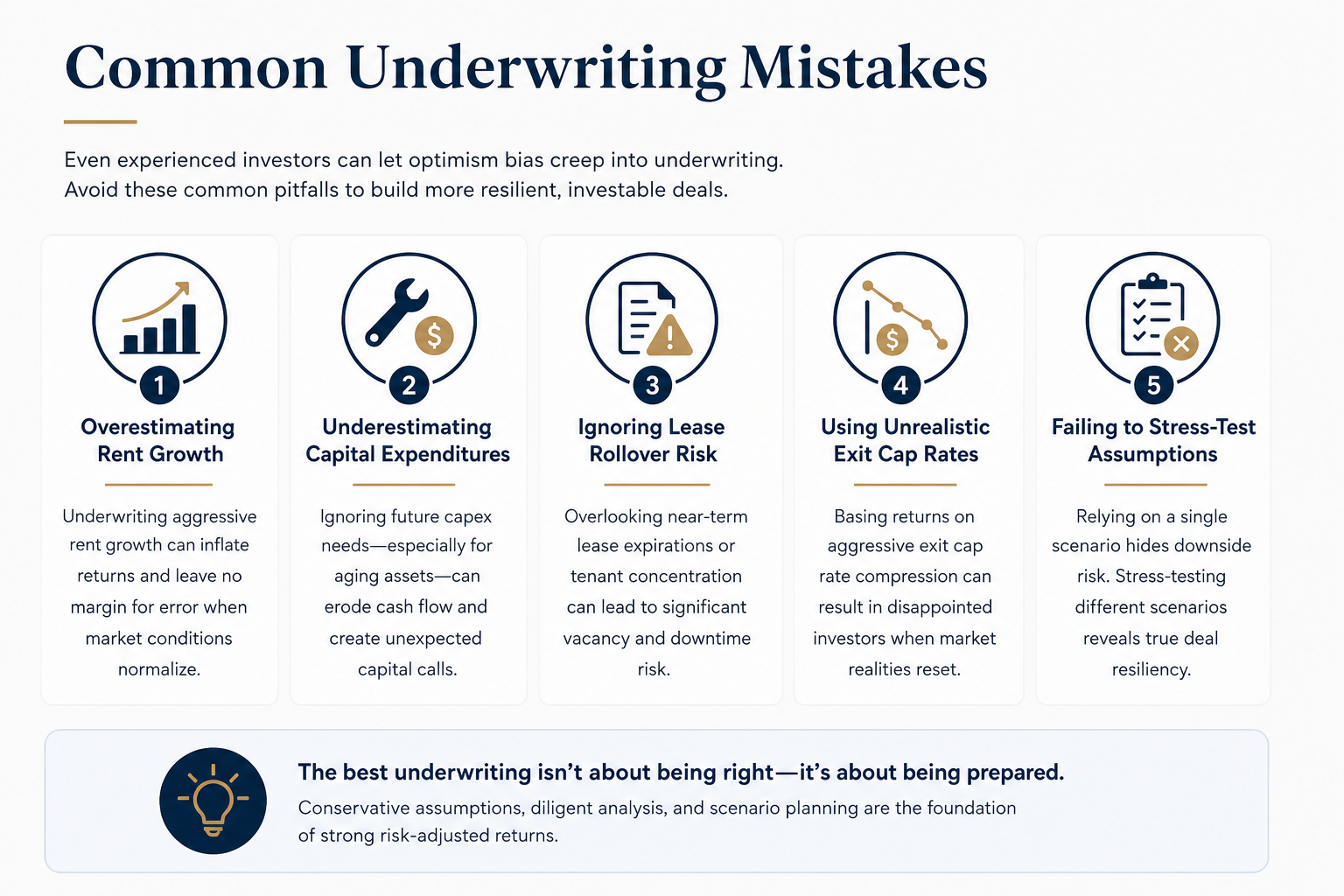
Despite being deeply interdependent, fund administration and Real Estate Underwriting are frequently managed by different teams, different systems, and different vendors. This creates five operational frictions that erode fund performance:
Underwriting teams generate detailed financial analysis for real estate deals — rent rolls, pro formas, sensitivity tables. But this data often lives in Excel files, deal management platforms, or email threads. Fund administrators, responsible for NAV and investor reporting, do not have real-time access to these assumptions. The result? Two versions of the truth.
When real estate underwriting updates — revised rent projections, occupancy changes, capex overruns — are not immediately reflected in fund administration systems, investor reports become stale. A fund might report Q2 performance using Q1 underwriting assumptions. Investors notice. Trust erodes.
Regulators now require funds to demonstrate that valuations and reporting are based on current, auditable data. When real estate underwriting assumptions and fund-level records are disconnected, compliance becomes a manual, error-prone exercise. That is a liability no fund can afford in 2026.
Fund managers need real estate underwriting data to decide how to deploy capital across properties and strategies. If administration systems do not reflect real-time deal pipeline status, underwriting timelines, or capital commitments, allocation decisions are made with incomplete information. Capital sits idle or gets misallocated.
Modern investors expect transparency. They want to know not just what their returns are, but why — grounded in the underwriting assumptions that drove the investment. When administration and real estate underwriting are siloed, that narrative becomes impossible to tell consistently.

When real estate fund administration and real estate underwriting are integrated — through unified platforms, shared data models, or coordinated expert teams — the operational and strategic benefits are substantial.
Integrated systems ensure that real estate underwriting assumptions flow directly into fund accounting and reporting. NAV calculations reflect current property-level projections. Investor dashboards show live deal pipelines. Performance metrics are always based on the latest financial analysis for real estate.
This is not a luxury. It is a competitive necessity. Funds that can tell investors, in real time, how their capital is performing against underwritten expectations build deeper relationships and raise capital more easily.
With real estate underwriting data feeding directly into administration systems, fund managers can produce quarterly reports in days instead of weeks. Ad-hoc investor queries get answered with live data. Regulatory filings carry full audit trails.
Speed matters. In a market where capital is mobile and investor attention is scarce, the fund that reports first often retains capital longest.
Integration allows fund administrators to flag discrepancies between real estate underwriting assumptions and actual performance early. If actual NOI falls below underwritten projections, the system triggers alerts. Stress-test scenarios from underwriting can be applied at the portfolio level. Covenant monitoring becomes automated and proactive.
This is where real estate financial analysis transitions from a deal-level exercise to a portfolio-level risk management tool.
Investors today demand transparency. Research shows that 57% of asset-service leaders consider automation a key enabler for operational change, with digital fund administration accelerating scalability. When real estate underwriting and administration are aligned, investors receive consistent, timely, and granular reporting — a significant competitive differentiator in fundraising.
A leading global asset manager established a 2,000+ person Global Capability Center to rebalance its workforce, reduce operational costs, and strengthen resilience. This model enabled the firm to accelerate access to top talent and position itself for AI-led transformation.
The same principle applies to integrating real estate underwriting and administration. Firms that unify these functions — whether internally or through expert partners — reduce fixed costs, eliminate redundant processes, and improve output quality.
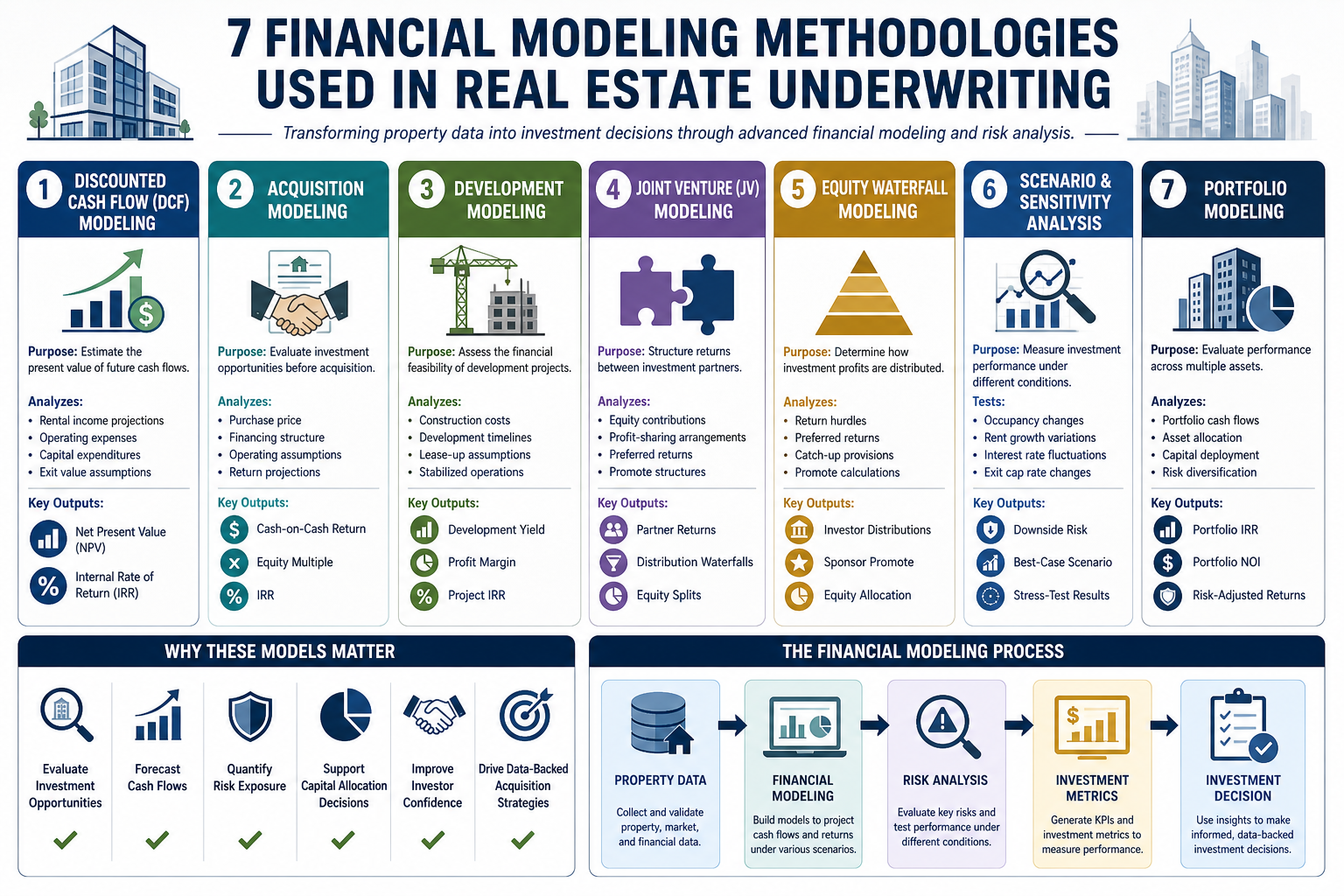
| Factor | Siloed Operations | Integrated Operations |
|---|---|---|
| Data Accuracy | Manual errors, version conflicts, reconciliation gaps | Single source of truth, real-time updates |
| Reporting Speed | 2–4 weeks for quarterly reports | 3–5 days for quarterly reports |
| Investor Transparency | Static, delayed reports with limited detail | Live dashboards, on-demand analytics, full traceability |
| Risk Detection | Reactive — issues surface after damage | Proactive — automated alerts on deviation |
| Compliance | Fragmented audit trails, manual evidence gathering | End-to-end traceability, automated documentation |
| Cost Structure | High fixed costs, multiple systems, redundant teams | Variable, scalable, technology-leveraged model |
| Scalability | Constrained by internal headcount and system capacity | Unlimited with cloud-based, modular platforms |
| Investor Retention | Declining trust, capital flight to better-reporting funds | Stronger relationships, easier follow-on fundraising |
Several technology trends are making the integration of fund administration and real estate underwriting not just possible, but essential for competitive funds.
AI is transforming fund management workflows. Reconciliation, NAV production, exception management, and reporting are now augmented by AI solutions that boost turnaround times and precision. 95% of asset and wealth administration firms have scaled generative AI adoption across use cases.
For real estate underwriting, AI can:
For administration, AI can:
Cloud-based deployment is the fastest-growing segment in fund administration, expanding at a CAGR of 8.1%. These platforms offer real-time data access, modular service architectures, and open API connectivity to portfolio management systems. This enables real estate underwriting data to flow seamlessly into administration workflows without manual intervention.
With increased regulatory requirements from FCA, SEC, and ESMA, a strong data governance framework is no longer optional. Integrated systems ensure that real estate underwriting assumptions, valuations, and investor reports are auditable and compliant by design — not as an afterthought.
The lines between deal management platforms, underwriting tools, and fund administration systems are blurring. Leading platforms now offer end-to-end workflows from initial deal screening through final investor distribution. Funds that adopt these converged stacks gain a structural advantage.
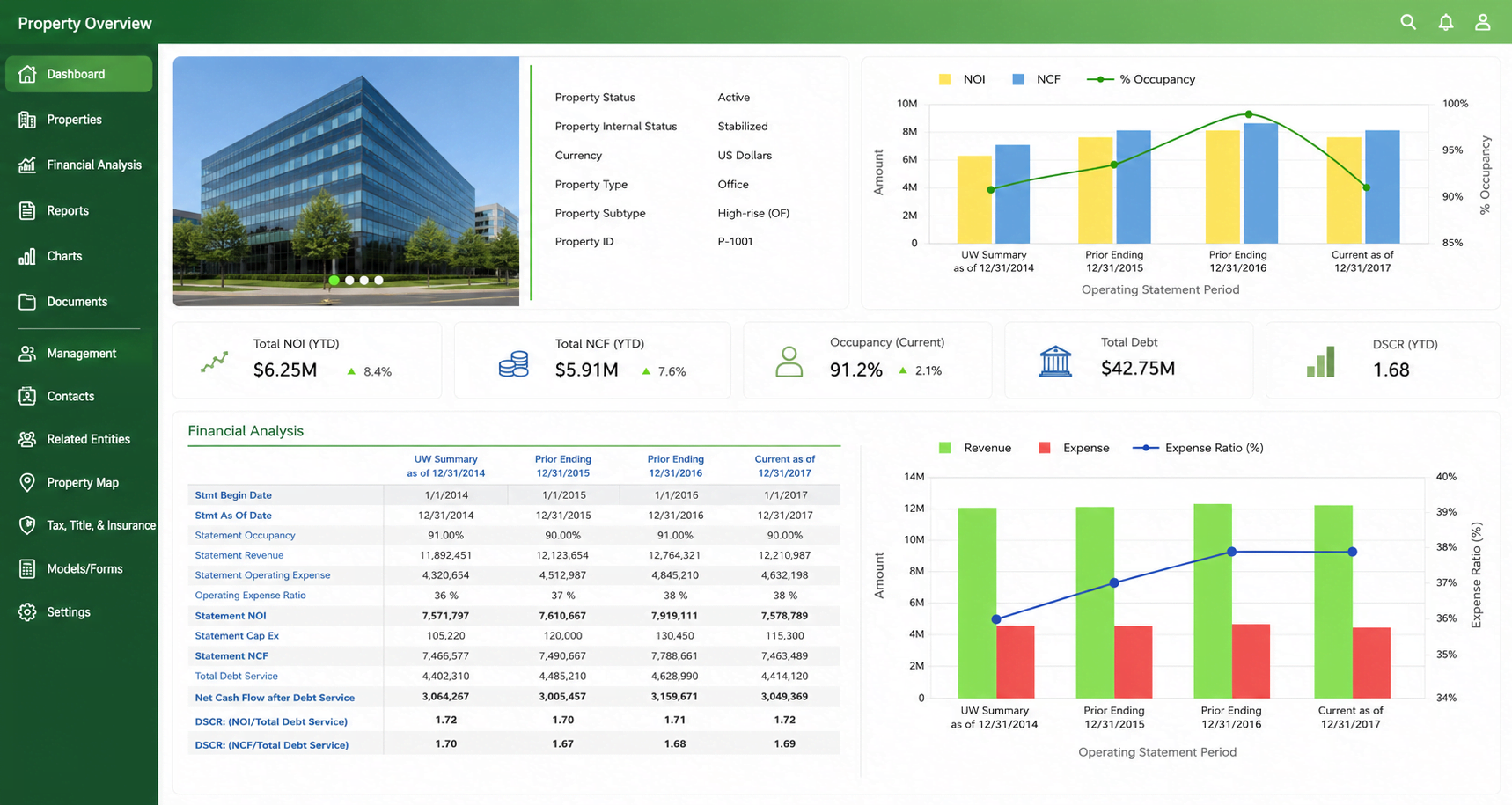
Many real estate fund managers are recognizing that building and maintaining integrated underwriting and administration capabilities in-house is expensive, time-consuming, and operationally complex. Partnering with specialized experts offers distinct advantages:
Expert partners bring concentrated knowledge of real estate financial analysis, fund structures, and regulatory requirements across multiple jurisdictions. This is particularly valuable for funds launching new strategies or entering new markets where internal expertise may be thin.
Integration allows managers to focus on core activities — sourcing deals, managing portfolios, and nurturing investor relationships — while operational functions scale elastically. This converts fixed costs into variable costs, improving profitability and strategic flexibility.
Expert partners with existing regulatory licenses, technology infrastructure, and operational frameworks can help funds launch and begin fundraising faster than building capabilities from scratch. In competitive capital markets, weeks matter.
Leading expert partners have already invested in cloud-native platforms, AI tools, and automated workflows. Fund managers benefit from this technology without the capital expenditure, implementation risk, or ongoing maintenance burden.
Expert partners operate across multiple funds and strategies. They see patterns, best practices, and emerging risks that a single fund manager might miss. This cross-pollination of insight improves real estate underwriting quality and administration precision over time.
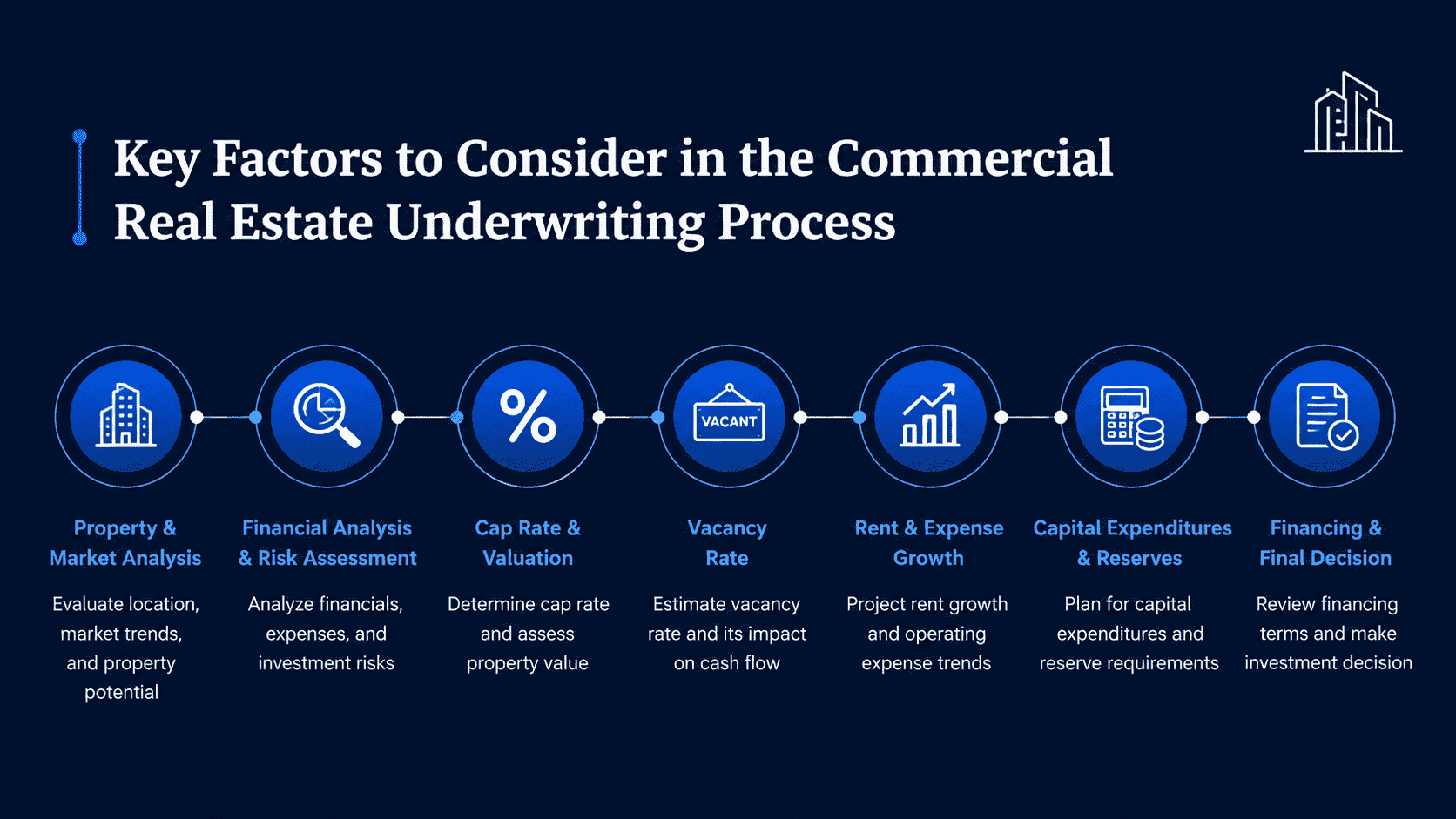
If you are a fund manager looking to integrate these functions, here is a practical roadmap:
Map where underwriting data lives — spreadsheets, CRMs, deal platforms, shared drives — and how it flows (or does not) into your fund administration systems. Identify every manual handoff, every version conflict, every reconciliation gap.
Ensure that underwriting assumptions — NOI, Cap Rate, DSCR, IRR, Equity Multiple — use the same definitions and formats as your fund accounting systems. This prevents the reconciliation errors that consume weeks of analyst time every quarter.
Look for partners with:
Use automation to:
Regularly review the integration’s effectiveness. Key metrics to track:
Use these metrics to refine the model continuously.
The real estate fund management industry is at an inflection point. Several trends will define the winners:
PwC analysis suggests that around one in six asset managers may be acquired or disappear by 2027, driven by fee compression and the costs of technology adoption. Firms with integrated operations — faster reporting, lower costs, stronger investor relationships — will be the acquirers, not the acquired.
Tokenization of real estate assets is gaining traction as a way to unlock liquidity and broaden investor access. These structures require sophisticated administration and underwriting integration to manage fractional ownership, automated distributions, and real-time valuation.
Investors increasingly demand ESG-aligned reporting. Integrated systems can embed ESG metrics into both underwriting (e.g., energy efficiency risks, carbon exposure) and administration (e.g., ESG performance reporting, impact measurement). Funds that cannot tell this story will lose capital to funds that can.
The evergreen, semi-liquid private fund universe has surpassed $427 billion in AUM and is expected to exceed $1 trillion within five years. These structures require more sophisticated administration and underwriting integration than traditional closed-end funds because of their continuous capital flows and redemption features.
The funds that lead in 2030 will be those that built AI-native operations in 2026. This means underwriting models that learn from portfolio performance, administration systems that predict investor behavior, and compliance frameworks that adapt to regulatory changes automatically.
Real estate fund administration and underwriting in real estate are not separate functions. They are two halves of a single, integrated discipline that defines how well a fund performs, how confidently it raises capital, and how sustainably it scales.
When these functions are connected:
The firms that integrate first will build structural advantages that compound over time. The firms that delay will spend the next decade catching up.
“Operational tenacity and investor-focused approaches must converge to delineate future winners.”
At OHI, we specialize in the integrated delivery of real estate financial analysis, underwriting in real estate, and fund administration for real estate investment funds. Our teams combine deep CRE expertise with advanced technology platforms to ensure your data flows seamlessly from deal underwriting to investor reporting — with the accuracy, speed, and transparency that modern capital demands.
Ready to integrate your fund operations? Connect with OHI to explore how unified underwriting in real estate and fund administration can transform your fund’s performance and investor relationships.

What is the difference between real estate underwriting and fund administration?
Underwriting evaluates the risk and returns of individual real estate deals using real estate financial analysis. Fund administration manages the ongoing accounting, reporting, and compliance of the investment fund as a whole. Integration ensures deal-level data feeds accurately into fund-level reporting.
Can smaller real estate funds benefit from integrated underwriting and administration?
Yes. Smaller funds often benefit most because they lack the internal resources to manage both functions separately. Expert integration provides enterprise-grade capabilities without the enterprise-grade overhead.
How does integration improve investor reporting?
Integration eliminates manual data transfers, reduces errors, and enables real-time reporting. Investors receive more accurate, timely, and detailed information grounded in the original financial analysis for real estate that drove each investment decision.
What technology should a fund look for in an integrated solution?
Look for cloud-native platforms with open APIs, AI-powered automation, real-time dashboards, and modular service architectures that can scale with your fund’s growth and strategy evolution.
How does integrated underwriting and administration improve risk management? Integration enables automated monitoring of actual performance against underwritten projections. When deviations occur, alerts trigger before losses materialize. Stress-test scenarios from underwriting can be applied dynamically across the entire portfolio.
Is it better to build integration in-house or partner with experts?
For most funds, partnering with specialized experts is faster, less expensive, and less risky. Expert partners bring proven technology, regulatory expertise, and cross-fund best practices that would take years to develop internally.
What role does AI play in integrated fund operations?
AI automates document extraction, reconciliation, reporting, and anomaly detection. It enables predictive analytics for capital calls, distributions, and performance forecasting. 95% of leading administration firms have already adopted generative AI across core workflows.
How does ESG reporting fit into integrated fund operations?
Integrated systems can embed ESG metrics into both underwriting (e.g., energy efficiency, carbon exposure) and administration (e.g., ESG performance dashboards, impact measurement). This meets growing investor demand for sustainable investment transparency.