Commercial & Residential Real Estate Clients
Served 250,000 Units and 10 million Sq. Foot Across Clients
Team Including CPAs, MBAs and Graduates
California | New York | Texas | Florida | Georgia | Ohio | Colorado | Kansas | Pennsylvania | Oregon | Washington and More
Homeowner Associations (HOA), Affordable Housing, Single Family Housing, Multifamily Apartments, Tax Credit & HUD Properties, Commercial, Student Housing, Retail, Industrial


Our indicative standard charges for Remote Property Manager role are listed below. Custom packages of 25, 50 and 80 hours per month are available.
Provides assistance with the day‐to‐day functions of the property management department and the functions of the Property Manager. They have very good communication skills, have a customer service background and mindset.

Property accounting is the process of tracking and managing the financial aspects of real estate properties. This includes recording income (like rent), expenses (such as maintenance and taxes), and the property's overall value. It helps property owners understand their investment's financial performance.
Asset management is the practice of overseeing and optimizing the value of various assets, such as investments, properties, or equipment. It involves making decisions to grow or maintain the worth of these assets over time.
Acquisition analysis is the evaluation of a potential business deal or investment to understand its value, risks, and benefits. It helps determine whether the acquisition is a sound decision both financially and strategically.

Property management companies can outsource accounting, accounts payable, accounts receivable, general ledger support, reconciliations, financial reporting, vendor support, lease administration, maintenance administration, and other recurring back-office functions. The scope can cover individual processes or a broader accounting workflow based on portfolio size, transaction volume, systems, and internal staffing. OHI provides outsourced property management back-office services for residential, commercial, hospitality, and affordable housing portfolios.
Property management companies can outsource accounts payable, accounts receivable, general ledger accounting, bank reconciliations, tenant accounting, CAM reconciliations, financial reporting, and monthly closing activities. Outsourcing can be structured around specific accounting functions or a broader property accounting workflow. OHI’s property management accounting resources identify AP, AR, tenant accounting, CAM reconciliations, general ledger, reporting, auditing, and monthly book closing as common outsourced functions.
Property managers can outsource back-office operations to add accounting capacity, reduce repetitive administrative work, standardize recurring processes, and support timely financial reporting. An outsourced team can handle transaction processing, AP/AR, reconciliations, vendor-related accounting, reporting, and administrative workflows while internal leaders focus on property operations, asset performance, and portfolio strategy. The appropriate outsourcing model depends on the firm’s portfolio, transaction volume, technology stack, and internal controls.
Outsourced property management accounting can provide Controllers and CFOs with additional capacity for reconciliations, general ledger maintenance, month-end close, financial reporting, variance analysis, and audit preparation. It can also help standardize accounting workflows across multiple properties and entities. This allows finance leaders to spend more time on cash flow, forecasting, NOI, portfolio performance, financial controls, and strategic decision-making instead of routine transaction processing.
Yes. An outsourced property accounting team can support PBC (Prepared by Client) audit requests by preparing account analyses, reconciliations, trial balances, supporting schedules, and audit documentation. OHI’s year-end accounting service includes preparation of audit schedules and support for portfolio PBC audits conducted by external accountants. This type of support can help Controllers organize documentation and maintain audit readiness across property-level and portfolio-level accounting.
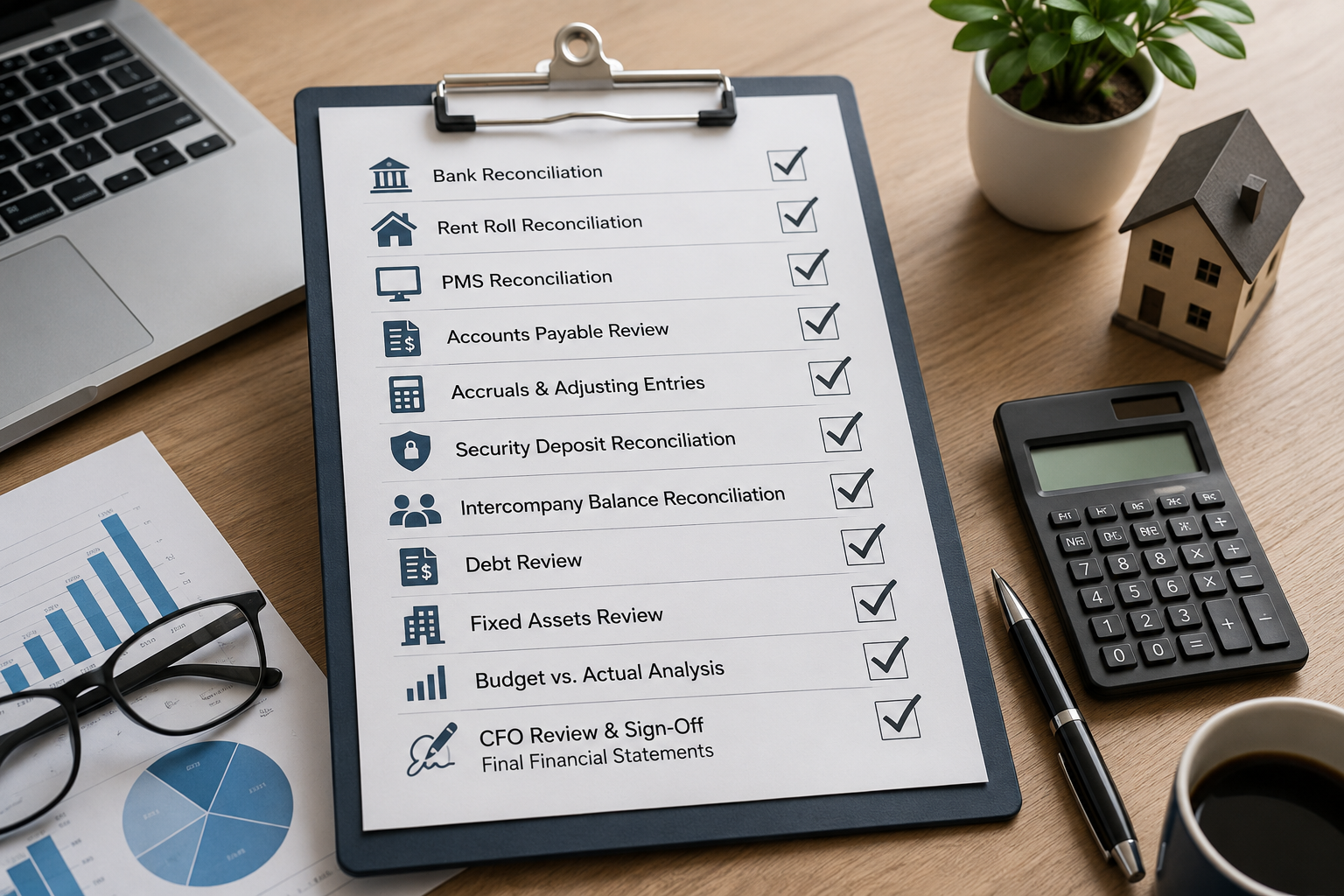
Yes. Outsourced property accounting teams can support month-end close through bank and balance-sheet reconciliations, accruals, journal entries, account reviews, supporting schedules, and financial reporting. For Controllers managing multiple properties or entities, standardized close procedures can improve consistency and provide financial information for variance analysis, budgeting, forecasting, and portfolio-level decision-making. OHI also maintains a dedicated month-end closing process resource.
Yes. Outsourced property accounting can support affordable housing and HUD portfolios where property-level accounting, reconciliations, reporting, compliance documentation, and audit readiness require consistent processes. OHI’s affordable housing case study describes support involving LIHTC and HUD-related requirements, month-end close, AP, standardized workflows, controls, and audit-ready reporting. OHI also has separate HUD compliance case studies addressing reserve and year-end accounting issues.
Yes. Hospitality businesses can outsource selected accounting and back-office functions such as accounts payable, reconciliations, financial reporting, vendor-related accounting, and recurring finance processes. The scope should be based on the property’s operating model, transaction volume, accounting system, reporting requirements, and internal controls. OHI’s current property management page identifies hospitality among its supported portfolio types, and OHI also publishes hotel-accounting client testimonials.
Yes. OHI states that its teams work within clients’ existing property management and accounting systems, including Yardi, RealPage, AppFolio, MRI, and Entrata. The specific workflow depends on the client’s chart of accounts, approval hierarchy, reporting requirements, integrations, and accounting processes. This approach allows the outsourced team to support existing operations rather than requiring a property manager to replace its core technology stack.