The Month-End Close Checklist Every Property Management CFO Needs in 2026
- August 27, 2026
- OHI
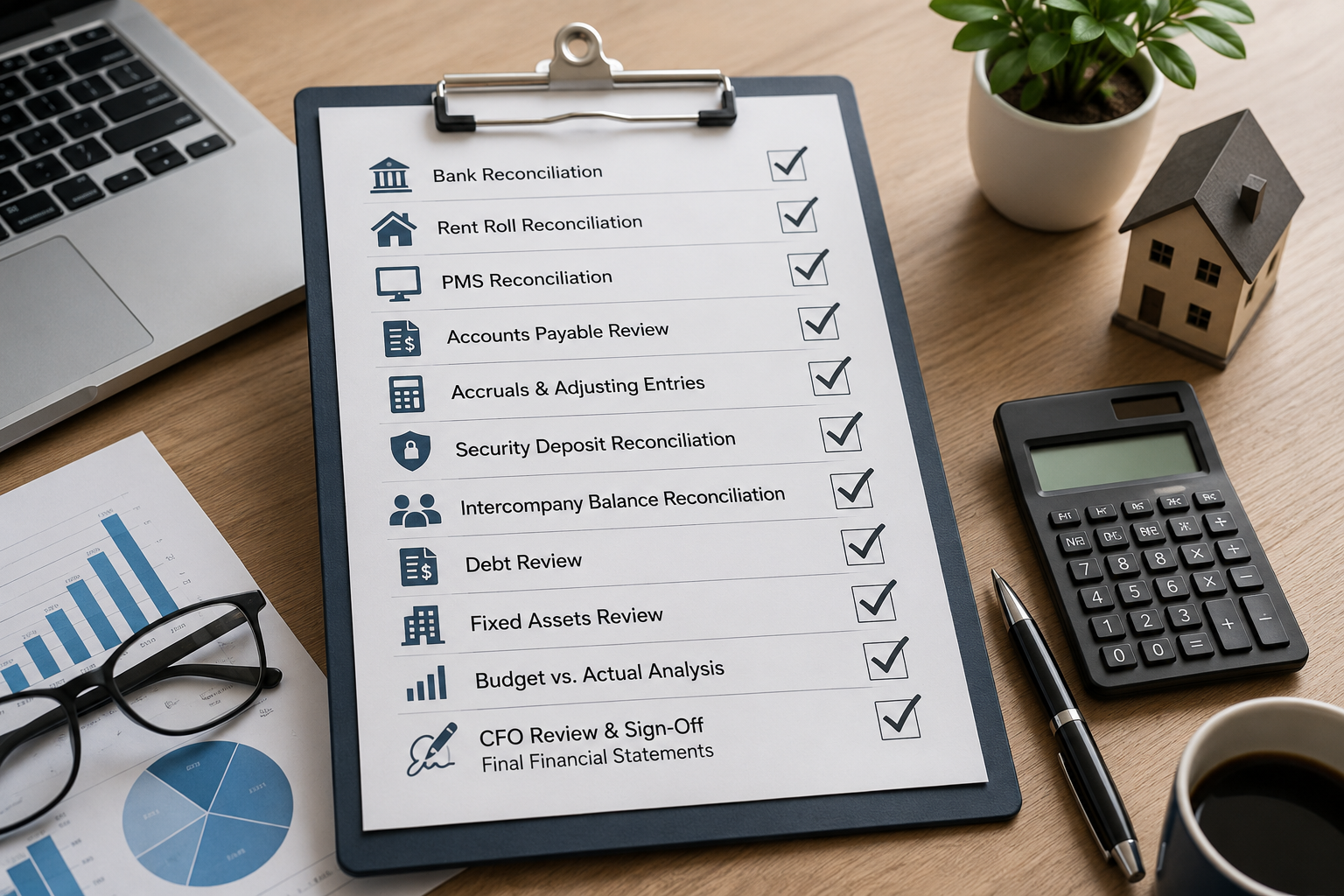
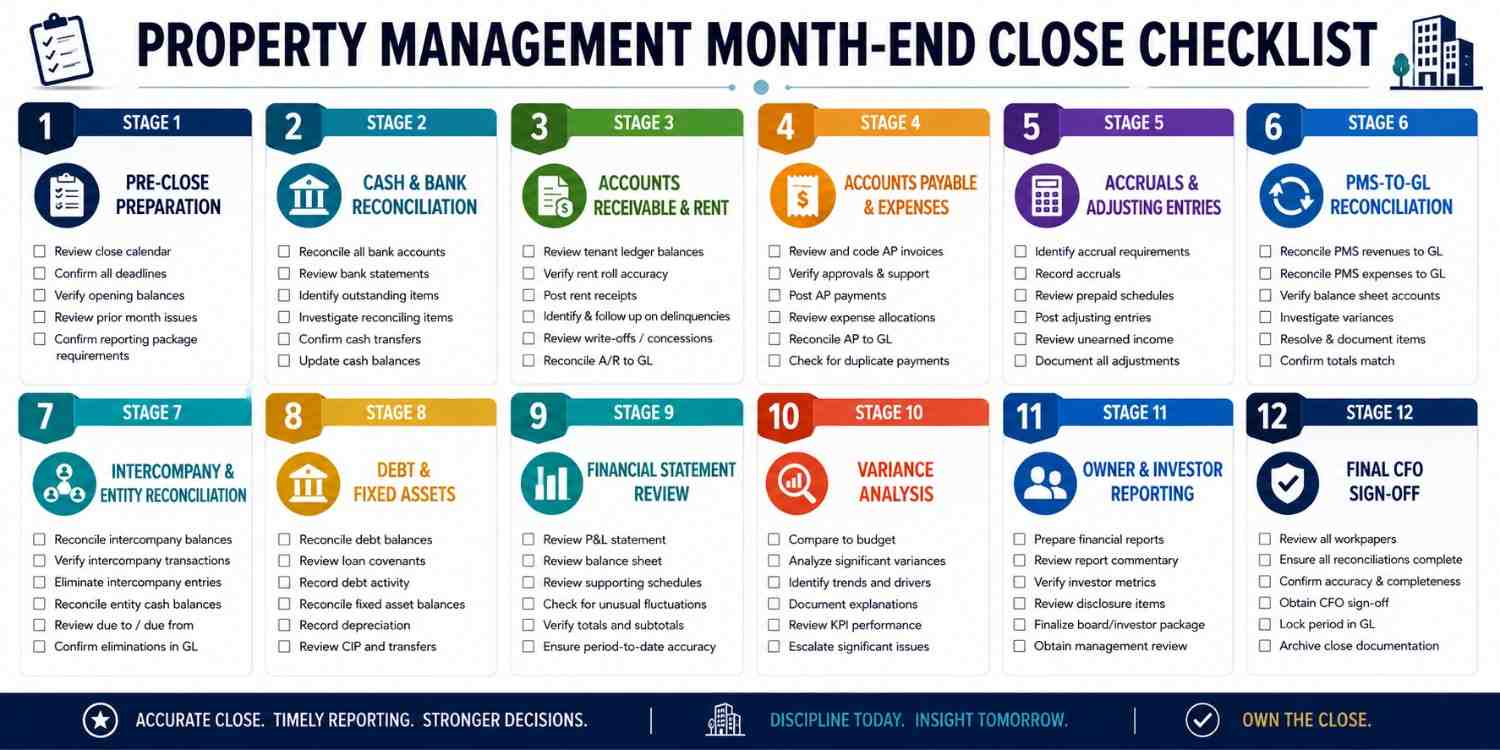
A property management month-end close checklist should cover bank, rent roll, PMS, A/P, accruals, security deposits, intercompany balances, debt, fixed assets, adjusting entries, and budget-vs-actual analysis, followed by CFO review and sign-off. It helps ensure accurate NOI, timely owner reporting, and audit-ready books.
For growing portfolios, month-end close becomes more complex as properties, entities, bank accounts, vendors, and PMS configurations increase. Unpaid invoices, rent roll adjustments, missed accruals, unreconciled security deposits, and premature owner distributions can create discrepancies between the PMS and general ledger.
A standardized close process gives CFOs stronger financial controls and helps property management teams consistently close within 7–10 days instead of taking weeks to finalize the books.
An accurate and timely month-end close is the groundwork of each financial decision a property management CFO makes for cash management, distributions to owners, and investments.
The practical stakes are high:
CFO Insight: Pre-close preparation failures are the single most common cause of close delays. If your team is still chasing bank statements on Day 3 of the close, the problem is upstream process, not accounting capacity.
| Close Task | What to Verify | Owner | CFO/Controller Review |
| Confirm close calendar and cutoff dates | All team members aligned on cutoff | Controller | Approve calendar |
| Lock prior accounting period | Prior period inaccessible to routine entry | Controller | Confirm lock |
| Collect bank and credit card statements | All statements received for all accounts | AP/AR Manager | Confirm receipt |
| Confirm AP invoice cutoff | All invoices through cutoff captured | AP Manager | Review exceptions |
| Review outstanding invoices | Nothing material missing from the period | Property Accounting | Spot check |
| Update rent roll for all properties | Current occupancy, rents, move-ins/outs | Property Accounting | Validate completeness |
| Identify pending or unapplied transactions | Clear queue before close | AR Manager | Review aged items |
| Close Task | What to Verify | Owner | CFO/Controller Review |
| Reconcile all operating accounts | Book balance = bank balance, per property | Property Accountant | Review exceptions |
| Reconcile security deposit trust accounts | Regulatory compliance, no commingling | Controller | Required sign-off |
| Investigate outstanding checks | Stale checks identified and resolved | AP Manager | Flag aged items |
| Clear unreconciled transactions | No unsupported items carried forward | Property Accountant | Approve adjustments |
| Reconcile credit cards | All charges coded, no unidentified items | AP Manager | Review unusual items |
Property management bank reconciliation must occur at the property level, not just the entity level. A single LLC may hold operating accounts for multiple properties each account must reconcile independently.
Security deposit trust account reconciliation carries regulatory weight in most U.S. states. The individual tenant/resident deposit liability ledger must equal the trust account bank balance at all times. This is a CFO-level control, not an optional best practice.
| Close Task | What to Verify | Owner | CFO/Controller Review |
| Reconcile rent roll to GL | Scheduled rent per PMS = revenue per GL | Property Accountant | Review variances |
| Review tenant/resident ledgers | No duplicate payments, unapplied credits | AR Manager | Sample review |
| Review delinquency report | AR aging accurate, collection notes current | Property Manager | Discuss write-offs |
| Verify rent collections | Deposits matched to tenant ledger entries | AR Manager | Spot check |
| Review concessions and adjustments | All concessions approved and properly coded | Controller | Approve adjustments |
| Review bad debt | Assess collectibility; post allowance entry | Controller | Required judgment |
| Verify late fees and other charges | Fees per lease terms, properly recorded | AR Manager | Compliance check |
Rent roll reconciliation is the revenue integrity control for property management. Every line on the rent roll scheduled rent, concessions, subsidies, and other income must tie to the GL. Unexplained variances between PMS-generated rent rolls and the GL are a data integrity problem that compounds every month it goes unresolved.
| Close Task | What to Verify | Owner | CFO/Controller Review |
| Capture all vendor invoices through cutoff | No material invoices omitted | AP Manager | Review AP aging |
| Review unpaid bills | Confirm what is legitimately unpaid vs. missing | AP Manager | Approve holds |
| Identify missing invoices | Utilities, recurring contracts, known vendors | Property Accounting | Accrue if not received |
| Verify expense coding | Correct GL account, correct property | Property Accountant | Sample audit |
| Review for duplicate payments | Vendor/invoice cross-check | AP Manager | Flag for recovery |
| Separate repairs from CapEx | Operating expense vs. capital asset | Controller | Required judgment |
Misclassifying capital expenditures as operating repairs, or vice versa, is one of the most common property accounting errors and one with material impact on NOI, asset basis, and depreciation schedules. This distinction requires Controller-level judgment, not clerical processing.
| Close Task | What to Verify | Owner | CFO/Controller Review |
| Accrue utilities not yet invoiced | Estimate based on prior periods or contracts | Property Accountant | Approve estimates |
| Accrue property taxes | Monthly accrual per tax schedule | Controller | Verify rate |
| Accrue insurance | Monthly proration of annual premium | Controller | Verify premium |
| Accrue payroll and benefits | Through period-end if payroll straddles cutoff | Controller | Confirm calculation |
| Accrue management fees | Per management agreement terms | Controller | Required review |
| Accrue maintenance contracts | Recurring service agreements | Property Accountant | Review contracts |
| Amortize prepaid expenses | Insurance, subscriptions, permits | Controller | Verify schedule |
| Record deferred revenue/expenses | Prepaid rent, deferred concessions | Controller | Verify accounting treatment |
Accrual discipline is the difference between GAAP-compliant financials and cash-basis approximations. In a 50-property portfolio, missing routine accruals by even modest amounts per property creates material distortion at the portfolio level.
PMS-to-GL reconciliation ensures each transaction recorded in the property management system (PMS) for rent, deposits, fees, credits, and owner balances is recorded in the accounting general ledger (GL).
This is one of the more complex steps of the month-end close in property management accounting. Some of the most common reasons for discrepancies are:
Recommended approach: Produce a property-level PMS-to-GL reconciliation report covering rent, deposits, fees, owner balances, and tenant balances. Any variance exceeding your materiality threshold requires documentation and resolution before the period is locked.
In portfolios arranged as individual properties owned as LLCs with a singular management company, every month intercompany balances need to be reconciled in multi-entity property management structures.
| Close Task | What to Verify | Owner | CFO/Controller Review |
| Reconcile management fees payable/receivable | Management entity and property entity agree | Controller | Required review |
| Reconcile due-to/due-from accounts | Intercompany balances net to zero | Controller | Required sign-off |
| Review owner/entity transactions | All distributions and contributions recorded | Controller | Approve distributions |
| Apply intercompany eliminations | If consolidated reporting is produced | Controller | Consolidation review |
Intercompany mismatches that carry forward become exponentially harder to unwind. A CFO overseeing 15–20 entities should require full intercompany reconciliation as a hard close gate not an optional step.
| Close Task | What to Verify | Owner | CFO/Controller Review |
| Reconcile loan balances | Book balance vs. lender statement | Controller | Confirm amortization |
| Record interest and principal split | Per amortization schedule | Property Accountant | Verify accuracy |
| Review CapEx additions | All approved capital items recorded as assets | Controller | Confirm capitalization |
| Post depreciation | Per depreciation schedule, all assets | Property Accountant | Verify schedule |
| Record fixed asset disposals | Retired assets removed from schedule | Controller | Required judgment |
Variance analysis is the CFO’s last line of defense before releasing financials.
For each property and for the consolidated portfolio, review:
Unexplained favorable variances deserve the same scrutiny as unfavorable ones. A property showing unusually low maintenance expense may have deferred maintenance or missing invoices not improved operations.
| Close Task | What to Verify | Owner | CFO/Controller Review |
| Prepare owner statements | Property-level P&L, cash summary, reserve balance | Property Accounting | Review before distribution |
| Prepare investor packages | Portfolio performance, NOI, distributions | Controller | Required sign-off |
| Calculate owner distributions | Confirmed cash balance post-reconciliation | Controller | Approve distributions |
| Review reserve balances | Replacement reserves funded per agreements | Controller | Confirm adequacy |
| Produce consolidated reporting | Portfolio-level financials if applicable | Controller | Final review |
Owner and investor reporting is the external-facing output of the entire close process. Errors here damage relationships and create disputes. Reporting should not be released until all reconciliations are complete and CFO sign-off is obtained.
| Close Task | What to Verify |
| All reconciliations complete and documented | No open items without resolution notes |
| Material adjustments reviewed | Judgment items documented with rationale |
| Control exceptions resolved or documented | Nothing carried forward without explanation |
| Supporting documentation archived | Close package complete and retrievable |
| Period locked in accounting system | No post-close entries without approval |
| Close completion date recorded | Track against close KPIs |
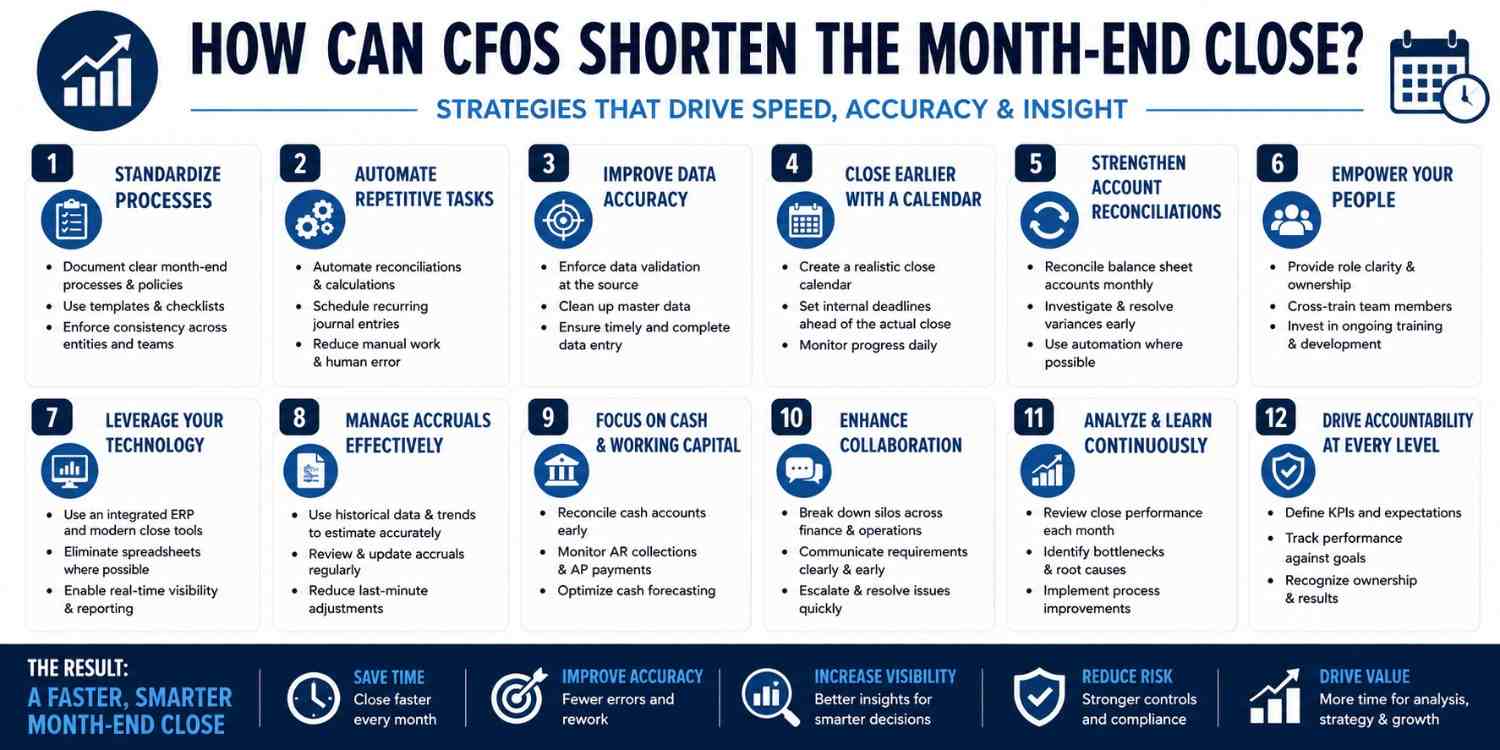
The fastest path to a shorter close is eliminating the rework that results from upstream data quality failures.
Practical strategies:
1. Set and enforce AP transaction cutoffs. Late invoices are the most controllable delay. Require vendors to submit invoices within a defined number of days after service. Accrue anything not received by cutoff.
2. Standardize reconciliations. Build reconciliation templates for bank accounts, rent roll, PMS-to-GL, and security deposits. Standardization eliminates the judgment overhead of recreating the process each month.
3. Automate recurring journal entries. Management fees, depreciation, insurance, and property tax accruals should be standing entries — not manual calculations performed each month.
4. Track close KPIs. You cannot improve what you do not measure. Track days-to-close, reconciliation completion rates, and post-close adjustment counts each month.
5. Consider outsourced accounting support for high-volume, repetitive tasks — particularly in portfolios experiencing rapid growth or staffing constraints. Outsourced property management accounting can provide scalable capacity without fixed headcount cost. For more on what this looks like operationally, see our guide to real estate back office services.