Smart Amenities Homeowners Want: A Guide for HOA Boards
- November 6, 2026
- khemanand
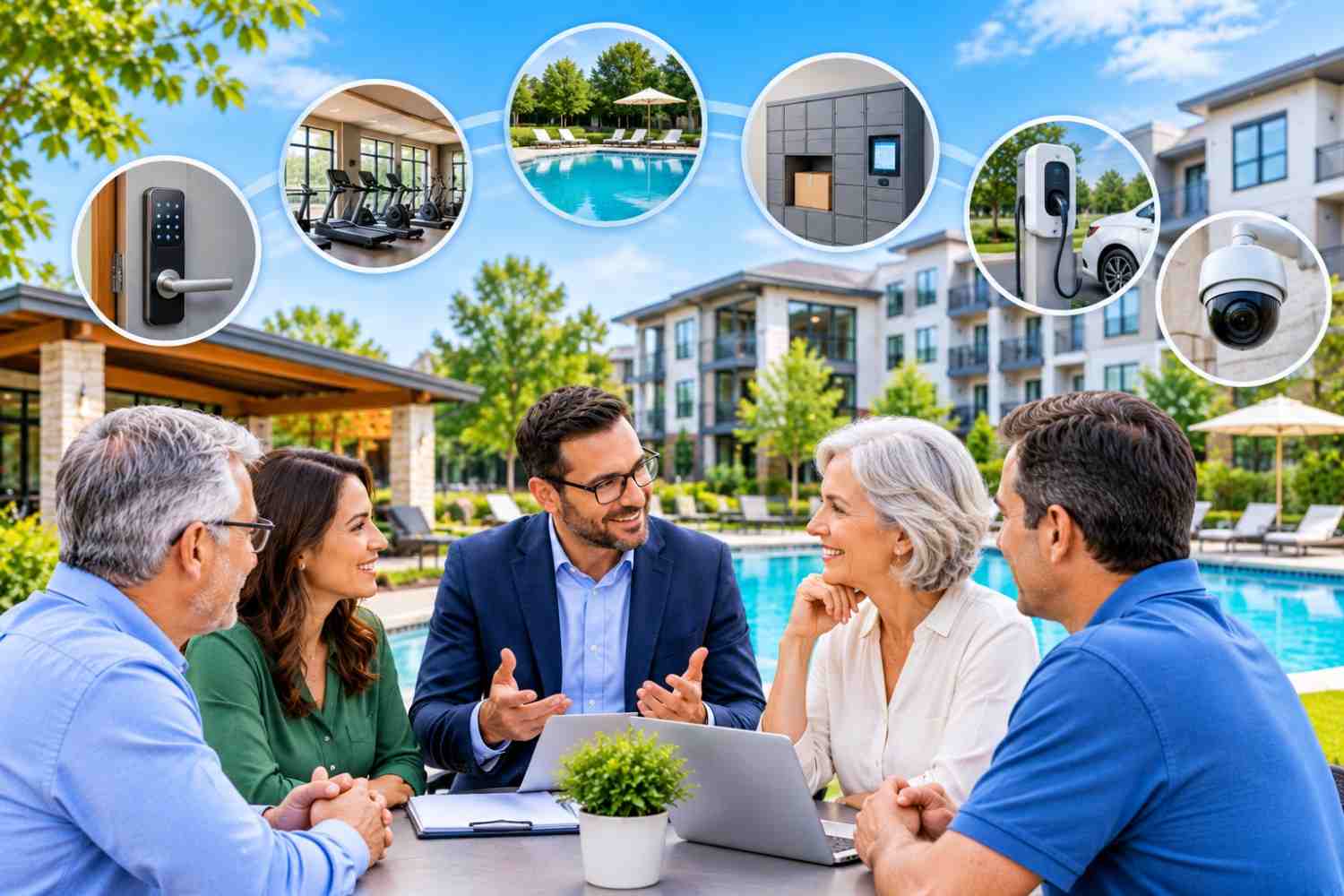
Homeowners expect more from their neighbourhoods than a swimming pool, clubhouse and fitness center. Now convenience plays a major role on how residents experience their neighbourhood. As a result, developers need to consider additional amenities such as convenient access controls and package management, EV charging stations and energy management systems, online reservations for community amenities, digital portals and other conveniences for residents and community management systems.
For an HOA Board, adding technology should never be about following trends. Smart amenities come with ongoing costs. The hoopla surrounding the latest gadgets can mask the costs of managing the system and the negatives associated with a disappointing user experience.
The goal of an HOA Board should be to identify community needs and select amenities that address those needs, ensure the HOA has the financial capacity to manage the amenity over the long-term, and maintain manageability.
Smart amenities are traditional community services or facilities that have been enhanced with technology to increase convenience, access, monitoring, communication, or management.
For example, a traditional clubhouse may require residents to contact the community manager to schedule the facility, complete a paper form, and collect a physical key. An enhanced clubhouse may provide the owners the ability to check the availability of the facility online, reserve it, and receive a temporary access code. Additionally, the enhanced clubhouse may have the ability to manage the climate and/or lighting of the facility.
Package rooms, parking, fitness centers, and pools are other amenities that can be enhanced to provide increased convenience and access.
Smart amenities may help improve:
While the technology is the easy part of the equation, the board must also determine who will manage the system, respond when the system fails, and review/approve vendor services and communicate with the owners. Finally, to gain the most value from smart amenities, the association must have a clear plan to manage the smart amenities.
Access Control Systems can provide convenience to homeowners and operational improvements to boards by allowing residents to electronically access gates, clubhouses, gyms, pools and other restricted areas with mobile credentials or access codes.
Mobile Credentials replace physical keys, so homeowners don’t have to carry around a bunch of keys and temporary access can be granted to vendors, contractors, service providers, etc. without having to physically distribute keys or credentials.
From a board perspective, they can have better control to restrict access to certain facilities and can quickly deactivate access as needed.
Prior to approving any Access Control Systems, boards should consider how the systems operate during a loss of power or the internet, how access credentials are managed, if activity logs exist, and what kind of technical support the vendor provides.
Recurring software costs, replacement access control devices, and maintenance should be taken into consideration when analyzing the total cost of ownership. Additionally, the cost of integrating the access control system with the existing doors or gates should be taken into account.
Electrical vehicle charging is an important consideration for many condominiums, townhomes and planned communities.
Not every resident will want to, or be able to, charge their vehicle at a public charging station. Therefore, having the ability to charge at home may be important to some residents.
There are a number of factors that Boards will need to assess. These may include, but are not limited to, electrical capacity, available parking, ownership of the charger, the utility of the electricity, the cost of the infrastructure, maintenance and insurance. There may also be considerations for future demand.
From a financial perspective, it may be more practical to start with a few chargers and build the electrical infrastructure to support a larger charging network in the future.
Boards will also need to determine how the cost of the electricity will be allocated.
Fitness centers are often found in HOA communities. Recently, HOA fitness centers have started to include more technology to make management and access easier.
Examples of technology that can make management easier and enhance the resident experience can include digitized entry, equipment monitoring, and online scheduling, as well as equipment and maintenance tracking.
The problem is determining whether the community actually needs this technology.
Some HOA boards agree to the purchase of technology upgrades without adequately reviewing if the current fitness center is being used. If the current fitness center is mostly empty, acquiring connected equipment would not address the issue of low usage.
There are also costs related to the repair and replacement of technology that needs to be considered.
Longer term, board members should evaluate the expected useful life of equipment along with its repair and replacement costs.
Pools are one of the more resource-intensive amenities in an HOA. Smart monitoring can allow management teams to monitor pool operating conditions more frequently and consistently.
Some systems can let boards monitor the temperature of the water, filtration schedules, equipment, energy consumption, and the condition of pool chemicals. Similar technology can be used to monitor irrigation and water management in common areas.
These systems should be used in conjunction with qualified maintenance staff.
Boards should also know who is notified and responsible for action in response to alerts. The frequency of sensor maintenance and calibration should also be known. Further, what happens if the system stops working should also be known.
Just because connected monitoring is available does not mean that an association should automatically monitor and act on the information. They should have processes in place to act on the information.
Reliable connectivity allows these spaces to be used for work and meetings.
Residents can use these spaces for work and other activities. The management of these spaces can be improved by the use of digital displays, occupancy-based lighting, and other smart devices.
The network should be managed in a way that ensures the security and integrity of the association’s administrative systems, access control and security systems.
The association should budget for the Wi-Fi, routers, access points, and other related software and services, as well as the eventual replacement of the hardware.
Deliveries can create operational challenges for residential communities.
Smart lockers or secured package rooms can provide residents a more convenient and secure location to pick up deliveries and reduce deliveries left in lobbies, offices and other common areas.
Automation of the delivery process can reduce the amount of coordination required from onsite staff. Residents can receive digital notifications when a delivery arrives and use a delivery access code to pick up that delivery.
Before a community invests in automated delivery solutions, the board should analyze actual package volume, the size of the community, available space, delivery patterns, oversized packages, access for delivery personnel, and the behavior of residents for picking up packages.
Policies should cover a variety of exceptions, including but not limited to, packages left by delivery personnel, damaged items, system malfunctions and other exceptions.
Rules should also address the interaction between personnel and delivery automation systems, including making certain deliveries that require signatures, and how employees will handle packages that are left behind by automation.
Security systems have improved with image quality, access from anywhere, and motion detection. Some systems even offer searchable and/or alert systems with their video recordings.
These features can improve security around entrances, gates, parking areas, mail and package rooms, clubhouses, and other common areas.
More cameras do not mean improved security.
Boards should identify the security concern they wish to address. They also should address where the cameras will be located, who will have access to the camera feeds, how long the feeds will be stored, who will respond to notifications, and how the vendor will be controlled.
There also are privacy concerns that need to be addressed. Relevant state and local laws may conflict with governing documents, so associations should hire legal counsel to address any gaps in understanding.
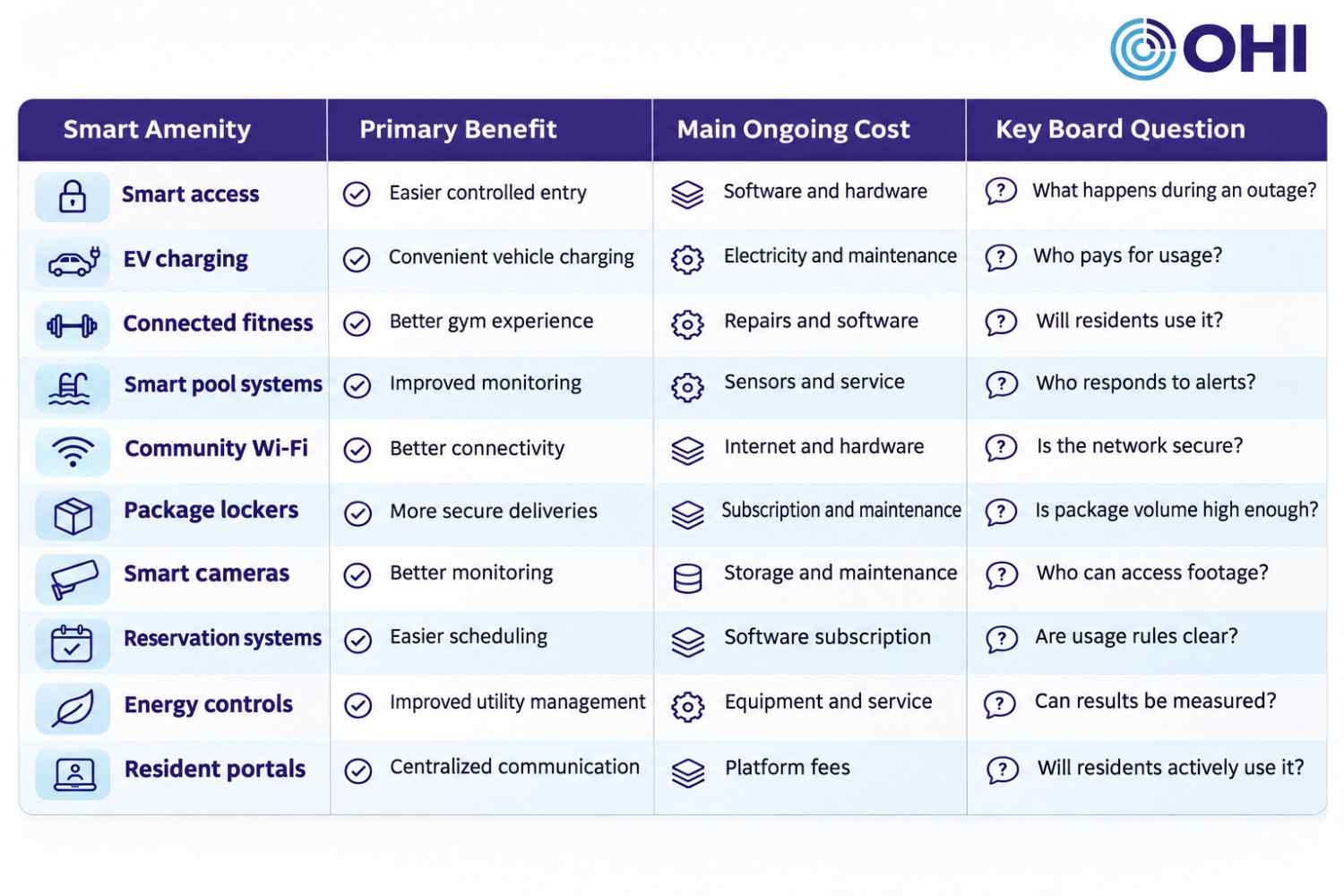
The real question should not be, “What technology should we install?”
It should be, “What community problem are we trying to solve?”
Homeowner surveys help boards to prioritize based on actual issues as opposed to assumed issues. After the homeowner feedback is gathered it should be aligned and integrated with usage data, service and maintenance requests, records, complaints, and operational issues.
For example, if homeowners repeatedly complain about missing packages, then the board should consider a package-management solution.
Boards also need to ensure that the solutions being considered are accessible and inclusive. Solutions should account for community members that are less digitally savvy or have physical disabilities. For example, technology should not make community facilities less accessible for the elderly, or for residents with disabilities. Solutions should not exclude community members.
Boards should consider all the costs associated with solutions and warranties when making decisions. An inexpensive solution that is short-lived may end up costing the association more.
The initial purchase price rarely represents the total cost of a smart amenity.
Boards should account for installation work, software subscriptions, utilities, internet connectivity, maintenance, vendor support, repairs, replacement components, and future upgrades.
Consider an association evaluating EV chargers. The equipment and installation may cost tens of thousands of dollars, but that is only the beginning.
The board should also ask:
Similar questions apply to access-control systems, cameras, fitness equipment, pool technology, and community apps.
Strong hoa management accounting practices can help associations track amenity expenses, compare actual costs against budget, organize vendor invoices, maintain clear financial reporting, and understand whether certain amenities are creating unexpected financial pressure.
Boards should also distinguish between operating costs and longer-term replacement obligations.
A monthly software fee may belong in the operating budget, while major equipment replacement may require longer-term planning. Depending on the association and applicable requirements, funding may come from operating assessments, reserves, user charges, special assessments, or another approved source.
The important point is that an association should not only determine whether it can afford to install an amenity. It should determine whether it can afford to operate, maintain, and eventually replace it.
Smart amenities can reduce certain manual tasks, but they often increase administrative work behind the scenes.
Someone must still manage contracts, review invoices, schedule service calls, track maintenance expenses, organize records, monitor budgets, coordinate vendors, update work orders, and respond to resident questions.
Consider a smart access system that suddenly stops working.
A technician may handle the repair, but management still needs to document the problem, contact the vendor, arrange access, communicate with residents, review the invoice, update maintenance records, and confirm that service has been restored.
Multiply that process across pools, gyms, package rooms, chargers, clubhouses, cameras, and gates, and the workload can become significant.
Organized property management back office support can help management teams keep vendor records current, process invoices, maintain documentation, coordinate service requests, track expenses, and support routine administrative workflows.
This does not replace board oversight. It gives the board better information and more consistent operational records when evaluating costs, vendor performance, and community needs.
The completion of a project is not an indication of a job well done. Smart amenities should be monitored for performance.
Various metrics (i.e. service/maintenance requests, utilization, repair calls, operating costs, etc.) should be tracked for smart amenities after their installation to gauge success.
If residents are not using a new smart amenity, it could mean the system is not intuitive and/or residents need to be trained on how to use it.
If an energy management system is designed to reduce utility costs and the system is not configured to capture pre- and post-utilization costs, the board may never know if the system is meeting the intended goal.
Reliability and long-term costs associated with a system should be considered over pure utilization.
Boards should evaluate the real world results of decisions compared to the original rationale for the project.
The best smart amenity is not necessarily the newest or most advanced technology available. It is the one that solves a real community problem, improves the resident experience, fits within the association’s financial capacity, and can be operated reliably over time. HOA boards should base decisions on homeowner needs, existing usage patterns, total lifecycle costs, vendor reliability, accessibility, administrative requirements, and long-term maintenance planning.
Technology can improve access, communication, scheduling, energy management, security, and daily community operations. But every connected system also creates responsibilities that continue long after installation. Boards that evaluate those responsibilities before making a purchase are better positioned to choose amenities that residents actually use and that the association can sustainably support for years to come.