True-Up Accounting: Meaning, Journal Entries, Examples, and Process
- November 16, 2026
- Sanjay Kumar
Accurate financial reporting depends on more than recording transactions. Businesses frequently recognize expenses, revenues, and liabilities before final amounts are available. When actual figures become known, accounting teams must compare them with the original estimates and record any necessary adjustments.
This process is known as true-up accounting.
For real estate companies and property management firms, true-up accounting is particularly important when reconciling property operating expenses, utility accruals, common area maintenance (CAM) charges, property taxes, insurance costs, and other estimated amounts.
Without timely reconciliations, financial statements may contain overstated expenses, understated liabilities, inaccurate tenant recoveries, or unexplained variances.
This guide explains what true-up accounting means, how it works, common journal entries, practical real estate examples, and the controls that help accounting teams maintain accurate financial records.
True-up accounting is the process of comparing previously recorded estimated amounts with actual or updated amounts and making the accounting adjustments required to reflect the appropriate financial position and performance.
Businesses use true-ups when they initially record transactions based on estimates, provisional information, or contractual calculations that are subsequently finalized.
For example, a property management company may accrue $12,000 for monthly utility expenses. When the actual invoice arrives at $11,400, the accounting team must reconcile the $600 difference and account for it appropriately.
The purpose of a true-up is to ensure that recorded financial amounts reflect the best available supporting information and applicable accounting requirements.
True-ups commonly occur during monthly, quarterly, and annual accounting close processes.
Importantly, a true-up resulting from new information is not necessarily the correction of an accounting error. The accounting treatment depends on the underlying transaction, timing, and applicable standards.
For a straightforward estimate-versus-actual comparison:
True-Up Adjustment = Actual Amount − Previously Estimated Amount
A positive difference indicates that the actual amount exceeds the estimate. A negative difference indicates that the estimate exceeded the actual amount.
However, the debit and credit entries depend on the account being adjusted and whether the original transaction has already been settled.
| Particulars | Amount |
| Estimated property maintenance expense | $15,000 |
| Actual maintenance expense | $16,200 |
| Difference | $1,200 |
| Required adjustment | Increase expense by $1,200 |
The accounting team must ensure the additional $1,200 is recognized in the appropriate reporting period and that the related payable is correctly recorded.
True-up adjustments can arise across several accounting activities.
Businesses often recognize expenses before receiving final vendor invoices.
For real estate companies, common examples include:
When the actual invoice becomes available, the accrual must be reviewed and settled.
Revenue true-ups arise when amounts recognized using estimates or provisional calculations need adjustment based on finalized information.
In commercial real estate, this can include tenant recoveries for operating expenses, where the final recoverable amount differs from amounts previously billed or recognized.
Revenue recognition and the related accounting entries must follow the applicable contracts and accounting standards.
Prepaid insurance, service contracts, and maintenance arrangements may require adjustments when contract terms change or additional information affects the recorded asset.
For example, if an insurance policy is canceled and the insurer confirms an unused-premium refund, the accounting team may need to recognize a receivable and reduce the remaining prepaid asset.
Ordinary amortization of a prepaid expense is not itself necessarily a true-up.
Commercial property owners and managers often charge tenants estimated amounts for recoverable property operating expenses.
At the end of the relevant reconciliation period, actual eligible expenses are compared with amounts billed or collected.
The resulting difference may require additional tenant billing, a credit, or a refund, depending on the lease agreement.
Property tax assessments and insurance expenses may differ from earlier estimates.
When actual amounts become available, accounting teams reconcile the original accruals or recoveries and record any necessary adjustments.
These reconciliations are particularly important where leases permit certain costs to be recovered from tenants.
Understanding journal entries is essential because a true-up should update the relevant account balances without duplicating previously recognized expenses.
A property management company estimates monthly electricity expenses of $8,000.
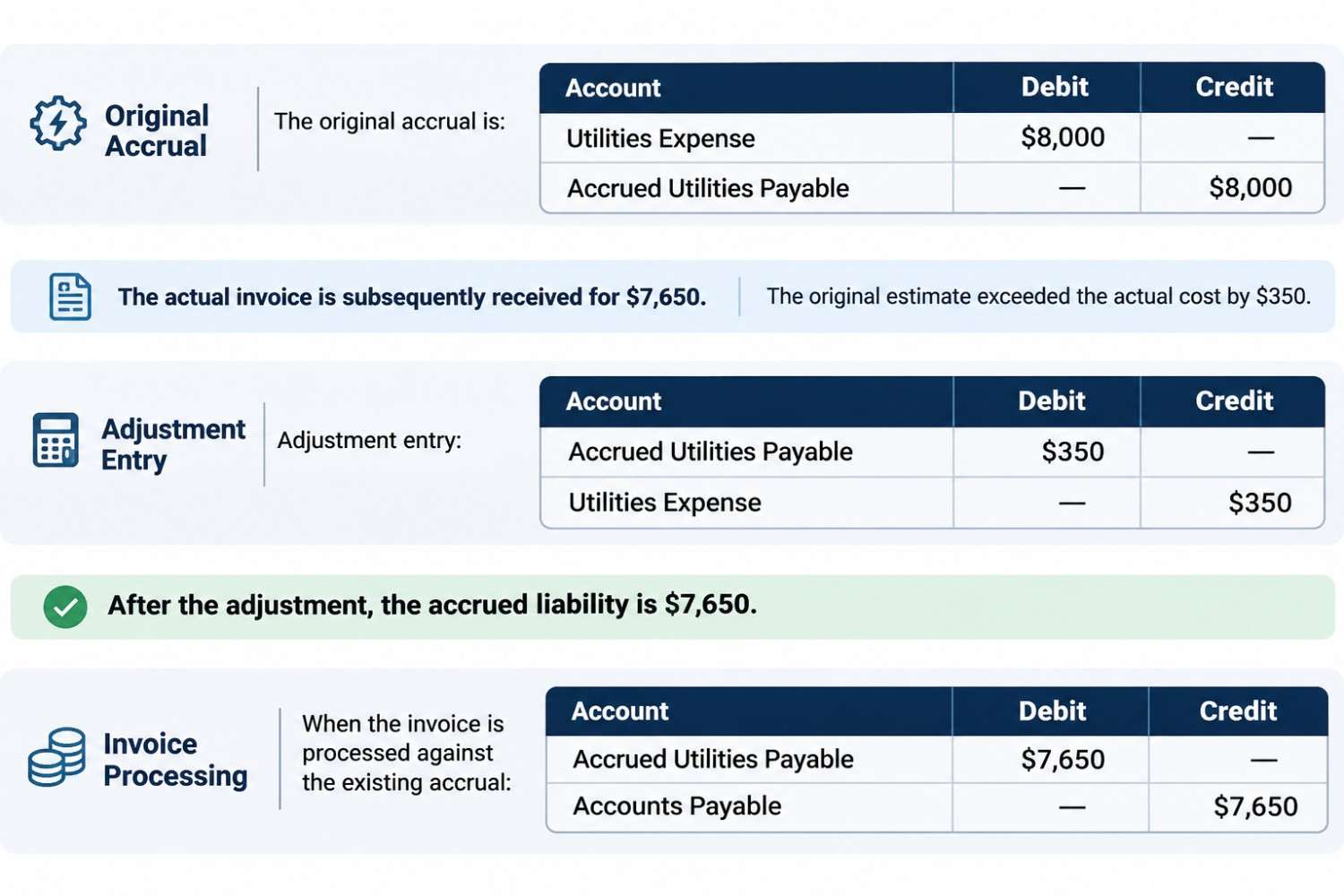
The payable is then settled through the normal vendor payment process.
These entries illustrate one valid approach when the underlying accrual and adjustment are recognized in the appropriate open accounting period.
A commercial property records an estimated $10,000 accrual for maintenance services.
The final vendor invoice totals $11,500.
The additional expense is $1,500.
Adjustment entry:
| Account | Debit | Credit |
|---|---|---|
| Repairs and Maintenance Expense | $1,500 | — |
| Accrued Maintenance Payable | — | $1,500 |
The final liability becomes $11,500 before settlement or reclassification to accounts payable.
Consider a commercial property where tenants make estimated monthly payments toward recoverable common area maintenance expenses.
For one tenant:
| Particulars | Amount |
|---|---|
| Annual estimated CAM billed | $48,000 |
| Actual recoverable CAM allocation | $52,500 |
| Additional amount due | $4,500 |
After validating the lease provisions, applicable exclusions, expense allocations, and prior billings, the property manager determines that the tenant owes an additional $4,500.
If the $4,500 represents additional recoverable revenue not previously recognized, an illustrative entry is:
| Account | Debit | Credit |
|---|---|---|
| Tenant Accounts Receivable | $4,500 | — |
| CAM Recovery Revenue | — | $4,500 |
The actual accounting treatment depends on the lease, previous recognition, settlement arrangements, and applicable accounting policy.
If actual recoverable CAM expenses were lower than the estimated payments, the reconciliation could instead result in a tenant credit or refund.
In real estate accounting, a true-up is commonly used to reconcile estimated property-level amounts with actual financial results.
Real estate organizations frequently manage multiple properties, entities, tenants, vendors, and operating budgets. This creates several areas where estimates must be monitored and reconciled.
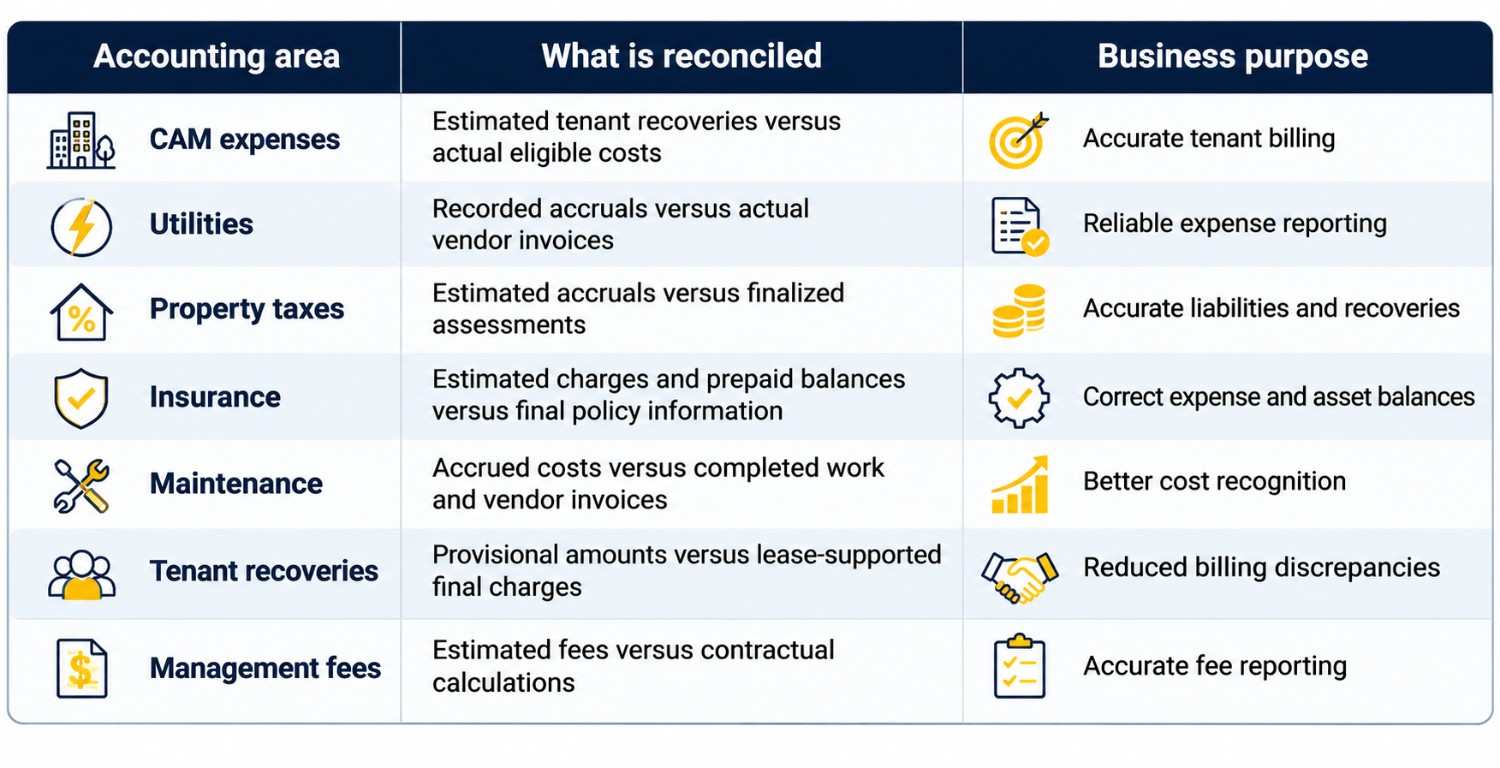
For property management firms, these reconciliations help explain operating variances, support owner reporting, and improve confidence in property-level financial information.
The appropriate frequency depends on the nature of the transaction, reporting requirements, and availability of actual information.
Monthly true-ups often address recurring operating expenses, vendor accruals, utilities, and other estimated liabilities.
Reviewing significant balances each month helps reduce the accumulation of unresolved adjustments.
Quarterly reviews may involve more comprehensive estimates, insurance adjustments, property tax provisions, and unusual fluctuations in property operating expenses.
Year-end true-ups may involve final expense estimates, outstanding accruals, property-level reconciliations, tenant recoveries, and audit-related adjustments.
Commercial lease operating expense reconciliations frequently take place after year-end, once actual annual expenses have been compiled and validated.
The timing of CAM statements and settlements depends on the applicable lease provisions.
A structured reconciliation process helps reduce errors and supports consistent financial reporting.
Review significant accruals, provisional balances, estimated recoveries, and other accounts requiring confirmation.
Prioritize high-value or unusual balances.
Collect relevant vendor invoices, contracts, lease agreements, bank records, operating expense statements, and accounting schedules.
Reconcile the original recorded figures with the final supported amounts.
Investigate differences rather than assuming that every variance requires an immediate journal entry.
Assess whether the difference represents:
Accounting estimate revisions and prior-period error corrections are not necessarily treated the same way.
Document the adjustment, supporting calculations, relevant accounting period, and applicable approvals.
Confirm that the adjusted general ledger agrees with the supporting schedules and related payable, receivable, or settlement records.
Analyze recurring differences and identify whether estimation methods, vendor processes, or reporting controls require improvement.
Missing vendor invoices, lease amendments, or reconciliation schedules can delay the verification of actual expenses.
Recommended control: Maintain organized supporting records and clear ownership of outstanding documentation.
If estimated expenses are reversed or adjusted incorrectly when invoices arrive, organizations may record duplicate expenses or leave unsupported liabilities.
Recommended control: Reconcile each material accrual against the corresponding invoice before completing the close.
Companies managing multiple properties may experience differences in account mapping, expense classifications, and reporting procedures.
Recommended control: Standardize account classifications, reconciliation templates, and review procedures across the portfolio.
Commercial leases may contain different expense exclusions, allocation methods, caps, and billing requirements.
Recommended control: Validate recovery calculations against each tenant’s lease provisions before issuing final statements.
Late reconciliations can leave old accruals unresolved and reduce confidence in monthly financial reports.
Recommended control: Establish clear close schedules, exception reporting, and escalation responsibilities.
Accounting teams should distinguish routine true-up adjustments from changes in estimates and accounting error corrections.
Under ASC 250, changes in accounting estimates generally affect the current period and, where appropriate, future periods. They are not ordinarily applied by restating previously reported periods.
Accounting errors require separate assessment, including whether previously issued financial statements are materially misstated.
For real estate companies, additional guidance may apply depending on the transaction.
For example, lease-related payments may involve ASC 842 considerations, particularly where variable payments, fixed charges, and nonlease components are involved.
The treatment of an adjustment should be determined from the underlying facts and applicable accounting guidance, rather than from the label “true-up” alone.
Accounting software can help organizations maintain reconciliation schedules, track accruals, and identify unusual differences between recorded and actual amounts.
Real estate accounting platforms such as Yardi, MRI, AppFolio, and other property management systems may provide relevant general ledger, payable, receivable, and property-level reporting information.
Depending on system configuration and available functionality, accounting teams can use these records to:
Technology can reduce repetitive work, but management review remains important, especially for material adjustments and complex lease calculations.
Real estate accounting teams often manage recurring financial close activities across multiple properties while also responding to owners, investors, vendors, and tenants.
As portfolios grow, maintaining timely reconciliations and complete documentation can place additional demands on internal accounting resources.
Outsourcing Hub India (OHI) provides real estate accounting support to property owners, operators, and management firms.
Depending on engagement scope, OHI can support the accounting activities that contribute to accurate true-ups, including:
Reviewing estimated expenses, supporting documentation, and recorded account balances to identify differences requiring further investigation or adjustment.
Supporting month-end and year-end close activities, reconciliation schedules, and preparation of accounting adjustments.
Assisting with commercial lease expense calculations, recoverable expense reviews, and reconciliation documentation.
Helping accounting teams review outstanding invoices, vendor balances, and related expense accruals.
Supporting consistent financial reporting, expense analysis, and review of significant budget-to-actual differences.
Preparing and organizing supporting schedules, reconciliations, and financial records for client and auditor review.
A structured approach to true-up accounting can help real estate companies:
OHI works with clients using established real estate accounting systems and defined review and approval processes.
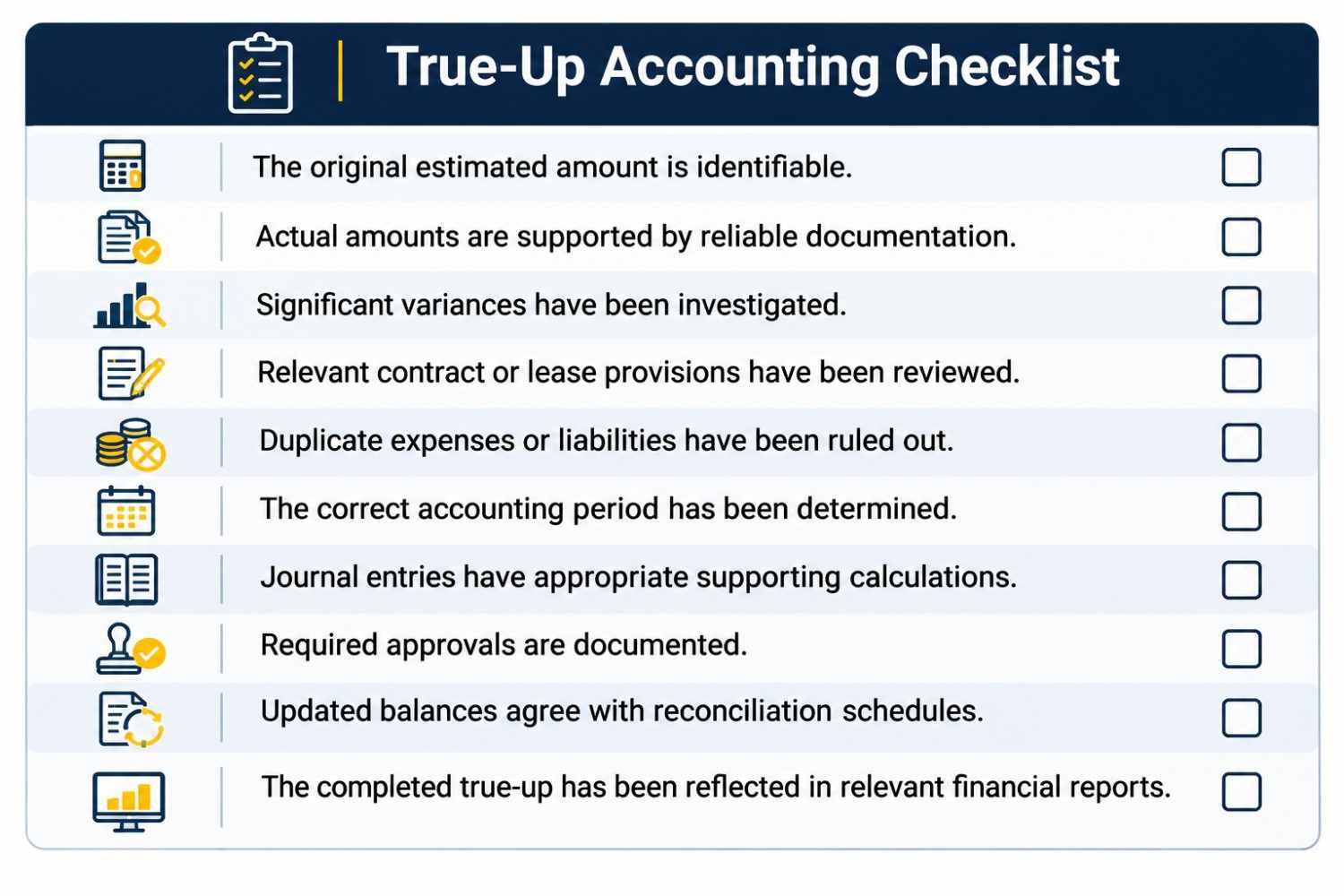
True-up accounting is an important part of maintaining accurate financial records. By reconciling estimated amounts with actual financial information, organizations can identify discrepancies, improve accounting controls, and provide more reliable reporting.
For real estate companies, the process becomes especially important when managing property operating costs, vendor accruals, tenant expense recoveries, and multiple properties.
An effective true-up process combines timely reconciliations, reliable documentation, appropriate accounting treatment, and clear review responsibilities.
Need additional support with property accounting, year-end reconciliations, or CAM true-ups?
OHI provides dedicated real estate accounting support to help property owners and management firms strengthen financial reporting and manage recurring accounting workloads.