Yardi Accounting Challenges for Growing Portfolios
- September 7, 2026
- OHI
With its accounting and property management solutions, Yardi systems cover a large portion of real estate needs. Multiple property and entity jurisdictions enable general ledger administration, payments, collections, receipts, balance closings and reporting.
However, the complexities of accounting are not diminished by Yardi. They are organized.
The accounting processes managed within Yardi increase in complexity with the growth a real estate portfolio. Acquisitions of properties, ownership entities, banking relationships, trading partners, transactions, and ownership combine to present accounting challenges that strain what was manageable at 20 real estate holdings at 75. The month end reported financials that used to take one small team to manage now requires the coordinated effort of many for five separate entities.
This essay looks at the accounting challenges associated with the growth of real estate portfolios/holdings managed by Yardi, what these challenges mean in relation to CFO/CPA responsibilities and what can be done to better organize accounting as it grows and matures.
The relationship between the size of a portfolio and the complexity of accounting is non-linear. Additional properties in a Yardi system include more bank accounts to reconcile, more vendors to manage, more expense allocations to code, and more reports to produce.
Things exacerbate at the level of an entity. A portfolio with properties ass transacted through different legal entities (LLCs, partnerships, trusts, and joint ventures) means accounting at the property level for each entity, tracking inter-company transactions, and performing consolidated reporting for the portfolio.
The following elements correlate to portfolio growth:
The complexity of accounting work does not increase in a linear fashion. Things compound. A system that is designed to help manage a portfolio may become the system that creates bottleneck issues for accounting with no processes and controls in place.
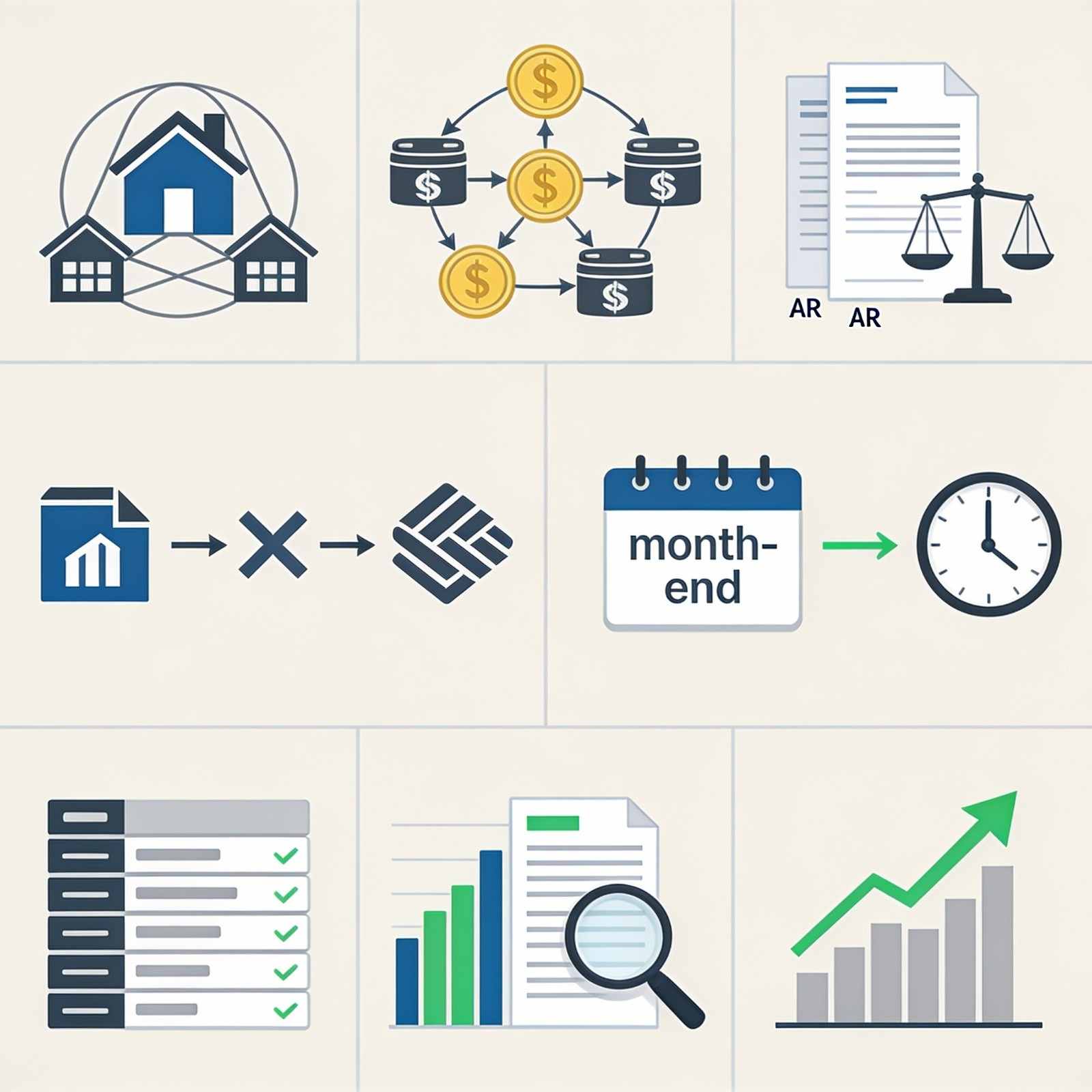
One challenge for accounting Yardi across a growing portfolio is maintaining consistency for an increased number of properties and legal entities.
In Yardi, each property is its own accounting unit. There are separate general ledgers, bank accounts, and financial statements. To maintain consistency for 10 separate entities, it takes deliberate process design beyond just configuring software; it requires thoughtful planning.
Different coding for the same transaction creates reporting problems. An expense coded one way at one property means a completely different expense at a different property.
Bank reconciliation is a tedious process for any multi-property Yardi user. For 30 properties held in separate accounts for operations, security deposits, and reserves, a portfolio could mean at least 60 reconciliations in one month.
Every reconciliation requires analysis of timing gaps, a review of unreconciled items, and a confirmation that the Yardi general ledger balance is equal to the banks’ closing balance. With increased volume, unreconciled items begin to add up with each passing month.
Not having a proper accounting process and procedure becomes apparent when accounting practice begins to fall behind reconciliations.
Increasing portfolio size results in increasing accounts payable volume. More properties mean more vendors, more invoices, more running of payments, and more opportunities for coding errors, duplicate payments, and approval delays.
In Yardi, payment of AP invoices requires coding of the invoice to the property, the expense account, and the entity. When invoice volumes are high and staff is limited, coding accuracy decreases. Inaccurate coding to a property impacts the P&L of that property and creates problems of reconciliation that become apparent at the end of the month.
Accounts receivable also poses equivalent challenges. As the tenant count increases, navigation of delinquent balances and collection activities across multiple properties requires scripted AR processes to avoid leaving balances unresolved and aging.
Multiple entity portfolios generate intercompany transactions. Examples of intercompany transactions include management fees and services costs that are paid from one entity to another or intercompany loans and shared services contract allocations.
In Yardi, intercompany transactions require recording on both sides of the transaction and require elimination at the consolidated report level. Failure to manage these transactions consistently or failure to regularly perform intercompany balance reconciliations results in unreliable consolidated financial reports.
Accurate intercompany balance reconciliations are essential to CFOs preparing portfolio level reports to investors or lenders. Financial reports must withstand scrutiny.
As your portfolio continues to grow, the month-end close within the Yardi system becomes increasingly more difficult to manage. This is due to numerous reasons including the need to reconcile bank accounts, review accounts payable aging, confirm accounts receivable balances, make accrual and prepaid journal entries, review intercompany transactions and generate finished financial statements at the property level.
In the absence of consistent policies and procedures that offer a formalized close checklist for all properties and entities, the length of time required to complete the close process stretches, and core close tasks are omitted. Accruals are posted after the fact, and owner statements are issued well after month ends. Consequently, the finance staff starts the following month with an extreme backlog.
A process that was previously manageable when you had 15 properties will surely be untenable when you have 60, without major shifts in policies, processes, procedures, and/or staffing.
The way data is organized and reported for analysis across a portfolio is structured by the chart of accounts. Inconsistencies in Yardi charts of accounts across properties or entities lead to reporting issues that are difficult to resolve.
When properties use different account codes for the same expense type, or when newly added properties have a chart of accounts designed locally, portfolio level financial analysis requires manual adjustments to be made to the data before the analysis can be performed. This increases the length of the close process, increases the risk of errors and lowers confidence in the results of the analysis reported.
Improving standardization of the chart of accounts across a growing portfolio is one of the highest-impact accounting changes that can be made, and at the same time is one of the accounting changes that is almost always postponed.
Rising ownership relationships increases reporting complexity. Owners may prefer different reporting formats, levels of detail, consolidation structures, and timeliness of reporting.
In Yardi, accurate production of owner statements, property level P&L, and the calculation of management fees must be timely and aligned to the expectations of each ownership group. If there are inconsistencies in the accounting or a delayed month-end close, owner reporting will be the first and most visible downstream function to investors and stakeholders.
Accurate owner reporting for residential and multifamily portfolios has its own accounting requirements. Residential Real Estate Accounting has aspects of property level cost allocation, tenant ledger management, trust accounting, accounting and reporting for the asset class that is dissimilar to the general practice of commercial or corporate accounting.
The greatest challenge associated with growth for Yardi accounting is not a challenge with the software. It is a capacity challenge.
The amount of work associated with transactions, reconciliation, and reporting is increasing due to growth for most internal finance teams. When additional accounting staff is hired, it adds fixed overhead and increased time for recruitment, training, and management. Failure to build capacity will result in backlogs, errors, and weaken internal control.
CFOs and controllers are stuck between either adding staff before the portfolio justifies it to ensure quality accounting remains or allowing accounting quality to decrease with the amount of growth for their portfolio.
The consequences on the executive level due to the operational problems mentioned previously can’t be overstated.
The consequences of delayed financial closing negatively impacts management’s ability to make time sensitive decisions causing stale data to inform strategic decisions. For example, if the financials for March are published in April, it’s unlikely that management was making strategic decisions weeks prior to the publication.
A reduction in reporting means that CFOs are unable to perform their analysis of bottoms up EBITDA summation to identify and communicate performance issues to management and the investment community.
Control breakdowns caused by insufficient reconciliations, approvals, and/or standard coding increase audit risk and the exposure to financial restatements.
Burnout of finance team members is an operational problem. When controllers and senior accountants have to be immersed in transactional work, morale and the strategic output suffers.
The greatest consequence of these problems is the opportunity cost of having the finance function tied up in operational work. It discourages the emphasis on strategic finance functions such as analysis and reporting.
Standardize the chart of accounts for all properties and entities. Create a master chart of accounts with coding conventions for the treatment of each major transaction type and assign when establishing the portfolio. Use this structure when adding each new property to the portfolio.
Accounting complexity for HOA and community association portfolios operating with Yardi has additional layers, including fund accounting at the association level, owner/member assessments, management of reserve funds, and Board-level reporting. HOA Management Accounting addresses these distinct workings across multi-entity association groups.
Outsourcing Yardi accounting support is most appropriate when the accounting workload has exceeded the realistic capacity of the internal team not as a first response to minor inefficiency, but as a strategic response to a structural capacity gap.
Indicators that outsourcing may be appropriate:
Outsourcing transactional accounting does not require surrendering financial oversight. CFOs and controllers retain strategic decision-making authority, review responsibility, and financial reporting control. What is outsourced is the execution capacity that internal teams cannot sustain at scale.
Yardi provides a capable platform for managing real estate accounting across complex, multi-property portfolios. But the platform’s effectiveness depends entirely on the quality of the accounting processes, controls, and team capacity supporting it.
As portfolios grow, the accounting challenges become operational and strategic not just technical. Delayed closes, inconsistent reporting, reconciliation backlogs, and intercompany errors are not Yardi problems. They are process and capacity problems that surface inside Yardi because the underlying accounting infrastructure was not designed to scale.
CFOs and controllers who address these challenges proactively by standardizing processes, strengthening controls, and building scalable accounting capacity before growth creates bottlenecks position their organizations to grow efficiently rather than reactively.