How Commercial Property Management Accounting Works
- May 25, 2026
- OHI
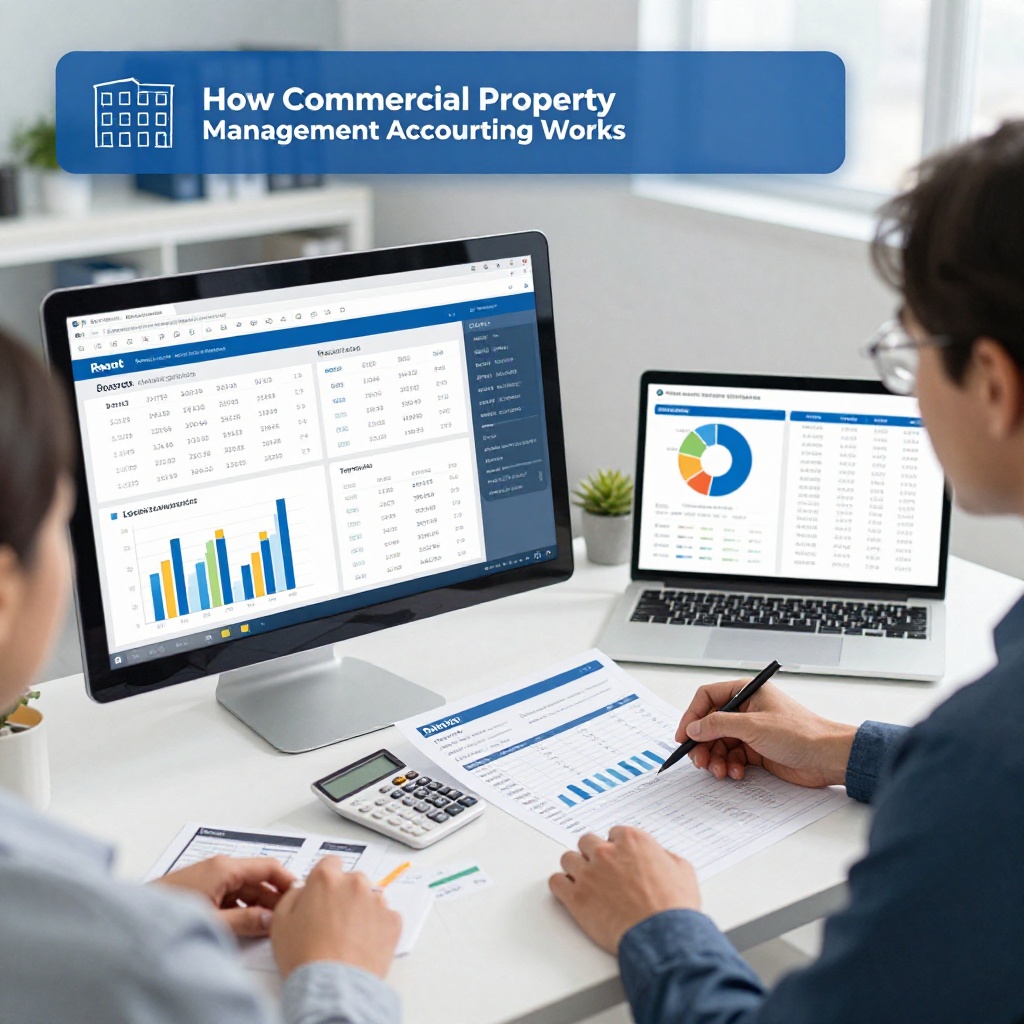
Commercial property management accounting includes everything you need to do to keep your income-generating properties in good financial shape and ready for an audit. This includes managing leases, billing rent, reconciling CAM, tracking expenses, reporting NOI, and closing the books at month-end. Because every lease is different, every tenant obligation is different, and a single mistake in one area can affect your reporting, compliance, and conversations with investors, it is more complicated than regular business accounting. This guide explains how commercial property management accounting really works, where it often goes wrong, and what a well-organized accounting function looks like in real life.
Key Takeaways
If you give your business property accounting to a general accountant, they will probably do it. It’s a lot harder to say if they will do it well.
Commercial property management accounting is the point where lease law, financial reporting, and property operations all meet. It requires knowledge of structures that most accountants don’t deal with, like triple-net provisions, tenant improvement allowances, co-tenancy clauses, percentage rent calculations, and expense caps. It’s only half the battle to know how to run the numbers. You also need to know what the law says about those numbers.
You should only need to know about your lease to understand your whole financial situation. Every invoice, every CAM estimate, and every rent roll is based on those terms. If the lease data in the system is wrong, everything else is too, and it keeps getting worse until a tenant questions a charge or an audit finds the mistake.
Lease administration is the process of taking important economic terms from signed leases and putting them into your property management system correctly. These terms include base rent, escalation schedules, start and end dates, renewal options, security deposits, concessions, and tenant-specific provisions. Before you send out your first invoice, everything needs to be right.
The rent roll is the living output of this work. When it’s clean, your billing is accurate and your reporting is accurate. If it isn’t, you’re building everything on a broken base.
The most likely time for rent roll accuracy to fail is after the acquisition. Properties change hands quickly. When there is a lot of time pressure, leases get abstracted, and small mistakes in deposit amounts, concession periods, or charge structures go unnoticed until billing disputes come up.
A Miami-based real estate firm managing over $300 million in assets and 4,500 units had recently acquired seven new properties with approximately 1,000 units. Their team had set up leases internally under tight acquisition timelines. Before relying on that data for billing and financial reporting, they engaged OHI to run a structured post-acquisition lease audit.
OHI put together a special team, set up a central document storage system, and went through all 1,000 leases against signed agreements, checking base rent, deposits, concessions, utility charges, and other income line by line. In Yardi, every difference was written down, sent for approval, and fixed. The full engagement took 30 days, and OHI still handles the portfolio’s accounting today. Click here to read the whole case study.
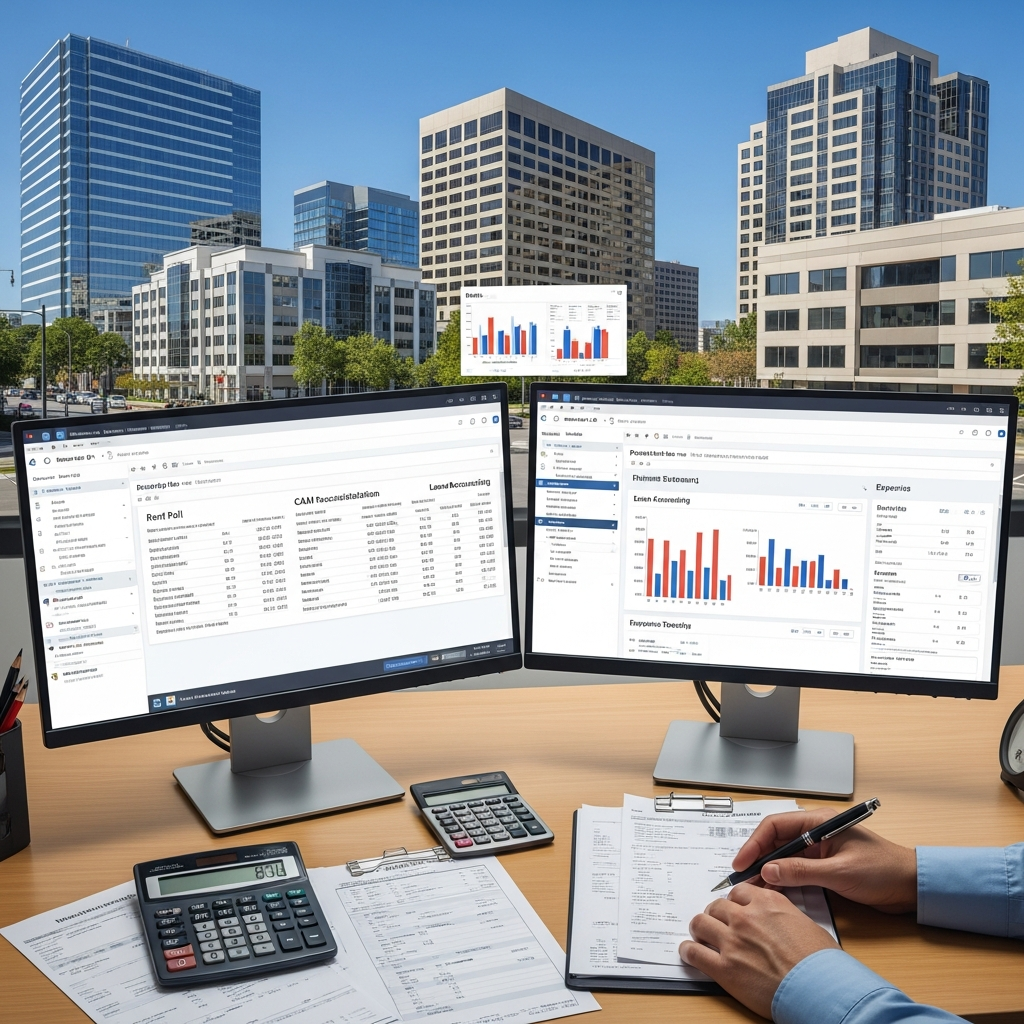
Your active lease terms create rent charges every month. Your lease data tells you everything you need to know about your base rent, operating expenses, parking, storage, and other recurring charges. Your billing will also be wrong if that data is wrong. And it takes a lot longer to fix billing problems caused by wrong escalation amounts or missed concession periods than it did to make the original mistake.
Your AR tracking runs through the month alongside this, monitoring outstanding balances, late charges, and payment applications against each tenant’s specific lease provisions.
CAM reconciliation is honestly where commercial property management accounting gets complicated.
Tenants in triple-net and modified gross leases pay monthly CAM estimates based on their proportionate share of common area expenses. At year-end, you reconcile those estimates against actual costs. Tenants either owe the difference or receive a credit. Simple in theory, messier in practice.
National Lease Advisors reports identifying over $1 million in erroneous CAM charges annually for their clients through lease audits alone.
The reconciliation itself requires GL verification of every recoverable expense, pro-rata share calculations based on occupied square footage, gross-up adjustments for vacancy, and tenant-specific exclusion reviews.
To close the month, you need to do bank reconciliations, reviews of AP ageing, accrual postings, prepaid amortisation, and depreciation entries. Your monthly financial package usually has a property-level P&L, a balance sheet, a summary of the rent roll, an AR ageing report, and a pack of comments on the differences for your ownership group or investors.
Scale breaks things that were never stressed that much. When you reach fifteen, procedures that handle three properties start to wobble. Manual workflows that handled one acquisition have a hard time taking on a portfolio expansion without making mistakes in timing or accuracy.
Even portfolios that are regularly watched by professionals, third-party CAM audits often find 3% to 5% in overcharges or misclassifications. That doesn’t mean that accountants are bad. It shows how hard it is to apply lease-specific rules consistently across hundreds of charges every month in systems that weren’t set up with enough detail when the portfolio was smaller.
Software gaps make it worse. Yardi, MRI, and RealPage all have different ways of setting up CAM, charging for it, and reconciling workflows. Your accountant for property management might be an expert in accounting but still make mistakes that could have been avoided if they didn’t know how the platform is set up.
It’s not by chance that property management accounting procedures are good. They are built: a standardised chart of accounts, documented lease abstraction checklists, monthly GL coding reviews, a CAM reconciliation calendar that starts in January instead of December, and reporting templates that are set up to show your investors and lenders what they really want to see.
You must have platform expertise. If you don’t know the system well enough, skilled accountants may still miss financial statement errors that are caused by CAM setup mistakes, wrong recoverable account designations, or missing lease escalation triggers in Yardi or MRI.
Outsourced accounting teams with real property management system knowledge give growing commercial portfolios the depth that in-house generalists rarely can. OHI supports accounting for commercial properties on Yardi, MRI, AppFolio, RealPage, and CoStar. It covers the whole monthly cycle, from lease abstraction to financial reporting.
OHI is a company that outsources accounting for real estate and has been doing it for more than 20 years for clients in the US, UK, Canada, and Australia. Their commercial property accounting teams take care of things like lease abstraction, rent billing, CAM reconciliations, AP coding, bank reconciliations, GL maintenance, NOI reporting, and month-end close for portfolios that include commercial, residential, and mixed-use properties.
For commercial property managers and real estate investment firms looking to bring structure, accuracy, and consistency to their accounting function, OHI offers commercial property accounting services. Learn more about OHI’s real estate accounting capabilities.
Your starting point is correct lease data. The monthly cycle then includes billing for rent, tracking accounts receivable, coding expenses, managing CAM charges, reconciling bank accounts, and making financial reports. The accuracy of what came before it is what determines each step.
Your accountant needs to know more than just basic accounting. They need to know about gross and net leases, CAM recovery calculations, pro-rata share allocations, tenant improvement accounting, and the property management platform that your portfolio runs on. Knowledge of leases and software are equally important.
When your portfolio grows faster than your team can handle, when CAM errors cause arguments, when the month-end close is always late, or when a new acquisition needs quick lease validation that your current team can’t handle without stopping work.