Asset Management Accounting vs. Traditional Property Accounting: What Sets Them Apart?
- September 30, 2026
- OHI
Most real estate firms run on two engines. One engine collects rent, pays vendors, and keeps the lights on. The other decides which properties to buy, when to refinance, and how to maximize investor returns.
Asset Management Accounting vs. Traditional Property Accounting comes down to the difference between these two functions. The first engine is traditional property accounting. The second is asset management accounting.
If your C-suite treats them as the same function, you are leaving money on the table. Worse, you are making strategic decisions with operational data. That is like using a speedometer to navigate a ship.
This guide breaks down exactly what separates these two disciplines. We’ll compare their scope, metrics, technology, team structure, and bottom-line impact. By the end, you’ll understand how asset management accounting differs from traditional property accounting and when your firm may need to upgrade its accounting function.
Asset management accounting is the strategic financial discipline that tracks, analyzes, and optimizes the performance of real estate assets across an entire portfolio. It sits at the intersection of finance, investment strategy, and property operations.
Unlike basic bookkeeping, asset management accounting answers questions like:
“Asset management accounting is not about recording what happened. It is about predicting what should happen next.”
Real estate asset managers rely on this function to make hold-sell decisions, report to institutional investors, and satisfy complex compliance frameworks. A dedicated real estate asset management company will often build this capability in-house before anything else.
Traditional property accounting handles the day-to-day financial operations of a building or portfolio. Think rent rolls, vendor invoices, CAM reconciliations, and monthly bank reconciliations.
This function is essential. Without it, buildings do not function. But its horizon is short. It looks backward at what already happened. It lives in the general ledger.
Typical tasks include:
Traditional property accounting keeps the asset running. Asset management accounting makes the asset profitable.
| Dimension | Asset Management Accounting | Traditional Property Accounting |
|---|---|---|
| Primary Goal | Maximize asset value and investor returns | Ensure accurate financial records and compliance |
| Time Horizon | Multi-year, lifecycle-focused | Monthly, quarterly |
| Key Users | CIOs, CFOs, investors, lenders | Property managers, on-site staff, tax preparers |
| Core Output | Investment dashboards, IRR models, investor reports | Rent rolls, P&L statements, bank recs |
| Data Sources | Property-level + market + debt + investor-level data | Property-level transactions only |
| Decision Support | Strategic (buy, hold, sell, refinance) | Operational (approve invoice, adjust budget) |
| Technology Stack | Yardi Investment Management, MRI, Argus, custom BI | QuickBooks, AppFolio, Buildium, basic Yardi |
| Regulatory Scope | Fund-level compliance, GAAP/IFRS, SEC reporting | Local tax, HOA, basic GAAP |
Traditional property accounting is reactive. A bill comes in. It gets coded. A tenant pays. It gets deposited. The job is accuracy and timeliness.
Asset management accounting is proactive. It builds forward-looking models. It stress-tests assumptions. It asks whether a $400,000 lobby renovation will yield $600,000 in rent premiums over five years.
“You cannot optimize a portfolio with a general ledger. You need a financial control tower.”
For a real estate asset management company, this strategic layer is the difference between a 12% IRR and an 18% IRR. It is not trivial. It is the entire game.
Traditional accounting focuses on cash basis or accrual basis net income. It tells you if the property made money last month.
Asset management accounting lives in a different vocabulary:
| Metric | Why It Matters in Asset Management Accounting |
|---|---|
| Unlevered IRR | Measures property performance independent of financing |
| Equity Multiple | Shows total cash returned per dollar invested |
| NOI Margin | Reveals operational efficiency trends |
| Debt Yield | Helps lenders and owners assess refinancing risk |
| CapEx per Unit | Benchmarks reinvestment intensity against comps |
| Lease Spreads | Tracks rental rate growth on new vs. expiring leases |
These metrics do not appear in a standard property accounting report. They require data integration across acquisitions, operations, debt, and capital markets.
A property accountant sends a monthly report to the regional manager. An asset management accountant sends a quarterly investor update to a pension fund.
The stakes are different. The detail is different. The narrative is different.
| Report Type | Traditional Property Accounting | Asset Management Accounting |
|---|---|---|
| Frequency | Monthly | Monthly, quarterly, annual |
| Audience | Property manager, regional VP | Investors, board, lenders, JV partners |
| Format | Standard P&L, balance sheet | Custom dashboards, variance analysis, forecasts |
| Narrative | “We collected 98% of rent.” | “We are 3% below pro forma due to lease-up delays; here is our corrective action plan.” |
Real estate asset managers use these reports to defend valuations, secure new capital, and justify management fees.
Traditional property accounting runs on entry-level software. It is designed for speed and simplicity.
Asset management accounting demands enterprise-grade infrastructure. It pulls data from:
“The best real estate asset management services do not just collect data. They connect it.”
Without integration, asset management accounting becomes manual, slow, and error-prone. With integration, it becomes a competitive weapon.
Property accounting deals with 1099s, sales tax, and local occupancy regulations.
Asset management accounting deals with:
One missed covenant calculation can trigger a default. One misstated promote can trigger a lawsuit. The risk profile is not comparable.
| Role | Traditional Property Accounting | Asset Management Accounting |
|---|---|---|
| Typical Title | Staff Accountant, AP Clerk | Asset Management Analyst, Portfolio Accountant |
| Education | Accounting degree, bookkeeping cert | Accounting/Finance degree, CFA, CPA preferred |
| Core Skill | Transaction processing, reconciliations | Financial modeling, Excel, Argus, investor relations |
| Compensation | $45K–$65K | $85K–$150K+ |
| Career Path | Property Controller | CFO, CIO, Head of Asset Management |
You do not need a CFA to reconcile a bank statement. You absolutely need one to model a joint venture waterfall.
Traditional property accounting manages costs. It asks: “Did we pay too much for landscaping?”
Asset management accounting creates value. It asks: “Should we sell this asset at a 4.25% cap and redeploy capital into a value-add deal at a 7% cap?”
This is the fundamental shift. One function is administrative. The other is accretive.
If you are a CEO, CFO, or CIO at a real estate firm, here is the hard truth:
Operational accounting cannot answer strategic questions.
You cannot ask a property accountant whether your fund is on track to hit its 15% target IRR. They do not have the data. They do not have the model. They do not have the mandate.
You need asset accounting services built for the boardroom, not the back office.
Consider a $500 million portfolio. A traditional accounting function keeps the books clean. An asset management accounting function identifies the following in one year:
That is $6.1 million in value created or preserved. The cost of building the asset management accounting function? Maybe $400K annually.
The ROI is not even close.
Not every firm needs a full asset management accounting function on day one. But if you check three or more boxes below, the upgrade is overdue.
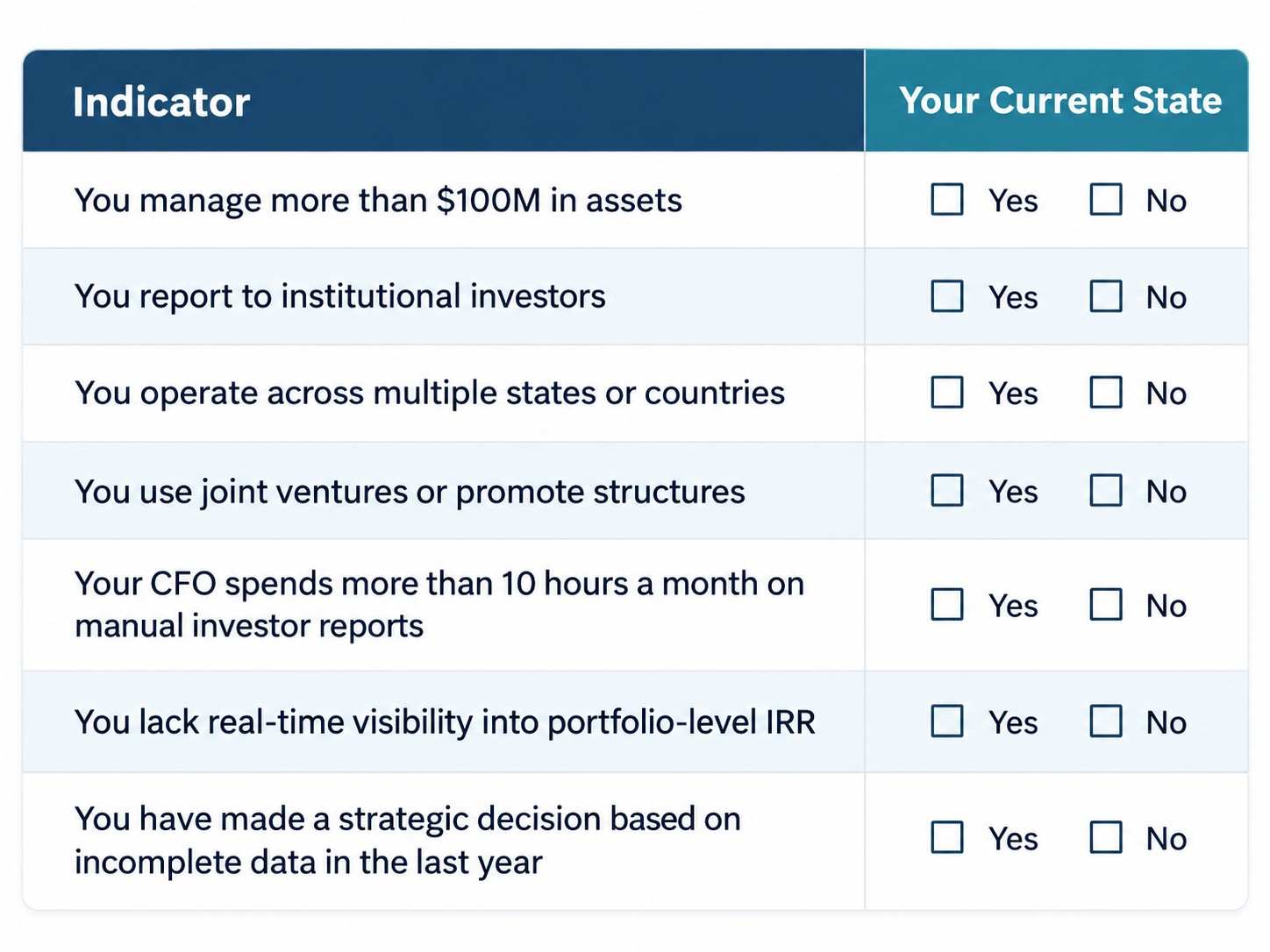
If you checked three or more, you are running strategic finance on operational infrastructure. That is a recipe for suboptimal returns.
You have three paths.
Hire a senior asset management accountant or analyst. Integrate your tech stack. Build reporting templates.
Pros: Full control, deep institutional knowledge
Cons: Expensive, slow to scale, hard to find talent
Engage a real estate asset management company that offers embedded asset accounting services.
Pros: Immediate expertise, scalable, access to best practices
Cons: Less control, requires strong vendor management
Keep property accounting in-house. Outsource the strategic layer to specialists who feed data into your investor reporting.
Pros: Balanced cost and control
Cons: Requires clear SLAs and data governance
“The firms that win are not the ones with the most properties. They are the ones with the best data and the fastest decisions.”
Traditional property accounting and asset management accounting are both essential, but they serve very different purposes.
Property accounting keeps the day-to-day financial operation of a property accurate and under control. It focuses on transactions, reconciliations, rent collections, payables, financial statements, and compliance.
Asset management accounting takes that financial information a step further. It combines property-level results with investment assumptions, debt, market data, capital plans, and investor requirements to help leadership understand performance, identify risks, forecast outcomes, and make better hold, sell, refinance, and investment decisions.
The distinction becomes increasingly important as portfolios grow, ownership structures become more complex, and reporting expectations increase. Metrics such as IRR, equity multiple, debt yield, lease spreads, portfolio forecasts, and investor-level returns require capabilities that traditional property accounting alone is not designed to provide.
For real estate firms, the objective should not be to replace one function with the other. The strongest finance infrastructure connects both: reliable property accounting creates the financial foundation, while asset management accounting turns that information into strategic insight.
Whether that capability is built internally, outsourced to a specialist, or structured through a hybrid model will depend on portfolio size, complexity, technology, investor requirements, and internal resources. What matters most is having the right accounting and reporting structure to support both operational accuracy and informed investment decisions.