Real Estate Asset Management During Market Uncertainty: Risk Mitigation Strategies That Actually Work
- August 18, 2026
- Tajinder Malhotra
Practical, proven ways to protect property value, income, and investor confidence when markets get shaky.
Real estate asset management is the practice of overseeing property investments to maximize value and minimize risk. During market uncertainty, the strategies that actually work include diversification, stress testing, strong asset accounting, liquidity planning, tenant risk control, and data-driven monitoring. Working with experienced real estate asset managers or a trusted real estate asset management company helps investors stay protected when conditions change fast.
Markets rise and fall. That’s normal.
But when uncertainty hits — rising interest rates, inflation, shifting tenant demand, or economic slowdown — property owners feel it fast. Rental income can dip. Property values can swing. Refinancing can get harder. Even well-performing assets can suddenly look shaky on paper.
This is exactly why real estate asset management matters more than ever. It’s not just about collecting rent or fixing leaks. It’s about protecting long-term value through smart planning, accurate accounting, and active risk control.
Many owners only think about risk management after something goes wrong. By then, options are limited and costs are higher. The smarter approach is to build risk mitigation into everyday decisions, long before a downturn hits.
In this blog, we’ll break down the risk mitigation strategies that truly work. We’ll also look at how real estate asset management services, asset management accounting, and asset accounting services all play a role in keeping your portfolio stable, no matter what the market does next.

Real estate asset management means actively managing a property or portfolio to increase its value over time.
It covers many things:
Unlike property management, which handles daily operations, asset management focuses on the bigger picture. It’s about strategy, not just upkeep.
Good real estate asset managers ask one core question every day: “Is this asset performing as well as it can, given current market conditions?”
They look beyond the current month’s rent roll. They think in terms of years, exit strategies, and how each decision today affects value tomorrow.
Uncertain markets bring unpredictable pressure points. Interest rates can rise overnight. Tenant demand can shift with the economy. Construction and labor costs can spike without warning. Lenders can tighten requirements just when refinancing is needed most.
During stable times, small mistakes go unnoticed. During uncertain times, they get expensive fast. A slightly high vacancy rate, a slow accounting process, or an outdated lease clause can turn into a real financial problem when the broader market is already under pressure.
That’s why risk mitigation isn’t optional anymore. It’s a core part of doing business, not an extra step.
“In uncertain markets, the winners aren’t the ones who avoid risk completely. They’re the ones who see it coming and plan for it early.” — Senior Portfolio Manager, Real Estate Advisory Firm
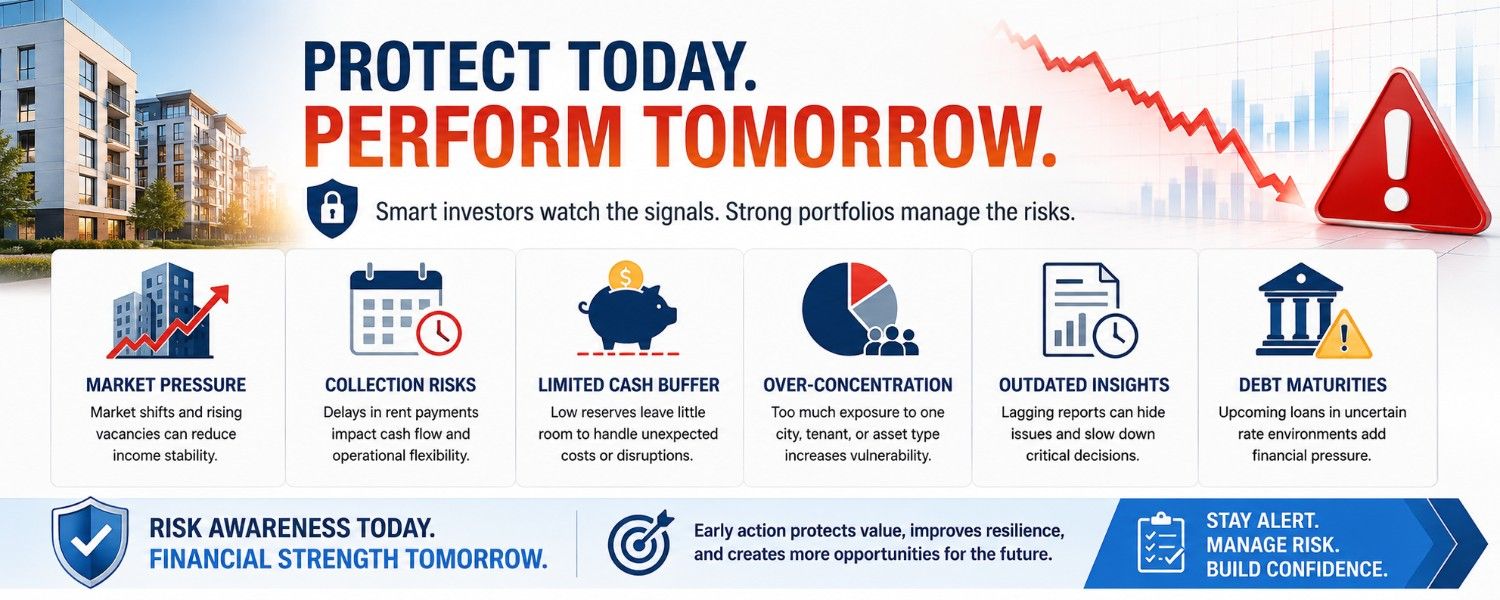
Before diving into strategies, it helps to know what warning signs to watch for. Common red flags include:
If two or more of these apply to your portfolio, it’s time to prioritize risk mitigation, not just growth.
Let’s go through the strategies that experienced professionals rely on when markets get unpredictable.
Putting all capital into one property type or city is risky. If that market slows down, the whole portfolio suffers.
Smart diversification spreads risk across:
This way, a downturn in one sector doesn’t sink the entire portfolio. Even a modest mix — say, adding one different asset type or region — can meaningfully reduce overall exposure.
Before uncertainty hits, ask “what if?”
Stress testing helps owners prepare responses before problems happen, not after. This is a standard practice among top real estate asset managers, and it doesn’t require complex software. Even a simple spreadsheet model, updated quarterly, can reveal weak points early.
Numbers don’t lie. But only if they’re accurate and current.
Reliable asset management accounting gives owners a clear, real-time view of cash flow, expenses, debt levels, and asset performance. Without it, decisions get made on guesswork instead of facts.
Strong asset accounting services also help with:
When markets shift, this financial clarity becomes the difference between a fast, smart decision and a costly delay. Owners who review financials monthly, rather than quarterly, tend to catch problems weeks earlier.
Cash reserves matter more during uncertain times. Owners with strong liquidity can cover unexpected costs, ride out vacancy periods, and avoid forced sales at bad prices.
A simple rule many professionals follow: keep enough reserves to cover at least six to twelve months of operating expenses per asset. This buffer prevents small cash flow gaps from turning into forced, below-market decisions.
Tenant stability protects income. During uncertainty, review:
Staggering lease expirations avoids the risk of too many tenants leaving at once. It also gives owners more flexibility to reprice space gradually instead of all at once during a downturn.
Modern real estate asset management services rely on dashboards and analytics tools to track performance in real time.
This allows early warning signs — falling occupancy, rising expenses, slow rent collection — to be caught before they become bigger problems. Technology also makes it easier to compare performance across a portfolio, spotting which assets need attention first.
Not every risk can be avoided. Some can be transferred.
These steps protect owners from risks outside their direct control, like natural disasters, lawsuits, or tenant defaults.
During uncertain periods, silence creates anxiety. Regular, honest updates build trust, even when the news isn’t perfect.
Owners and managers who communicate proactively tend to get more flexibility from lenders and more patience from investors when challenges arise.

Consider a mid-sized owner with a mixed portfolio of office and residential properties across two cities.
When interest rates began climbing, the ownership team ran a stress test and found that one office property would struggle to cover debt payments if vacancy rose above 20%. Instead of waiting, they acted immediately.
They tightened cash reserves, renegotiated a lease early with a key tenant, and asked their asset accounting services provider to move from quarterly to monthly reporting. This gave them faster visibility into rent collection trends.
At the same time, they leaned on their real estate asset management company to identify a smaller residential acquisition in a different market, adding diversification without overextending their budget.
Within a year, the office property remained stable despite market pressure, and the new residential asset helped offset softer office performance. None of these individual steps were dramatic. Together, they made the portfolio far more resilient.
This is the real value of risk mitigation: it’s rarely one big move. It’s several smaller, disciplined actions working together.
| Market Risk | Mitigation Strategy | Who Leads It |
|---|---|---|
| Falling property values | Diversification across markets | Real estate asset managers |
| Rising interest rates | Stress testing & scenario planning | Asset management team |
| Cash flow uncertainty | Strong asset accounting services | Accounting/finance team |
| Tenant default or vacancy | Lease risk review & staggering | Property + asset managers |
| Unexpected expenses | Liquidity reserves | Finance & ownership |
| Data blind spots | Technology-driven monitoring | Asset management company |
| Legal/disaster exposure | Insurance & legal structuring | Legal & risk advisors |
| Investor uncertainty | Transparent, regular reporting | Asset management & leadership |
Not every owner has the time, tools, or expertise to manage all of this alone. That’s where professional real estate asset management services come in.
These services typically include:
A good service provider acts like a partner, not just a vendor. They help owners make confident decisions, even when markets feel unpredictable. They also bring cross-market experience, having seen similar risks play out in other portfolios before.
“The biggest mistake owners make during downturns is going quiet. The best asset managers communicate more, not less, when markets get tough.” — Director of Asset Management, Investment Group
Should you build an internal team or hire an outside real estate asset management company? Here’s a simple comparison.
| Factor | In-House Team | Real Estate Asset Management Company |
|---|---|---|
| Cost | Higher fixed cost | Flexible, often performance-based |
| Expertise | Limited to hired staff | Broad, cross-market experience |
| Technology | Requires investment | Usually already in place |
| Scalability | Harder to scale quickly | Easy to scale with portfolio growth |
| Market Insight | Local only | Often multi-market perspective |
| Speed of Setup | Slower to build | Faster to onboard |
For smaller portfolios, an outside company often makes more financial sense. For very large portfolios, a hybrid approach works well — an internal team handling strategy, supported by outside specialists for accounting or technology.
Accounting isn’t just record-keeping. It’s a risk management tool.
Reliable asset accounting services help owners:
During uncertain markets, delayed or inaccurate numbers can lead to missed warning signs. Clean accounting removes that blind spot and gives everyone — owners, lenders, and investors — the same trusted source of truth.
Here’s an easy way to think about risk mitigation, step by step:
This cycle repeats. Markets change, so risk management should never be a one-time task. Owners who revisit this framework quarterly tend to catch problems while they’re still small and manageable.
Evaluate your portfolio across 8 critical risk areas and identify financial, operational, and market vulnerabilities before they impact asset performance.
Q: What is the main goal of real estate asset management?
The main goal is to maximize property value and income while minimizing financial and operational risk over time.
Q: How is asset management different from property management?
Property management handles daily operations like maintenance and tenant requests. Asset management focuses on financial strategy, risk, and long-term value.
Q: Why is asset accounting important during market uncertainty?
Accurate accounting gives owners real-time visibility into performance, helping them react quickly instead of guessing.
Q: Should small investors hire a real estate asset management company?
Yes, especially if they lack time or expertise. A good company brings market insight, technology, and risk experience that’s hard to build alone.
Q: What’s the biggest risk mitigation mistake owners make?
Waiting too long to act. Early monitoring and stress testing prevent small issues from becoming major losses.
Q: How often should a portfolio be reviewed for risk?
Ideally monthly for financial performance, and quarterly for a full risk and strategy review.
Q: Can diversification alone protect a portfolio during a downturn?
Diversification helps, but it works best combined with strong accounting, liquidity planning, and active monitoring.
Market uncertainty isn’t going away. But the right approach turns risk into something manageable, not something feared.
Strong real estate asset management combines smart strategy, accurate asset management accounting, active monitoring, and experienced guidance. Whether you rely on skilled real estate asset managers in-house or partner with a trusted real estate asset management company, the goal stays the same: protect value, protect income, and stay ready for whatever the market brings next.
The investors and owners who prepare early are always the ones who come out ahead. Waiting for a downturn to start managing risk is far more expensive than building the right systems now.
Looking for expert real estate asset management services or reliable asset accounting services for your portfolio? A proactive strategy today can protect your returns tomorrow.