Real Estate Asset Management 2026: AI, Sectors, Growth & ESG
- July 21, 2026
- Amit K. Vatsayan
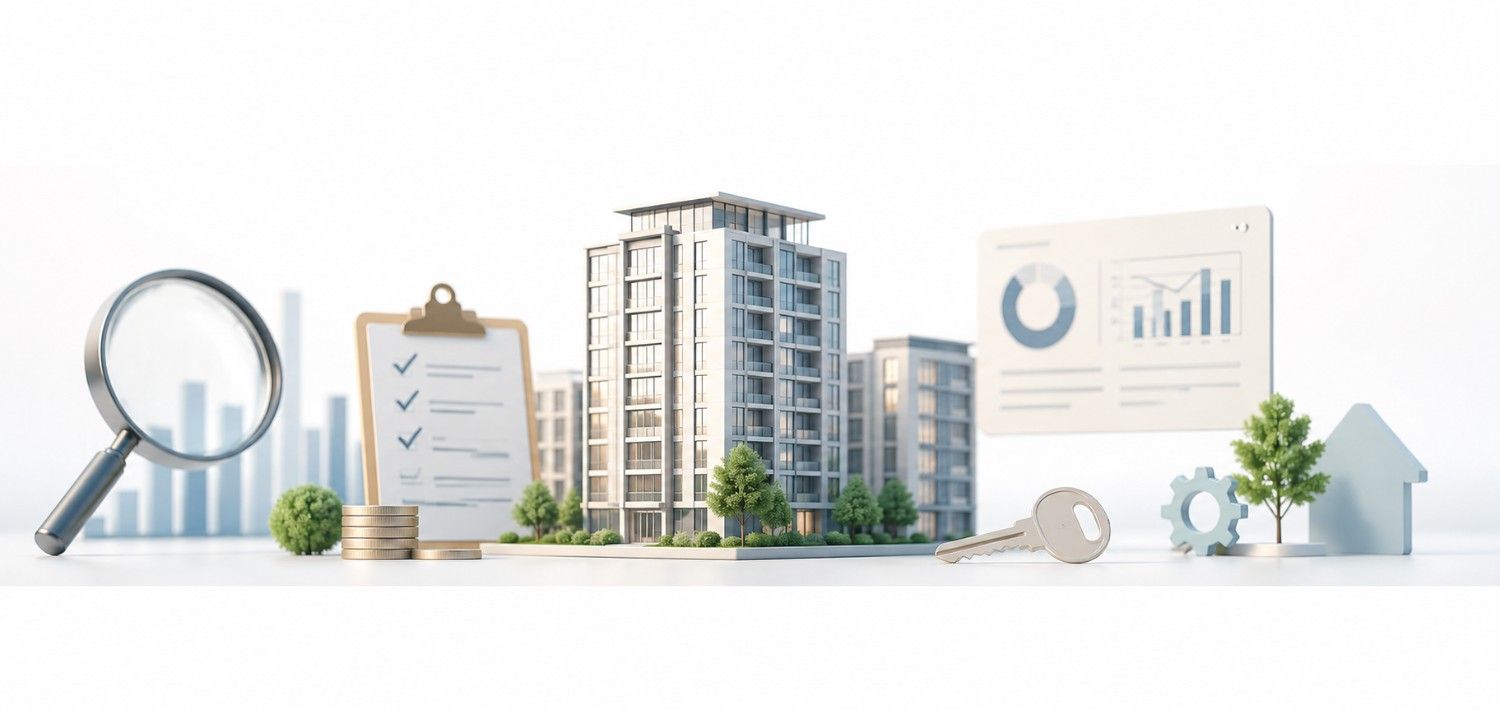
Real estate asset management is the process of maximizing the value and financial returns of a property portfolio. It covers the full lifecycle of an investment — from acquisition and holding to repositioning and sale.
An asset manager acts as the “owner” of the investment. They make strategic decisions about capital improvements, leasing, financing, and exit timing. Their goal is simple: grow returns while keeping risk in check.
“Asset management is the step after the closing of the deal. The degree to which it is practiced can make the difference between a successful investment and a losing one.” — Asset Management Firm
This is different from property management. Property managers handle day-to-day tasks like rent collection, maintenance, and tenant issues. Asset managers focus on the big picture — financial performance, market positioning, and long-term strategy.
If you are searching for real estate asset management services, you are looking for professionals who can handle the strategic side of your portfolio. This includes financial planning, market analysis, and investor reporting.

| Feature | Asset Management | Property Management |
|---|---|---|
| Primary Focus | Maximizing investment returns and long-term value | Day-to-day operations and tenant satisfaction |
| Time Horizon | Strategic, long-term (3-10 years) | Tactical, short-term (monthly/quarterly) |
| Key Metrics | Cash flow, IRR, cap rate, ROI, NOI | Occupancy rate, rent collections, maintenance costs |
| Main Tasks | Capital planning, hold/sell analysis, financing, market strategy | Leasing, repairs, tenant relations, rent collection |
| Stakeholders | Investors, lenders, owners | Tenants, vendors, on-site staff |
| Goal | Increase returns while managing risk | Keep the property running smoothly |
Think of it this way: the asset manager is the CEO, and the property manager is the operations manager. Both are essential, but their roles do not overlap.
A real estate asset management company typically offers both services or partners with property management firms to deliver the full solution.
Real estate asset managers handle a wide range of responsibilities. Here are the core duties:
1. Financial Oversight and Reporting
Asset managers track budgets, cash flow, and key performance indicators. They prepare monthly and quarterly reports for investors and stakeholders. Common metrics include:
Asset management accounting is critical here. It ensures every dollar is tracked, every expense is categorized, and every report is accurate.
2. Capital Planning
They evaluate and approve major value-add projects. This includes renovations, repositioning, refinancing, and redevelopment. Every dollar spent must improve returns.
3. Leasing and Tenant Strategy
For commercial properties, real estate asset managers review lease terms, approve major tenants, and negotiate rent. They set the leasing strategy that drives revenue.
4. Operational Oversight
They recruit and direct property management teams. They set performance standards and hold teams accountable for results.
5. Hold or Sell Analysis
Real estate asset managers monitor market conditions to find the best time to sell or refinance. Timing the exit can add millions to investor returns.
6. Risk Management
They identify market, financial, and operational risks before they hurt returns. This includes tracking interest rates, tenant defaults, and regulatory changes.
“The key to protecting an investor’s investment is anticipating market changes through on-the-ground resources and direct oversight of each asset.” — Pauline Mang, Asset Management Firm

The industry has changed fast. Here is what is driving real estate asset management in 2026.
In 2026, 75% of real estate asset managers use AI and machine learning for portfolio decisions. This is up from 51% just two years ago.
| AI Application | Usage Rate | Impact |
|---|---|---|
| Marketing and leasing | 90% | Faster tenant placement, better targeting |
| Property management automation | 87% | Reduced operational costs, faster response |
| Investment analysis and underwriting | 72% | Better risk assessment, faster decisions |
| Portfolio forecasting | 68% | More accurate revenue and expense projections |
| ESG and sustainability tracking | 45% | Growing fast as regulations tighten |
AI is not replacing real estate asset managers. It is giving them better data to make faster, smarter decisions.
Not all property types perform the same in 2026. Smart real estate asset managers are rotating capital into high-demand sectors.
| Sector | 2026 Outlook | Why It Matters |
|---|---|---|
| Senior Housing | Strong demand | Aging population, 10,000 Americans turn 65 daily |
| Data Centers | Supply-constrained | AI and cloud computing drive massive power demand |
| Industrial / Logistics | Steady growth | E-commerce and last-mile delivery keep demand high |
| Self-Storage | Niche expansion | Downsizing trends, small business inventory needs |
| Multifamily | Mixed | Affordability pressures in some markets |
| Office | Repricing | Hybrid work has permanently changed demand |
“The repricing of office assets is the most significant structural shift in real estate since the rise of e-commerce.” — PwC Emerging Trends in Real Estate 2026
Environmental, Social, and Governance (ESG) is no longer a checkbox. In 2026, it is a value-creation strategy.
| ESG Shift | Old Approach (2020-2024) | New Approach (2026) |
|---|---|---|
| Motivation | Regulatory compliance, investor pressure | Cost reduction, risk mitigation, asset value |
| Focus | Reporting carbon emissions | Operational efficiency, tenant health, resilience |
| Measurement | Broad sustainability scores | Asset-specific ROI on green upgrades |
| Integration | Separate ESG team | Embedded in every asset decision |
Nearly half of real estate asset managers adjusted their ESG strategies in 2026 due to macro uncertainty. The ones who got it right are seeing lower insurance costs, higher tenant retention, and better financing terms.
With interest rates higher than the 2010s, debt-focused strategies are delivering better risk-adjusted returns.
| Strategy | 2026 Performance | Risk Level | Best For |
|---|---|---|---|
| Senior debt / lending | Stable, predictable income | Low | Conservative investors |
| Value-add equity | Higher upside, more volatility | Medium | Growth-focused portfolios |
| Opportunistic / distressed | Highest returns | High | Experienced managers |
| Core-plus | Balance of income and growth | Medium-Low | Most institutional investors |
Real estate asset managers are allocating more capital to debt and preferred equity. This provides downside protection while still capturing upside.
companies identify five forces shaping real estate in 2026:
| Force | What It Means for Real Estate Asset Managers |
|---|---|
| Demographics | Aging population drives senior housing; urbanization shifts demand |
| Digitalization | AI, proptech, and data analytics are now essential tools |
| Decarbonization | Energy efficiency upgrades improve asset value and reduce risk |
| Defence | Geopolitical uncertainty makes location and supply chain strategy critical |
| + Disruption | Technology and policy changes are accelerating faster than ever |

The right technology stack can cut costs and improve decision-making. Here are the tools top real estate asset managers use:
| Tool Category | Purpose | Example Platforms |
|---|---|---|
| Portfolio Management | Track assets, leases, and financials | Yardi Voyager, AppFolio, Juniper Square |
| Data Analytics | Market trends, valuations, forecasts | HouseCanary, CoStar, REIS |
| AI Forecasting | Predictive analytics for rent, occupancy, and expenses | HouseCanary, Cherre, Skyline AI |
| Asset Management Accounting | Financial statements, investor reporting, tax planning | QuickBooks, Sage Intacct, specialized CRE accounting software |
| ESG Tracking | Carbon footprint, compliance, sustainability metrics | Measurabl, GRESB, Deepki |
“Our goal is to put the real-time insights and analytics investors need at their fingertips so they can answer tough real estate questions quickly and confidently.” — Ketan Bhalla, President and Chief Product Officer.
Asset accounting services are a critical part of this stack. Without accurate financial tracking, even the best strategy fails.
Different property types need different strategies. Here is how top real estate asset managers approach each sector in 2026.
The senior housing sector is one of the strongest in 2026. With 10,000 Americans turning 65 every day, demand is structural, not cyclical.
Key strategies for senior housing asset managers:
Data centers are supply-constrained. Power availability is the biggest bottleneck.
Key strategies for data center asset managers:
E-commerce growth keeps industrial demand strong. Last-mile logistics is the sweet spot.
Key strategies for industrial asset managers:
Self-storage is expanding beyond traditional use cases.
Key strategies for self-storage asset managers:
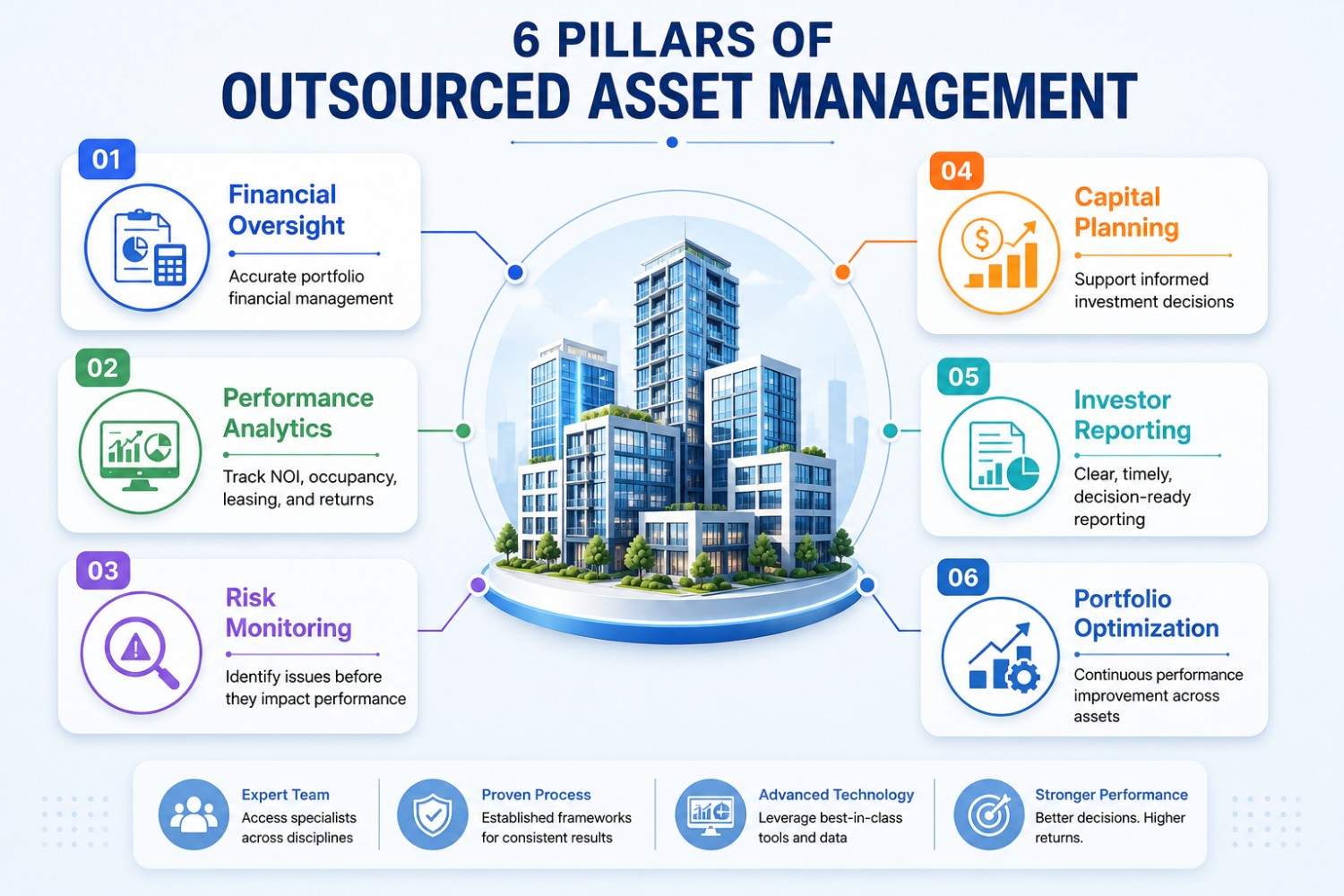
Many portfolio owners face a choice: build an internal team or hire outside experts. Here is how the options compare in 2026.
| Factor | In-House Team | Outsourced Real Estate Asset Management Services |
|---|---|---|
| Cost | High fixed costs (salaries, benefits, overhead) | Variable, scales with portfolio size |
| Speed to start | 3-6 months to hire and train | Immediate, plug-and-play |
| Expertise | Limited to team’s experience | Access to specialists across sectors |
| Technology | Must invest in software and training | Included in service |
| Scalability | Hard to scale down in slow markets | Flexible, pay for what you need |
| Reporting | Custom but time-consuming | Standardized, investor-ready reports |
| Best for | Large portfolios (500+ units) | Mid-market portfolios (50-500 units) |
“Outsourced real estate asset management services give mid-market investors access to institutional-grade expertise without the institutional overhead.” — Industry Practice, 2026
For portfolios of 50 to 500 units, outsourcing often delivers better returns at lower cost. You get experienced real estate asset managers, proven technology, and professional reporting — without the fixed overhead.
A real estate asset management company that offers outsourced services can handle everything from asset accounting services to investor reporting.
Asset managers track dozens of metrics. These are the ones that drive decisions in 2026.
| KPI | What It Measures | Target Benchmark |
|---|---|---|
| Net Operating Income (NOI) | Property profitability | Grow 3-5% annually |
| Occupancy Rate | Tenant demand | 90%+ for most sectors |
| Tenant Retention | Stability and satisfaction | 70%+ renewal rate |
| Cash-on-Cash Return | Annual cash yield | 6-10% depending on strategy |
| IRR | Total return over hold period | 12-18% for value-add |
| Cap Rate | Valuation relative to income | Varies by market and sector |
| Debt Service Coverage Ratio (DSCR) | Ability to cover debt payments | 1.25x minimum |
| Expense Ratio | Operating efficiency | 35-45% of effective gross income |
Asset management accounting is the financial backbone of portfolio performance. It goes beyond basic bookkeeping.
| Accounting Task | Why It Matters |
|---|---|
| Budgeting and forecasting | Sets financial targets and tracks progress |
| Cash flow management | Ensures liquidity for operations and distributions |
| Investor reporting | Builds trust and transparency with stakeholders |
| Tax planning | Minimizes liability and maximizes after-tax returns |
| Audit support | Keeps financials ready for lender and investor review |
| Cost segregation | Accelerates depreciation for tax savings |
Many portfolio owners underestimate the complexity of asset management accounting. It requires specialized knowledge of real estate tax rules, partnership accounting, and investor reporting standards.
Outsourced asset accounting services solve this by providing:
Real estate asset management services that include accounting deliver more value than those that do not. Financial accuracy is the foundation of every good decision.
Every property investment goes through three phases. Each phase needs a different strategy.
This is where value is created or destroyed. The asset manager evaluates potential deals, runs financial models, and negotiates terms.
Key acquisition tasks:
A strong acquisition sets up the entire investment. A weak acquisition creates problems that are hard to fix later.
This is the longest phase. The real estate asset manager executes the business plan, monitors performance, and adjusts strategy as conditions change.
Key holding tasks:
The holding period is where small decisions compound. A 1% improvement in occupancy or a 2% reduction in expenses can add millions to total returns over a 5-year hold.
The exit is where returns are realized. Timing and execution matter as much as the initial purchase.
Key disposition tasks:
“The best real estate asset managers treat disposition as a process that starts on day one of acquisition, not as an afterthought.” — Industry Best Practice
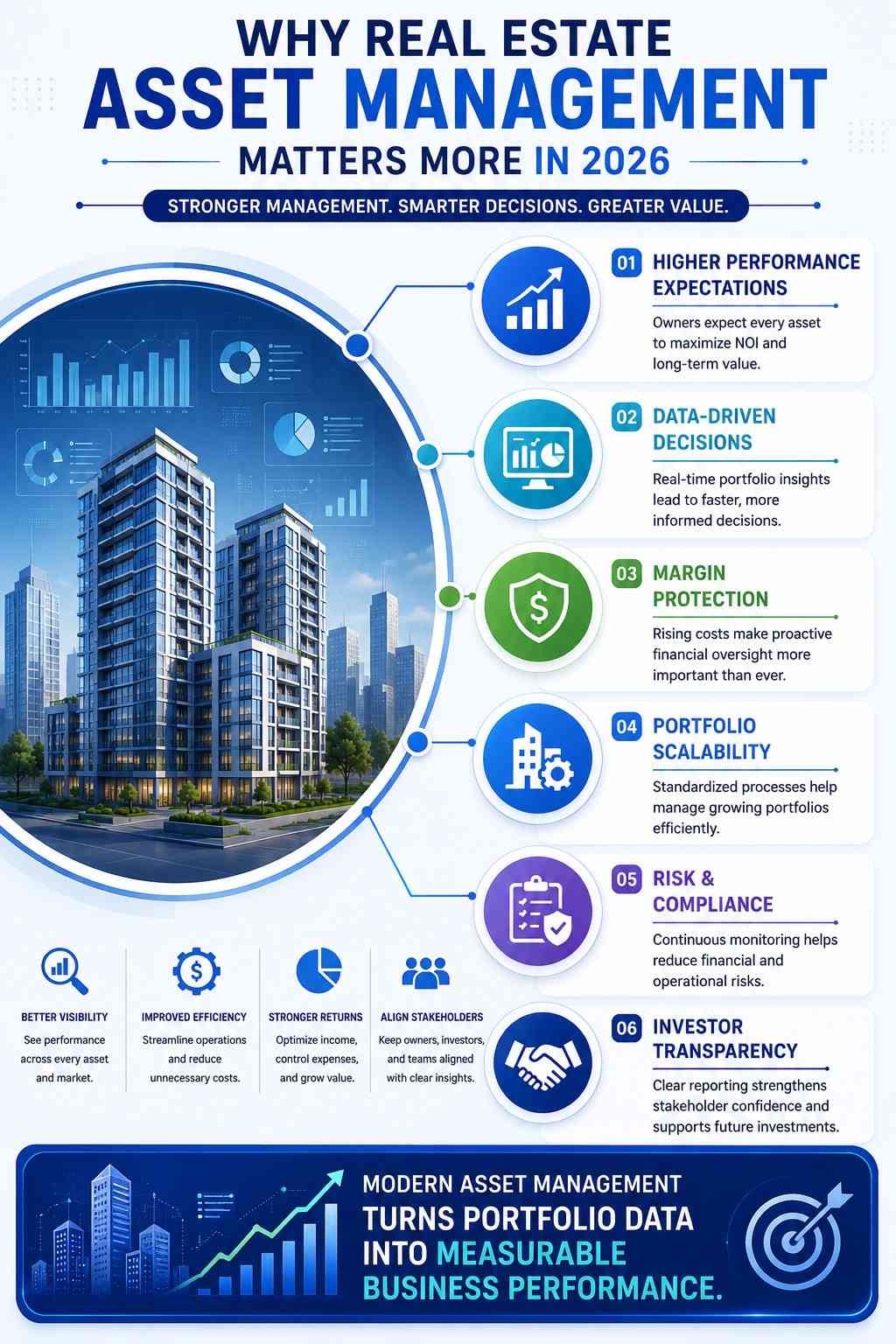
Three forces are making professional real estate asset management essential.
Interest rates are higher than the 2010s. Debt costs more. Equity investors demand higher returns. Every basis point of inefficiency hurts more than it used to.
| Cost Factor | 2019-2021 | 2024-2026 |
|---|---|---|
| 10-year Treasury | 1.5-2.5% | 4.0-5.0% |
| Commercial mortgage rates | 3.5-5.0% | 6.5-8.5% |
| Equity return expectations | 12-15% | 15-20% |
| Cap rate compression | Yes | Reversed in many markets |
Higher capital costs mean real estate asset managers must work harder to deliver returns. There is less room for error.
Geopolitical uncertainty, inflation, and policy shifts are creating more volatility. Real estate asset managers need to react faster and plan for more scenarios.
Key risk factors in 2024-2026:
AI and data analytics are now standard. Real estate asset managers who do not use these tools are at a disadvantage.
Technology competitive advantages in 2026:
Not all real estate asset management companies are the same. Here is what to look for in 2026.
| Criteria | What to Ask | Red Flags |
|---|---|---|
| Track record | What is your average IRR and cash-on-cash return? | No specific numbers, only general claims |
| Sector expertise | Which property types do you specialize in? | Claims expertise in every sector |
| Technology stack | What tools do you use for forecasting and reporting? | Manual spreadsheets, no automation |
| Team experience | How many years of experience does your team have? | High turnover, junior-heavy team |
| Reporting frequency | How often do you provide updates? | Quarterly or less for active assets |
| Fee structure | How are your fees structured? | Hidden fees, unclear performance incentives |
| References | Can I speak to current clients? | Refuses to provide references |
| ESG integration | How do you incorporate sustainability into decisions? | No ESG strategy or treats it as checkbox |
| Asset management accounting | Do you handle accounting and reporting? | No, or outsources to unknown third party |
The right approach depends on portfolio scale.
| Portfolio Size | Typical Approach | Key Challenge |
|---|---|---|
| 1-10 properties | Owner-managed or single property manager | Limited time and expertise |
| 10-50 properties | Hybrid: owner + outsourced specialist | Inconsistent reporting and processes |
| 50-500 properties | Dedicated asset manager or outsourced service | Scaling operations without adding overhead |
| 500+ properties | In-house team + technology platform | Maintaining consistency across markets |
| Institutional | Multiple specialized teams + AI platforms | Coordination and governance |
For the 50-500 property range — the mid-market — outsourced real estate asset management services often deliver the best combination of expertise, cost, and scalability.
Real estate asset managers in this space need to understand both the big picture and the details. They must balance strategy with execution.
Knowing the right strategies is only part of effective asset management—the real question is whether your portfolio is consistently following them. Even experienced owners and asset managers can overlook process gaps that gradually reduce returns, increase operational risk, or delay critical decisions.
Use the checklist below as a quick self-assessment to evaluate the maturity of your real estate asset management practices. It covers the key areas that influence portfolio performance, financial oversight, investor confidence, and long-term asset value.
Looking beyond 2026, several trends will reshape the industry.
| Future Trend | What to Expect | Timeline |
|---|---|---|
| Generative AI | AI that writes investor reports, analyzes leases, and recommends strategies | 2026-2028 |
| Predictive analytics | Forecasting tenant defaults, market shifts, and optimal exit timing | Now-2027 |
| Tokenization | Fractional ownership via blockchain, improving liquidity | 2027-2030 |
| Climate adaptation | Properties designed for extreme weather, carbon-neutral operations | 2026-2030 |
| Remote asset management | Managing properties across markets without local teams | Now-2026 |
| Integrated platforms | Single platform for accounting, reporting, leasing, and forecasting | 2026-2028 |
Real estate asset managers who adopt these technologies early will have a significant advantage.
Real estate asset management is the strategic oversight of property investments to maximize returns and reduce risk. It covers acquisition, holding, repositioning, and sale decisions. Real estate asset managers act as the strategic owner of the investment, making decisions about capital improvements, leasing, financing, and exit timing.
Asset management focuses on long-term financial strategy and investment returns. Property management handles day-to-day operations like maintenance, leasing, and tenant relations. Real estate asset managers set the strategy. Property managers execute it.
A real estate asset manager oversees financial performance, capital planning, leasing strategy, risk management, and exit timing. They prepare investor reports, approve major projects, and make hold-or-sell decisions. Asset management accounting is a core part of their work.
According to the U.S. Bureau of Labor Statistics, the average salary is $134,180 per year. Job growth is projected at 17% through 2030. Senior real estate asset managers at large firms can earn $200,000 or more.
Net Operating Income (NOI), occupancy rate, cash-on-cash return, Internal Rate of Return (IRR), and capitalization rate are the most critical metrics. Real estate asset managers track these religiously to guide decisions.
Senior housing, data centers, industrial logistics, and self-storage are the top-performing sectors. Office remains challenged due to hybrid work trends. Real estate asset managers are rotating capital accordingly.
In 2026, 75% of real estate asset managers use AI for marketing, leasing, forecasting, and risk assessment. AI improves speed and accuracy but does not replace human judgment. It is a tool, not a replacement.
ESG stands for Environmental, Social, and Governance. In 2026, it has shifted from compliance to value creation — improving efficiency, reducing risk, and attracting capital. Real estate asset managers now embed ESG into every decision.
For portfolios under 500 units, outsourcing real estate asset management services is usually more cost-effective. For larger portfolios, a hybrid model often works best. A real estate asset management company can provide the expertise without the overhead.
Top platforms include Yardi Voyager, AppFolio, HouseCanary, CoStar, and Juniper Square. AI-powered forecasting tools are becoming standard. Asset management accounting software is essential for accurate reporting.
Asset accounting services handle the financial tracking, reporting, and tax planning for property portfolios. They include monthly financial statements, investor reports, audit support, and cost segregation studies. Many real estate asset management services include accounting as part of their package.
Look for track record, sector expertise, technology stack, team experience, reporting frequency, transparent fees, client references, and ESG integration. Ask about their asset management accounting capabilities too.