Outsource Property Management Accounting: The CFO’s Guide to Efficiency & Growth
- February 10, 2017
- admin@ohi
As a property portfolio expands, the growing number of entities, bank accounts, vendors, transactions, and owner reporting requirements can place significant pressure on internal finance teams. Outsource Property Management Accounting to manage these increasing accounting demands more efficiently, allowing CFOs and Controllers to reduce operational workloads, strengthen financial oversight, and focus their time on strategic planning and portfolio growth.
Outsourcing property management accounting can help minimize the ever-growing burden of property management accounting. By outsourcing certain accounting processes and reporting to a specialized firm, a property management company can strengthen its financial management processes and increase the time available to the finance leaders for more strategically important issues, such as cash flow, portfolio performance, and risk management.
For property managers of multifamily and other residential rental properties, outsourcing accounting can help consolidate and standardize reporting at the property level, improve financial controls, and help with the reconciliation of owner statements.
Unaffiliated external accounting teams can be used to fulfill a number of accounting services at both the property level and the overall portfolio level. These can include accounts payable, accounts receivable, cash and bank reconciliations, general ledger accounting, monthly account closes and reporting, preparation of owner balances and statements, and other accounting and reporting functions.
Unlike lower level property management bookkeeping services, an organized outsourcing model can complement the internal accounting function. The CFO or Controller maintains oversight and control, while an outsourced team performs all the work according to established controls, and supporting documentation to allow for ongoing reporting.
This type of service can also include entity level reporting, consolidation of the portfolio at the highest level, along with preparation of financial statements for each of the properties and accounting for rental activities, ownership reporting, and monitoring the cash flows of the portfolio.
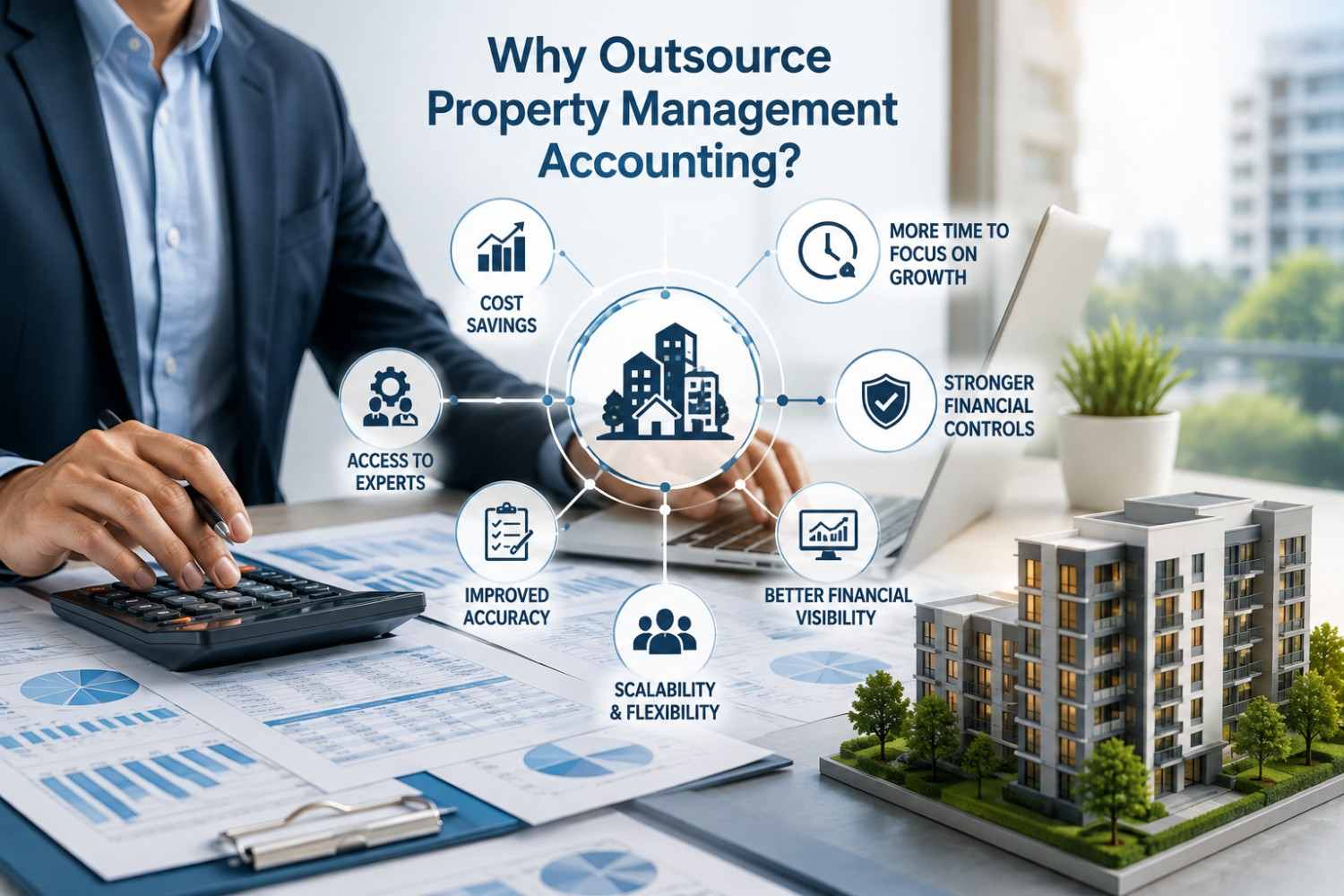
Most property management companies outsource accounting to manage their growth without growing their finance teams. Outsourcing property management accounting can help structure transactions and improve ‘reporting,’ ‘reconciliations’ and ‘financial controls.’ Furthermore, it scales with the growth of new properties/subsidiaries or an increase in overall activity.
Benefits include:
Outsourcing property management accounting can help any finance leader struggling with capacity issues. For residential operators, it is able to provide consistent accounting for both multiple properties and numerous ownership entities, along with bank accounts and reporting structures.
Accounting outsourcing for a property management CFO focuses on increasing reporting capacity while simultaneously decreasing the responsibility for transactional work. The automation and design of structured reconciliations, close workflow, approval controls, and reporting create greater efficiency at the CFO level while allowing more focus on cash flow, budget, risk, and capital management.
The finance leader won’t have to address reconciled accounts or follow up on coded invoices. Instead, the finance leader can do budget vs. actual analysis and analyze trends in the portfolio.
Working through an outsourcing process tends to reveal the following:
Outsource work -> reduce workload -> better control over processes -> faster outputs -> better financial visibility -> make better informed decisions as a CFO.
When evaluating a property management outsource accounting model, teams should not think about simply transferring tasks outside of their control. The real goal should be creating a more flexible finance operating model.
Property management companies can outsource accounting functions and retain proper internal oversight and approvals.
These functions often include:
For a residential portfolio, outsourced teams can support multifamily and community financial reporting for multiple owners and divisions.
These workflows can be extended to Property Management Bookkeeping Services, Residential Real Estate Accounting Services, Real Estate Accounting Services, or Asset Management Accounting based on the portfolio and reporting requirements.
Property management accounting outsourcing can be a worthwhile expense because sometimes it financially justifies not having to train employees every time the volume or the size of the portfolio increases. Efficiency can be gained through the ability to leverage staffing, a greater degree of standardization, enhanced technology, lower management burden, and better use of high-level finance resources. But payroll savings can’t be guaranteed. More key efficiencies come from improved process standardization and technology than payroll savings.
Thus, the true comparison to outsourcing accounting should not be done strictly on hourly cost vs employee salary. CFOs should look at the accounting function and operating model in its entirety — recruiting costs, training, oversight costs, the use of management time, and the risks of delays and impaired visibility due to lack of software and high turnover.
There are a multitude of indicators that suggest that a property management company should consider outsourcing accounting.
There are gaps in the management team’s ability to review and provide required financial oversight to operations.
Outsourcing the accounting function does not automatically solve any or all of these issues, though in many circumstances, it is better to outsource stuff that is more of a process and keep the function of approval and decisions and finance oversight more strategic.

A property management accounting outsourcing partner should be able to address substantive issues of the finance function, and not just be a partner that provides accounting services for a low price.
A CFO assessment should address the following:
Real estate expertise: How well do they understand the specific needs of real estate at the property level, the entity level, the portfolio as a whole, and residential real estate accounting?
Some organizations with broader administrative functions may evaluate Real Estate Back-Office Services, while community association portfolios may require dedicated HOA Accounting Services.
At a certain volume of business, outsourcing becomes a critical component of a firm’s growth strategy. If the organization has to manage real estate and accounting services at the same level, then they need to hire an accountant every time they sign a contract for management or an acquisition.
Multifamily and residential owners can hire a Residential Real Estate Accounting service to maintain a consistent and scalable back office when they introduce new portfolios and properties. This service standardizes the general ledger and reporting processes and ensures consistent reconciliations and monthly close protocols for the portfolio.
A scalable accounting structure helps CFOs and property managers focus on:
Lack of a scalable accounting structure does not mean leadership in finance is lacking. Scalable accounting suggests a more strategic accounting structure that separates transactional and more complicated finance work.
Property management accounting outsourcing helps growing property management companies scale their transaction processing, reconciliations, month end close, financial reporting and reporting to owners without adding to their internal accounting function.
Residential and multifamily operators stand to benefit from outsourcing with Residential Real Estate Accounting.
For CFOs and Controllers, process diagnosis is key in determining if workload, reporting delays, weakness in controls or staffing issues are impacting financial decision making. Determining which functions can be standardized, controlled and outsourced to a qualified partner would have the most benefit.
When property management accounting is outsourced, some account functions are delegated to an external accounting service provider. Typically, this work encompasses accounts payable, receivable, bank reconciliations, maintenance of the general ledger, month end closings, reporting to owners, and preparation of financial statements. Among other things, the CFO/Controller retains responsibility for account oversight, approvals, financial policies and strategies.
One of the primary reasons companies outsource property management accounting is to eliminate repetitive tasks. Other reasons include expanding accounting capacity and accounting efficiencies, enhancing reporting consistency, and supporting growth and expansion of the business portfolio. A robust outsourcing model strengthens several internal control enhancing frameworks and procedures while cash flow, budgeting, portfolio performance, and planning become more strategic for finance executives.
Property management companies can outsource the following accounting functions: accounts payable and accounts receivable; reconciliations of bank accounts and credit cards, and maintenance of the general ledger and preparation of journals; month end accounting; preparation of financial statements, month end reports, and owner statements; preparation of reports for each of the properties managed separately and collectively; preparation of reports for the common area maintenance (CAM) and reconciliations; and year-end accounting support. In addition, residential real estate accounting teams can provide accounting support for multifamily and apartment reporting for multiple ownership entities.
The greatest advantage of outsourcing accounting functions is that companies can add accounting capacity to support the expansion of the property portfolio without adding staff to the internal finance department at that same rate of expansion. Robust accounting practices implemented across multiple properties or entity groups enable management to maintain consistency of reconciliations, financial reporting, and closing procedures, as well as owner reporting and residential real estate accounting frameworks for the management team.
There are many variables that drive the cost of a property management accounting outsourcing engagement, including the size of the portfolio, number of transactions, complexity of the accounting services required, reporting requirements, and the extent of review required. CFOs should also determine the total cost of the internal accounting function, beyond the cost of outsourcing, and consider the expense of recruitment, ongoing staff costs, training, oversight, replacement of staff, and the inefficiencies that can occur from a poorly implemented accounting process.