Real Estate Asset Management vs Property Management: Key Differences Explained
- July 29, 2026
- Tajinder Malhotra
If you own commercial buildings, apartment complexes, or mixed-use developments, you have probably heard two terms used almost interchangeably: real estate asset management and property management. They sound alike. They both involve buildings and money. But they are not the same. Not even close.
Confusing the two can cost you serious money. It can lead to poor hiring decisions, missed growth opportunities, and a portfolio that underperforms year after year. This guide breaks down the real differences in plain, simple English. No jargon. No fluff. Just facts you can use today.

Real estate asset management is the strategic brain behind your property investments. It is not about fixing leaks or screening tenants. It is about making your portfolio more valuable over time.
A real estate asset manager thinks like an investor, not a landlord. They study market cycles, financing options, acquisition timing, and long-term exit strategies. Their job is to increase your return on investment and protect your wealth.
This role includes asset management accounting, cash flow forecasting, and portfolio performance tracking. It also involves deciding when to buy, when to sell, and when to refinance. These decisions shape your financial future.
“Real estate asset management is not about managing the building. It is about managing the money the building generates.”
Property management is day-to-day operations. A property manager makes sure the building runs without drama. They handle tenant complaints, maintenance requests, lease enforcement, and rent collection.
If a tenant calls about a broken air conditioner at midnight, the property manager answers. If a unit sits empty for two weeks, the property manager markets it. Their job is operational. It is about keeping things moving.
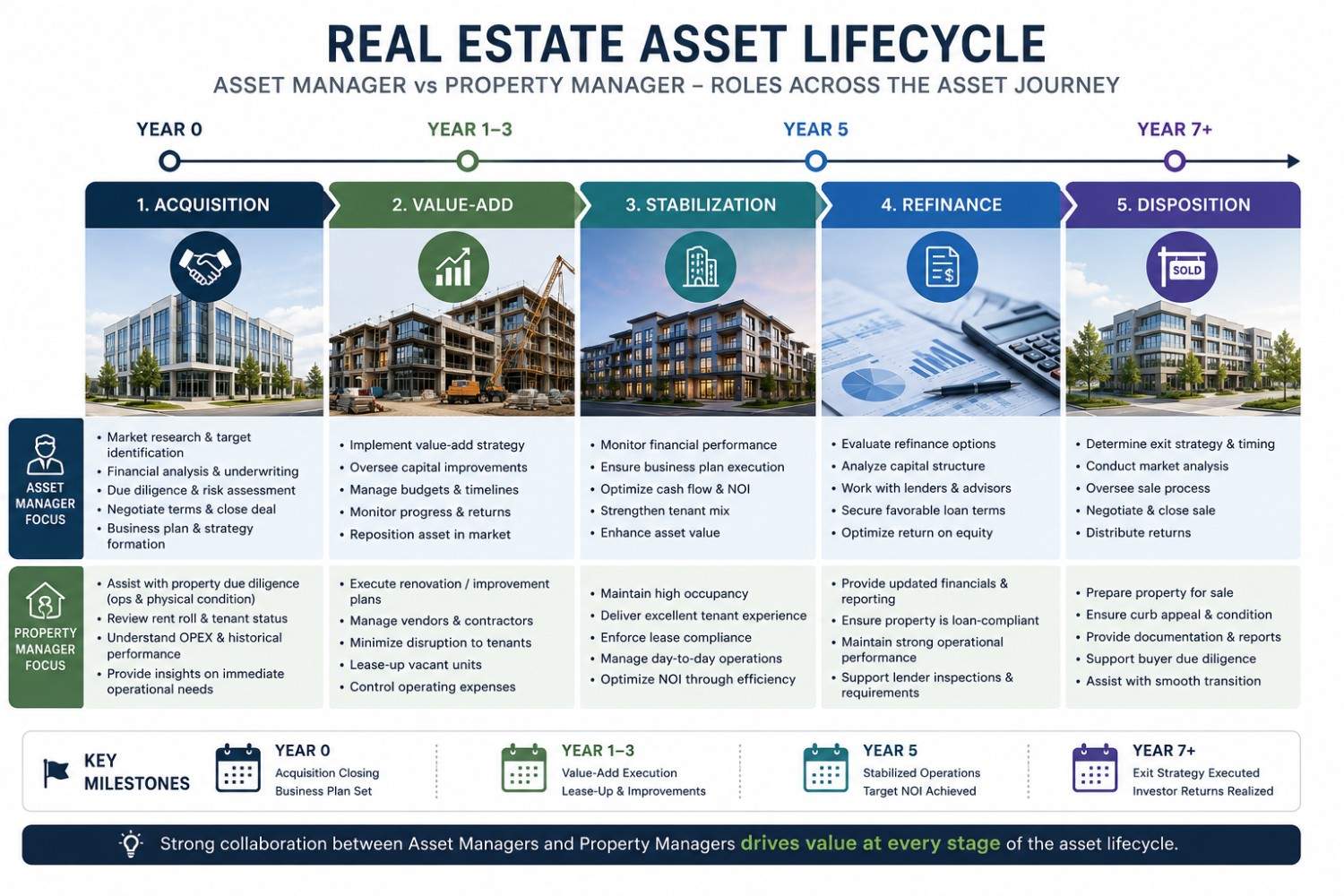
Property managers keep the lights on. Asset managers make sure the investment still makes sense five or ten years from now.
Here is the simplest way to tell them apart:
| Aspect | Real Estate Asset Management | Property Management |
|---|---|---|
| Focus | Long-term financial strategy | Daily building operations |
| Time Horizon | 3 to 10+ years | Week to week, month to month |
| Key Tasks | Valuation, acquisitions, dispositions, refinancing | Leasing, maintenance, tenant relations, rent collection |
| Reporting Style | Investment performance, IRR, NOI growth, cap rate analysis | Occupancy rates, rent rolls, maintenance logs, tenant complaints |
| Primary Goal | Maximize portfolio value and ROI | Ensure smooth, efficient building operations |
| Who They Report To | Investors, owners, stakeholders, boards | Asset manager or property owner directly |
One role thinks in years. The other thinks in days. Both matter. But they serve completely different purposes.
The real estate market has changed. Interest rates shift without warning. Cap rates compress in some markets and expand in others. Remote work reshaped office demand forever. In this environment, simply owning property is not enough. You need a strategy.
Real estate asset managers study these shifts in real time. They adjust your approach before the market punishes you. They ask questions most owners forget to ask. Is this asset still competitive? Should we reposition it? Can we cut costs without hurting tenant experience or property value?
Without this layer of strategic thinking, you are just hoping your property appreciates. Hope is not a strategy. It is a gamble.

Let us talk about the numbers. Asset management accounting is a specialized form of accounting. It tracks the financial health of each property in your portfolio at a granular level.
Standard property accounting records rent coming in and expenses going out. Asset accounting services go much deeper. They track depreciation schedules, capital reserves, debt service coverage ratios, and tax implications across your entire portfolio.
Here is what asset accounting services typically include:
| Service | What It Covers |
|---|---|
| Financial Reporting | Monthly and annual profit and loss statements for each individual asset |
| Budgeting & Forecasting | Projected income, expense trends, capital expenditure planning |
| Debt Tracking | Loan balances, interest calculations, refinancing triggers, covenant compliance |
| Tax Support | Depreciation schedules, cost segregation studies, 1031 exchange documentation |
| Investor Reporting | Distribution calculations, waterfall structures, K-1 preparation, capital account tracking |
This level of financial detail helps real estate asset managers make informed, data-backed decisions. You cannot improve what you do not measure. And you cannot measure what you do not track.
Not every property owner needs a full asset management team. But there are clear signs that real estate asset management services will help you grow faster and safer.
You own multiple properties. Managing one building is manageable with basic tools. Managing five, ten, or fifty properties requires systems, dashboards, and strategic oversight. You need someone looking across the entire portfolio, not just inside one building.
You are not a full-time real estate professional. Maybe you are a doctor, lawyer, tech entrepreneur, or business owner who invests on the side. You do not have time to analyze cap rates, negotiate refinancing terms, or evaluate new acquisition markets.
Your returns have gone flat. If your net operating income has not grown meaningfully in two or three years, something is wrong. A fresh strategic perspective can unlock value you did not know was trapped inside your assets.
You plan to scale aggressively. Buying more properties means more complexity. More debt. More tax implications. More investor relationships. Real estate asset management services build the infrastructure before your growth breaks it.
Real estate asset managers wear many hats. Their daily work looks nothing like a property manager’s routine. Here is what their responsibilities actually look like:
| Responsibility | Description |
|---|---|
| Acquisition Analysis | Underwriting new deals, running sensitivity models, stress-testing assumptions |
| Disposition Timing | Deciding the optimal quarter or year to sell based on market cycles |
| Capital Improvement Planning | Choosing upgrades that boost net operating income, not just curb appeal |
| Lease Strategy | Setting renewal terms, escalation clauses, and tenant mix that align with long-term goals |
| Financing Optimization | Refinancing to lower interest rates, extend terms, or pull out equity for new acquisitions |
| Risk Assessment | Monitoring market saturation, tenant concentration risk, regulatory changes, and environmental liabilities |
They do not replace your property manager. They guide them. They set the financial targets. The property manager executes the day-to-day plan to hit those targets.
| Task | Frequency |
|---|---|
| Tenant screening and leasing | Weekly |
| Rent collection and late fee enforcement | Monthly |
| Maintenance coordination and vendor management | Daily |
| Tenant complaint resolution | Daily |
| Property inspections | Monthly or quarterly |
| Lease renewals and negotiations | As leases expire |
| Eviction proceedings when necessary | As needed |
| Local regulatory compliance | Ongoing |
This is essential work. Without it, buildings fall apart and tenants leave. But it is tactical, not strategic. It keeps the machine running. It does not decide where the machine should go.
In very small portfolios, one person sometimes wears both hats. This is common with owners of duplexes, triplexes, or small apartment buildings. But as you grow, the roles must separate.
Why? Because strategy and operations require completely different mindsets. Operations demand urgency. A leaking roof cannot wait. Strategy demands patience. A refinancing decision might take six months to execute properly.
One person bouncing between both worlds often does neither well. If you are serious about building long-term wealth through real estate, separate the functions. Let specialists handle what they do best.

Let us look at how each role affects your bottom line in practical terms:
| Scenario | Property Management Only | Real Estate Asset Management + Property Management |
|---|---|---|
| Annual Rent Growth | 2-3% (market average) | 4-6% (strategic lease restructuring and market repositioning) |
| Operating Expense Trend | Rises steadily with inflation | Flat or reduced through vendor consolidation and energy upgrades |
| Major Capital Expenditures | Reactive (fix when broken) | Planned (value-add upgrades timed to market demand) |
| Exit Sale Price | Based on current trailing income | Based on optimized income, market timing, and buyer pool expansion |
| Investor IRR Over 5 Years | 8-10% | 12-18% |
This is not theory. This is what happens when someone is actively managing the asset, not just maintaining the building.
If you decide to outsource this strategic function, what should you look for in a real estate asset management company?
Track record comes first. Have they managed assets similar to yours in size, type, and location? A retail specialist may struggle with industrial logistics properties. A multifamily expert may not understand office repositioning.
Reporting transparency is critical. How often will you see performance updates? What metrics do they track? Do they provide clear dashboards or buried spreadsheets? You deserve visibility.
Fee structure must align incentives. Some firms charge a percentage of assets under management. Others take a performance-based fee tied to returns above a benchmark. Make sure their success is tied to your success.
Communication style matters more than you think. You want a partner who explains strategy in plain language. Not someone who hides behind jargon and buzzwords.
“The best real estate asset management company treats your capital with the same care they would treat their own family’s wealth.”
Let us go deeper into asset management accounting because this is where many owners get stuck. They have a bookkeeper. They have accounting software. But they do not have asset-level financial intelligence.
Here is the difference:
| Regular Property Accounting | Asset Management Accounting |
|---|---|
| Records rent and expenses | Tracks rent, expenses, debt, reserves, and capital events |
| Monthly P&L only | Monthly P&L plus rolling 12-month forecasts |
| Generic chart of accounts | Asset-specific chart of accounts tied to investment thesis |
| Basic tax prep | Proactive tax planning including cost segregation and 1031 tracking |
| No investor reporting | Detailed capital account and distribution waterfall reporting |
Without asset accounting services, you are flying blind. You might know your building made money last month. But do you know if it is on track to meet your five-year return target? Do you know which asset is dragging down your portfolio average? Do you know when your debt covenants might trigger?
These are the questions real estate asset managers answer with data.
Not everyone can be a great real estate asset manager. The role demands a rare mix of skills:
| Skill | Why It Matters |
|---|---|
| Financial Modeling | They must underwrite deals and forecast performance under multiple scenarios |
| Market Analysis | They need to read local and macro trends before they become obvious |
| Negotiation | Refinancing, vendor contracts, and lease terms all require sharp negotiating |
| Capital Markets Knowledge | Understanding debt structures, equity partnerships, and institutional investor expectations |
| Risk Management | Identifying threats before they become crises |
| Communication | Translating complex financial data into clear decisions for owners and investors |
These skills do not overlap much with property management. A great property manager might be terrible at financial modeling. A great asset manager might struggle with tenant relations. That is why the separation makes sense.
Even experienced investors confuse these roles. Here are the most common mistakes:
| Mistake | Why It Hurts |
|---|---|
| Hiring a property manager and expecting strategy | They will keep the building running but will not grow your wealth |
| Ignoring asset management accounting | You miss tax savings, refinancing opportunities, and performance red flags |
| Waiting too long to hire asset management help | By the time you realize you need it, value has already leaked |
| Thinking asset management is only for big institutions | Even small portfolios benefit from strategic oversight |
| Choosing based on lowest fee alone | Cheap advice often costs more in missed opportunities |
Here are direct answers to the most common questions people search for:
What is the difference between real estate asset management and property management?
Real estate asset management focuses on long-term financial strategy, portfolio growth, and maximizing investment returns. Property management handles daily operations like maintenance, tenant issues, and rent collection.
Do I need a real estate asset manager if I already have a property manager?
Yes, if you want strategic oversight and wealth growth. A property manager runs the building efficiently. A real estate asset manager ensures the building still fits your long-term financial goals.
What are asset accounting services?
They are specialized financial tracking and reporting services focused on property-level performance, depreciation, debt management, capital planning, and investor distributions.
What does a real estate asset management company charge?
Fees vary by firm and portfolio size. Common models include a percentage of assets under management or performance-based fees tied to returns above an agreed benchmark.
Is asset management accounting different from regular property accounting?
Yes. Regular accounting tracks income and expenses. Asset management accounting includes forecasting, capital planning, debt tracking, and investor-level reporting.
When should I hire real estate asset management services?
Consider hiring when you own multiple properties, your returns have flattened, you plan to scale, or you simply do not have time to analyze markets and financing options yourself.
What do real estate asset managers do on a daily basis?
They analyze acquisitions, time dispositions, plan capital improvements, optimize financing, assess risk, and report portfolio performance to owners and investors.
| Point | Summary |
|---|---|
| Real estate asset management is strategic | It focuses on long-term value creation and ROI maximization |
| Property management is operational | It keeps buildings running smoothly day to day |
| Asset accounting services provide the data layer | Without accurate financial tracking, strategy is just guessing |
| Real estate asset managers think in years and cycles | They plan acquisitions, dispositions, and financing with patience |
| A real estate asset management company adds expertise | Especially valuable for investors scaling their portfolios |
| Asset management accounting goes deeper than bookkeeping | It includes forecasting, tax planning, and investor reporting |
Real estate remains one of the most powerful wealth-building tools available. But owning property is only the beginning. Managing it well is what separates average investors from those who build generational wealth.
Real estate asset management gives you the strategic edge. Property management gives you operational peace of mind. You need both. But you must know which is which.
If your portfolio is growing, your strategy should be growing too. Consider bringing in real estate asset management services before you feel the pain of poor performance. Because in real estate, the best time to plan is always before the market forces your hand.
“You do not make money in real estate when you sell. You make it when you buy right and manage with discipline over time.”
Start thinking bigger. Start managing smarter. Your future returns will thank you.