Real Estate Asset Management for Data Centers: Why Capital Is Moving Here in 2026
- August 4, 2026
- Tajinder Malhotra
About this article: This article was written by the real estate asset management team at OHI. We have spent over 20 years overseeing commercial property portfolios across data center, multifamily, industrial, and office assets. We wrote this to help investors and fund managers understand how digital infrastructure fits into modern portfolio strategy.
Something strange is happening in commercial real estate.
Office buildings are struggling. Retail is stable but not exciting. Multifamily is crowded. And yet, one asset class cannot build fast enough. Data centers.
In 2026, capital is pouring into digital infrastructure at a speed no one expected. Pension funds, private equity, and even traditional multifamily investors are reallocating. They are buying land, developing facilities, and holding assets that house servers instead of people.
But data centers are not like other real estate. They do not have tenants who drink coffee in lobbies. They have power densities, fiber connections, and cooling requirements that most professionals in real estate asset management have never seen before.
If you are an investor, a fund manager, or part of a team handling real estate asset management for digital infrastructure, this guide explains what is happening, why it matters, and how to manage these assets successfully.
Three forces collided to create this boom.
First, artificial intelligence went mainstream. Large language models, machine learning platforms, and generative tools require enormous computing power. Every AI query, image generation, and data analysis runs on a server somewhere. Those servers live in data centers.
Second, cloud adoption accelerated. Businesses moved more operations online. They store data remotely instead of on local machines. They run software through browsers instead of desktops. All of that traffic flows through data centers.
Third, edge computing expanded. Instead of sending all data to a central location, companies now process it closer to the user. This created demand for smaller data centers in secondary markets, not just the major hubs.
The result is a supply-demand imbalance. Global data center construction reached approximately $68 billion in 2025, and demand is projected to outpace supply through 2027. The world needs more data center space than builders can deliver. Professionals handling real estate asset management who understand this shift are positioning their portfolios to capture long-term, stable returns.
Data centers look like warehouses from the outside. On the inside, they are completely different animals.
A standard office building cares about natural light, parking ratios, and lobby aesthetics. A data center cares about power availability, fiber latency, and cooling efficiency. The tenant is not a person. It is a machine. And machines have very specific needs.
| Feature | Traditional Commercial Real Estate | Data Center Real Estate |
|---|---|---|
| Primary Value Driver | Location and tenant quality | Power capacity and connectivity |
| Tenant Type | Humans and businesses | Cloud providers and enterprises |
| Lease Structure | 3 to 10 years with rent escalations | 10 to 20 years with triple-net terms |
| Capital Intensity | Moderate (tenant improvements) | Very high (power and cooling infrastructure) |
| Operating Costs | Utilities, maintenance, management | Power, cooling, security, redundancy |
| Obsolescence Risk | Design aging | Technology and power density changes |
| Yield Profile | 4% to 6% cap rates | 5% to 8% cap rates with long-term stability |
Professionals in real estate asset management who come from office or multifamily backgrounds must relearn the basics. A data center lease is not measured in dollars per square foot. It is measured in dollars per kilowatt. The building is not valued by its marble lobby. It is valued by its redundant power feeds and cross-connects.
A hyperscale facility might lease to a single tenant who needs 50 megawatts of critical power. A colocation facility, or colo, might host dozens of smaller tenants who rent rack space by the kilowatt. Both models require different approaches to real estate asset management.
Real estate asset management for data centers follows the same lifecycle as other properties. But the details at each stage are unique.
Specialists in real estate asset management evaluate land and power before anything else. A great location with no power is worthless. They study utility grids, substations, and renewable energy availability. They negotiate with power companies before they negotiate with contractors.
They underwrite differently. A standard commercial real estate pro forma uses rent per square foot. A data center pro forma uses rent per kilowatt of critical power load. The team handling real estate asset management must model power costs, which can swing wildly based on local utility rates and seasonal demand.
They oversee construction that looks nothing like standard development. Data centers need raised floors, specialized cooling systems, biometric security, and fire suppression that does not use water. The general contractor must have experience in mission-critical facilities.
They manage tenants who sign 10 to 20 year leases. These are not month-to-month renters. They are major technology companies and financial institutions. The team responsible for real estate asset management handles lease compliance, service level agreements, and expansion rights.
Finally, they plan exits. Data centers trade at premium valuations because of their stable cash flows. But they also require specialized buyers. A standard multifamily investor will not buy a hyperscale facility. The professionals running real estate asset management must know who the logical buyers are before they list the asset.
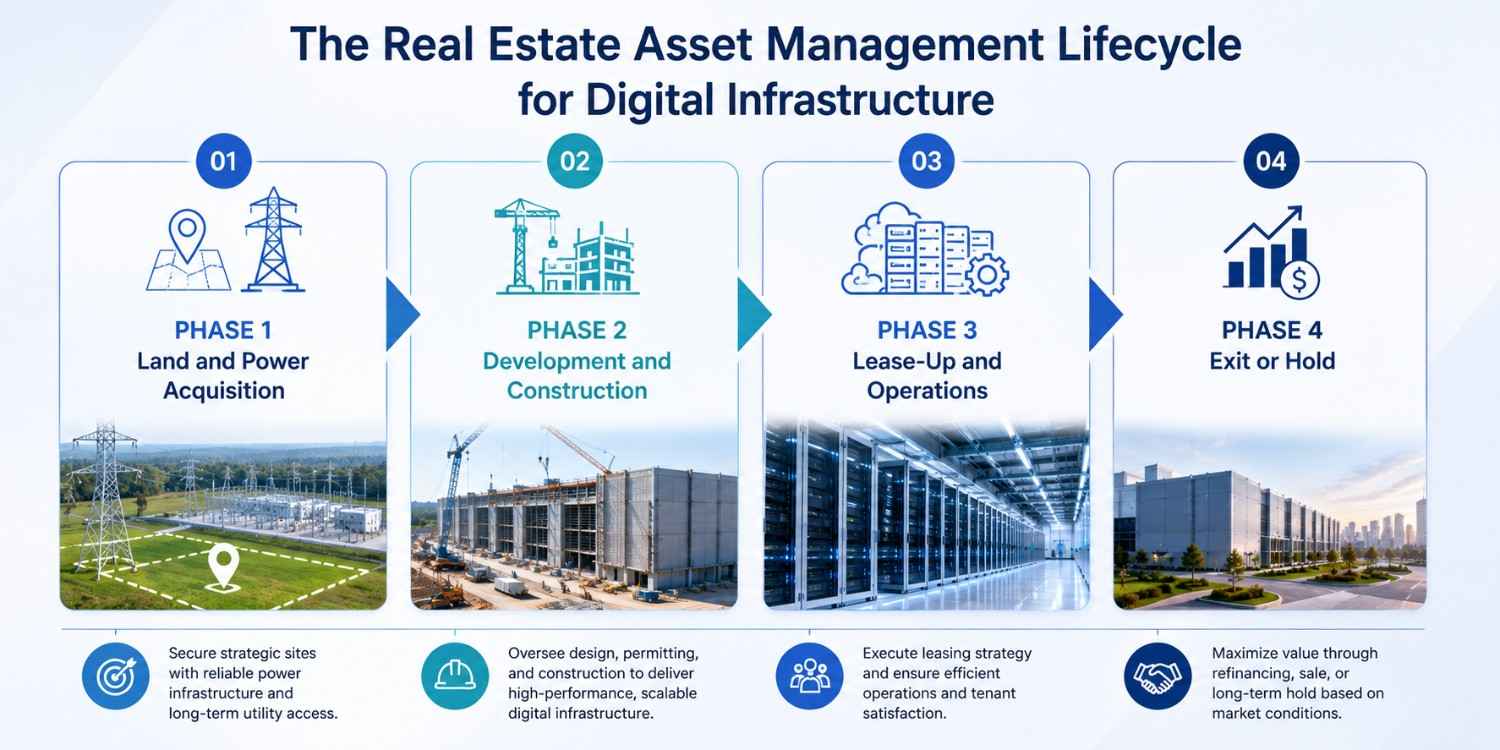
Real estate asset management for data centers follows four distinct phases. Each requires different skills and risk tolerance.
This is where the game is won or lost. Real estate asset managers must identify land near power substations, fiber routes, and water supplies for cooling. They secure utility commitments before closing on the land. They entitle the property for heavy industrial power use, which can take 12 to 24 months.
Northern Virginia alone hosts over 2,800 megawatts of live data center capacity, according to market research. That is more than the next five US markets combined. This concentration happened because land with access to cheap, abundant power and dark fiber was available early.
The risk is highest here. The reward is buying land at agricultural prices and selling it later as digital infrastructure.
Development is capital-intensive and technically complex. A standard build costs $7 to $12 million per megawatt of power capacity. The shell is only part of the expense. Electrical switchgear, uninterruptible power supply systems, chillers, and generators cost more than the concrete and steel.
Real estate asset managers oversee budgets that would make a multifamily developer dizzy. They hire mission-critical contractors who understand uptime requirements. They manage timelines where every month of delay costs hundreds of thousands in carrying costs.
Asset management accounting is critical during this phase. Costs must be tracked by system: power infrastructure, cooling, security, shell, and tenant improvements. This coding affects depreciation schedules, tax treatment, and investor reporting. Many teams use specialized asset accounting services to keep the books clean during construction.
Once built, the focus shifts to finding tenants and optimizing operations. Data center lease-up is slower than apartment leasing. Tenants perform extensive due diligence. They test power quality, review security protocols, and audit cooling redundancy.
When leased, operations focus on uptime. Data centers promise 99.999% availability. That is less than six minutes of downtime per year. Real estate asset managers work with technical operations teams to ensure redundancy. If one power feed fails, another must take over instantly.
Operating expenses are dominated by electricity. A one-cent reduction in per-kilowatt-hour rates can save millions annually. Those handling real estate asset management negotiate utility contracts, explore renewable energy options, and implement efficiency improvements to lower PUE.
Some facilities sign Power Purchase Agreements, or PPAs, with renewable energy providers to lock in long-term power costs. This is becoming standard for real estate asset management services that oversee sustainability goals.
Mature data centers with long-term leases trade at premium valuations. Buyers include institutional investors, data center REITs, and infrastructure funds. They pay for the stable, bond-like cash flows.
Real estate asset managers must decide whether to sell into a hot market or hold for continued income. The decision depends on investor return targets, debt maturity, and market cap rate trends.
Data centers speak a different financial language. Real estate asset managers must track metrics that do not exist in other asset classes.
| Metric | What It Measures | Why It Matters |
|---|---|---|
| Critical Power Load (MW) | Total power capacity available for servers | Determines maximum revenue potential |
| Power Utilization Effectiveness (PUE) | Total facility power divided by IT equipment power | Lower is better; 1.2 is excellent, 1.5 is average |
| Rent per kW | Revenue per kilowatt of leased power | The primary pricing metric for data center space |
| Occupancy by Power | Percentage of total power capacity leased | More accurate than square footage occupancy |
| Weighted Average Lease Term (WAULT) | Average remaining lease duration | Longer terms provide stability and financing strength |
| Tenant Credit Quality | Financial strength of the operator leasing space | Determines default risk and refinancing options |
| Operating Expense Ratio | Costs as a percentage of revenue | Power and cooling dominate; efficiency is key |
| Debt Service Coverage Ratio | Cash flow available to cover debt payments | Lenders require 1.25x or higher for data center loans |
Real estate asset managers who oversee these facilities need specialized reporting. Standard property accounting software often lacks the fields to track power load, PUE, or rent per kilowatt. Teams providing real estate asset management services need customized chart of accounts to report accurately.
Without clean tracking, investors cannot compare a data center asset to the rest of their portfolio. And without comparison, capital allocation decisions become guesses. This is why many firms now rely on dedicated asset management accounting support to handle the complexity.
Data center finance is more complex than traditional real estate. Real estate asset management must navigate several unique challenges.
Revenue recognition is different. A tenant might pay for reserved power they do not yet use. Some contracts include setup fees, cross-connect charges, and variable power pass-throughs. Asset accounting services must track each revenue stream separately.
Expense allocation is tricky. A facility might have one tenant using 80% of the power and another using 20%. Utility bills, maintenance, and security costs must be allocated fairly. Standard expense-sharing formulas from office buildings do not work.
Tax treatment varies by jurisdiction. Some states offer incentives for data center development. Others tax equipment heavily. Real estate asset managers must model the total tax burden, including property tax on expensive mechanical and electrical equipment.
Debt financing requires specialized lenders. Traditional commercial mortgage lenders often avoid data centers because they do not understand the technology risk. Teams providing real estate asset management services must build relationships with lenders who specialize in digital infrastructure.
All of this requires robust asset management accounting. Monthly reports must show power utilization, lease expiration schedules, capital expenditure tracking, and utility cost trends. Without this discipline, investors cannot see whether the asset is performing.
The opportunity is real. But the risks are equally real.
Power constraints are the biggest bottleneck. Many markets simply do not have enough electrical grid capacity to support new data centers. Real estate asset managers might buy land, entitle it, and then wait years for utility upgrades. That delay destroys returns.
Technological obsolescence is another threat. A facility built for today’s server density might be inadequate in ten years. Cooling systems designed for 5 kilowatts per rack may struggle with 50 kilowatt racks. The building does not become worthless, but it requires expensive retrofitting.
Tenant concentration creates vulnerability. A single hyperscale tenant might lease 80% of the building. If they leave at renewal, the asset is suddenly empty. Diversification is harder in data centers because there are fewer potential tenants than in office or industrial markets.
Environmental scrutiny is increasing. Data centers consume enormous amounts of electricity and water. Communities and regulators are questioning their environmental impact. Future restrictions on water use or carbon emissions could increase operating costs or limit expansion.
Cybersecurity is a building-level risk. A physical breach at a data center can compromise thousands of businesses. Security is not just a camera at the front door. It is biometric access, mantraps, 24/7 guards, and constant monitoring. The real estate asset management team must ensure these systems are maintained and upgraded.
Real estate multifamily and industrial investors are not leaving their core assets. They are simply adding data centers to the mix.
The reason is yield and stability. Data center leases are long. Tenants are creditworthy. The buildings are essential infrastructure, not optional space. Even in a recession, companies do not shut down their servers.
The asset class also offers inflation protection. Many leases include annual escalators tied to power costs or consumer price indexes. As inflation rises, revenue rises with it.
For any real estate asset management company, this means new skills are required. The old playbook of location, tenant mix, and rent per square foot is incomplete. The new playbook adds power, connectivity, cooling efficiency, and digital infrastructure expertise.
According to JLL, average data center lease terms have stretched to between 10 and 15 years for hyperscale deals, with some extending beyond 20 years. This is unheard of in traditional commercial real estate, where 5-year leases are standard.
Data centers are no longer a niche corner of commercial real estate. In 2026, they are a core asset class attracting capital from every corner of the market.
The opportunity is driven by forces that are not slowing down. Artificial intelligence needs computing power. Cloud services need physical space. Edge networks need distributed facilities. The demand is structural, not cyclical.
But success requires a different kind of real estate asset management. The metrics are different. The construction is different. The tenants are different. And the risks are different.
Real estate asset managers who learn this language will thrive. Those who treat data centers like warehouses with extra air conditioning will struggle.
The capital is moving. The question is whether your portfolio is moving with it.
Ready to explore data centers in your real estate asset management strategy? Start by studying power markets. Understand your local utility grid. Learn the difference between a megawatt and a square foot. The fundamentals of real estate asset management still apply, but the vocabulary has changed.