New Year HOA Budget Planning: Operating Expenses, Reserves and Assessments
- November 27, 2026
- Amit K. Vatsayan
Preparing a New Year budget is one of the most important financial responsibilities of a homeowners association (HOA) board. From maintaining common areas and paying insurance premiums to funding future roof replacements and major repairs, every financial decision affects the community and its homeowners.
Effective HOA Budget Planning begins with reviewing the previous year’s financial performance, forecasting operating expenses, determining appropriate reserve contributions, and calculating homeowner assessments based on the association’s financial obligations.
However, preparing a budget is not simply about increasing last year’s expenses by a fixed percentage. Boards must account for changing vendor contracts, insurance renewals, outstanding homeowner balances, maintenance requirements, and long-term capital expenditures.
A well-prepared annual budget allows HOA boards to maintain community services, protect shared assets, manage cash flow, and reduce the likelihood of unexpected financial demands on homeowners.
An Annual HOA Budget serves as a financial roadmap for managing the community throughout the year. It establishes how much money the association needs to collect, how those funds will be allocated, and what financial commitments must be fulfilled.
Without realistic budgeting, associations may struggle to pay vendors, maintain amenities, or fund essential capital improvements.
Effective budgeting helps HOA boards:
HOA Financial Planning should balance homeowners’ affordability concerns with the association’s responsibility to maintain the community. Keeping assessments artificially low may appear beneficial initially, but it can create larger financial obligations in subsequent years.
Before estimating future expenses, the board should understand where the association’s money was spent during the previous year.
Review the previous year’s budget alongside actual financial results to identify significant differences.
For example, if landscaping was budgeted at $40,000 but actual expenses reached $46,000, determine whether the difference resulted from contract increases, additional services, or unexpected maintenance.
If the increase is recurring, it should be reflected in the new budget.
When year-end accounts are not yet closed, combine year-to-date actuals with reasonable estimates for the remaining months.
Separate recurring operating costs from one-time expenditures, such as storm damage cleanup, emergency plumbing repairs, or unusual legal expenses.
This prevents temporary expenses from unnecessarily increasing future budgets while helping boards identify areas requiring contingency funding.
Homeowner delinquencies directly affect operating cash flow. Review accounts receivable aging reports to determine outstanding balances, collection trends, and payment arrangements.
An association may generate sufficient assessment income on paper but still experience cash shortages if homeowners delay payments.
Reconcile operating and reserve bank accounts with the general ledger. Review unpaid invoices, outstanding checks, prepaid expenses, and planned reserve expenditures.
These steps help establish a reliable financial starting point for the new year.
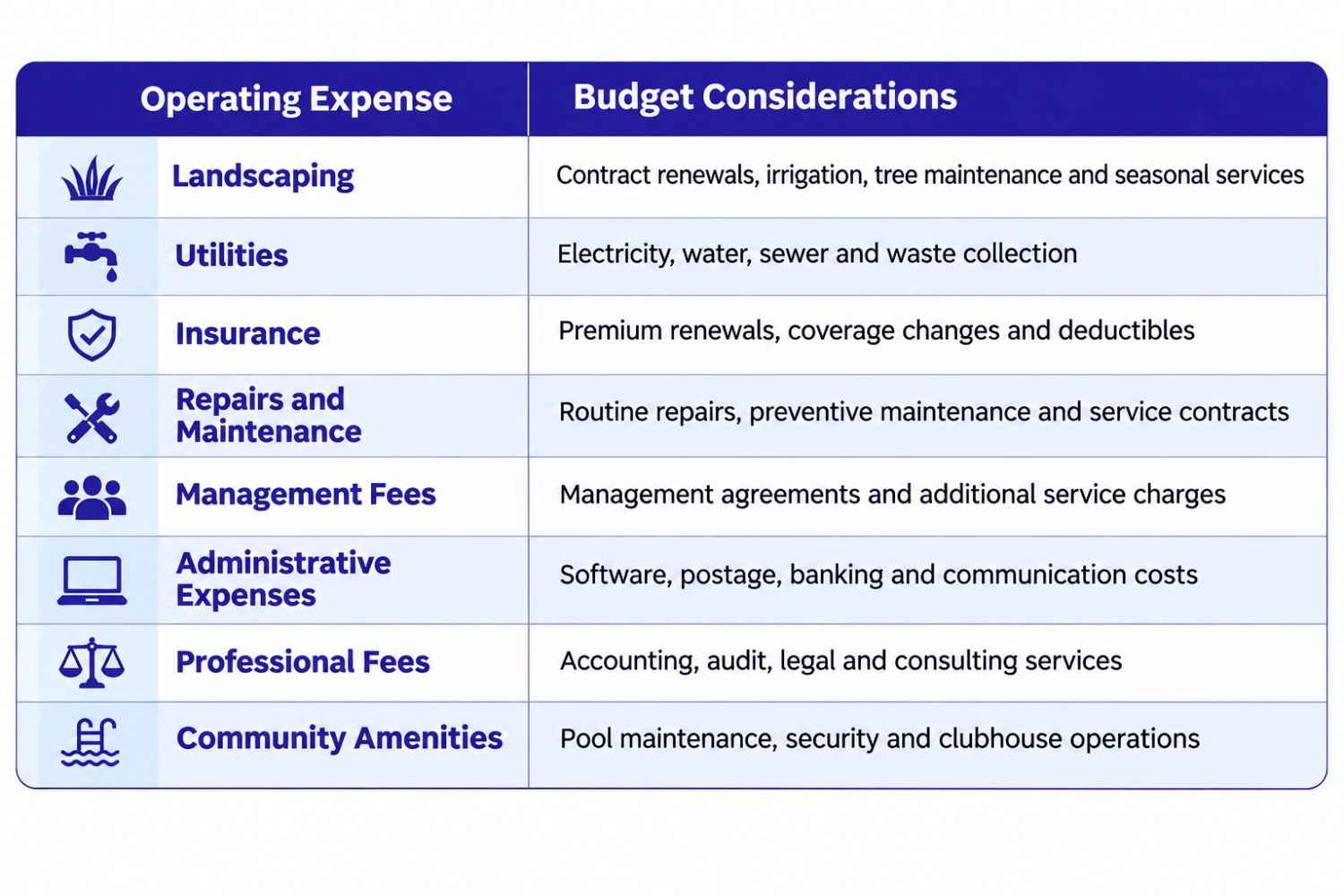
Review vendor agreements individually rather than applying a uniform inflation adjustment across all HOA Operating Expenses.
Obtain updated quotations, verify renewal dates, and identify contractual price increases. Utility forecasts should consider historical consumption patterns and announced rate changes.
Insurance premiums can materially affect association budgets. Request renewal estimates from the insurance broker before finalizing the budget and review potential changes in deductibles, coverage limitations, and payment schedules.
Where renewal costs remain uncertain, prepare a reasonable contingency rather than assuming premiums will remain unchanged.
Even well-maintained communities experience unforeseen repairs and service requirements.
A contingency allowance based on the association’s historical expenses, property condition, and financial risk can help manage unexpected operating costs without immediately disrupting other budgeted services.
One of the most important aspects of HOA budgeting is preparing for expenses that may not occur every year but require substantial funding when they arise.
An HOA Reserve Fund helps associations accumulate money for major repairs and replacements of common assets, such as:
Without adequate reserves, associations may need to impose special assessments or obtain financing to meet these obligations.
A reserve study evaluates the condition, estimated remaining useful life, and anticipated replacement costs of common assets. It also provides a funding plan based on the association’s long-term maintenance obligations.
The Community Associations Institute (CAI) recommends incorporating preventive maintenance and structural inspections into reserve planning.
Foundation for Community Association Research+1
Consider the following illustrative replacement schedule:
| Capital replacement | Estimated future cost | Remaining useful life |
| Roof replacement | $180,000 | 10 years |
| Road resurfacing | $90,000 | 6 years |
| Swimming pool renovation | $40,000 | 5 years |
| Exterior painting | $60,000 | 4 years |
| Irrigation replacement | $20,000 | 5 years |
| Total | $390,000 |
The association should use its reserve study, existing reserve balances, projected expenditure dates, and future funding needs to determine appropriate annual HOA Reserve Contributions.
Boards should avoid treating reserve funding as whatever remains after operating expenses have been budgeted.
For condominium associations, mortgage eligibility requirements may also affect financial planning. Beginning January 4, 2027, Fannie Mae’s minimum reserve allocation requirement for applicable condominium projects increases from 10% to 15% of annual budgeted assessment income, subject to applicable alternatives and eligibility criteria. This is a mortgage eligibility standard, not a universal statutory reserve requirement for all HOAs.
Fannie Mae+1
Once operating expenses and reserve contributions have been estimated, the board can determine the assessment revenue required to fund the community.
The basic formula for HOA Assessment Calculations is:
Annual assessment revenue required = Operating expenses + Reserve contributions + Other funding requirements − Reliable other income
Consider an association with 200 homes, where assessments are allocated equally among homeowners.
| Annual budget category | Amount |
| Landscaping and grounds maintenance | $60,000 |
| Utilities | $36,000 |
| Insurance premiums | $48,000 |
| Repairs and maintenance | $42,000 |
| Management and administrative fees | $30,000 |
| Legal and professional fees | $12,000 |
| Operating contingency | $12,000 |
| Total operating budget | $240,000 |
| Annual reserve contributions | $72,000 |
| Total funding requirement | $312,000 |
| Less: Other reliable income | ($12,000) |
| Required assessment revenue | $300,000 |
The resulting homeowner assessments would be:
Annual assessment per home
$1,500
$300,000 ÷ 200 homes
Monthly assessment per home
$125
$1,500 ÷ 12 months
Annual budget allocation
Operating expenses — 76.9%
$240,000
Reserve contributions — 23.1%
$72,000
The example assumes equal assessment allocations and full collection of billed assessments. Boards should separately evaluate anticipated collection shortfalls and working capital requirements.
Actual assessments must be allocated according to the association’s governing documents and applicable state laws. Some communities allocate expenses based on ownership percentages, unit size, or other established formulas.
Approving the annual budget is only the beginning. Boards should review financial performance throughout the year to identify emerging problems before they become significant.
Monthly financial reporting should include a balance sheet, income and expense statement, budget variance report, receivables aging, bank reconciliations, and reserve fund activity.
Consider an association’s first-quarter financial performance:
| Expense category | Budget | Actual | Variance |
| Landscaping | $15,000 | $16,500 | $1,500 unfavorable |
| Utilities | $9,000 | $10,200 | $1,200 unfavorable |
| Insurance | $12,000 | $12,000 | $0 |
| Maintenance | $10,500 | $8,800 | $1,700 favorable |
| Management and administration | $7,500 | $7,500 | $0 |
| Total | $54,000 | $55,000 | $1,000 unfavorable |
Although total expenses exceed the budget by only $1,000, individual categories reveal issues requiring attention.
Higher utility expenses may indicate increased consumption or rate changes. Lower maintenance costs could reflect postponed work rather than genuine savings.
Boards should distinguish between temporary timing differences and permanent cost increases, update year-end forecasts, and make corrective decisions where necessary.
Any formal budget amendments or assessment changes should follow applicable approval and notification procedures.
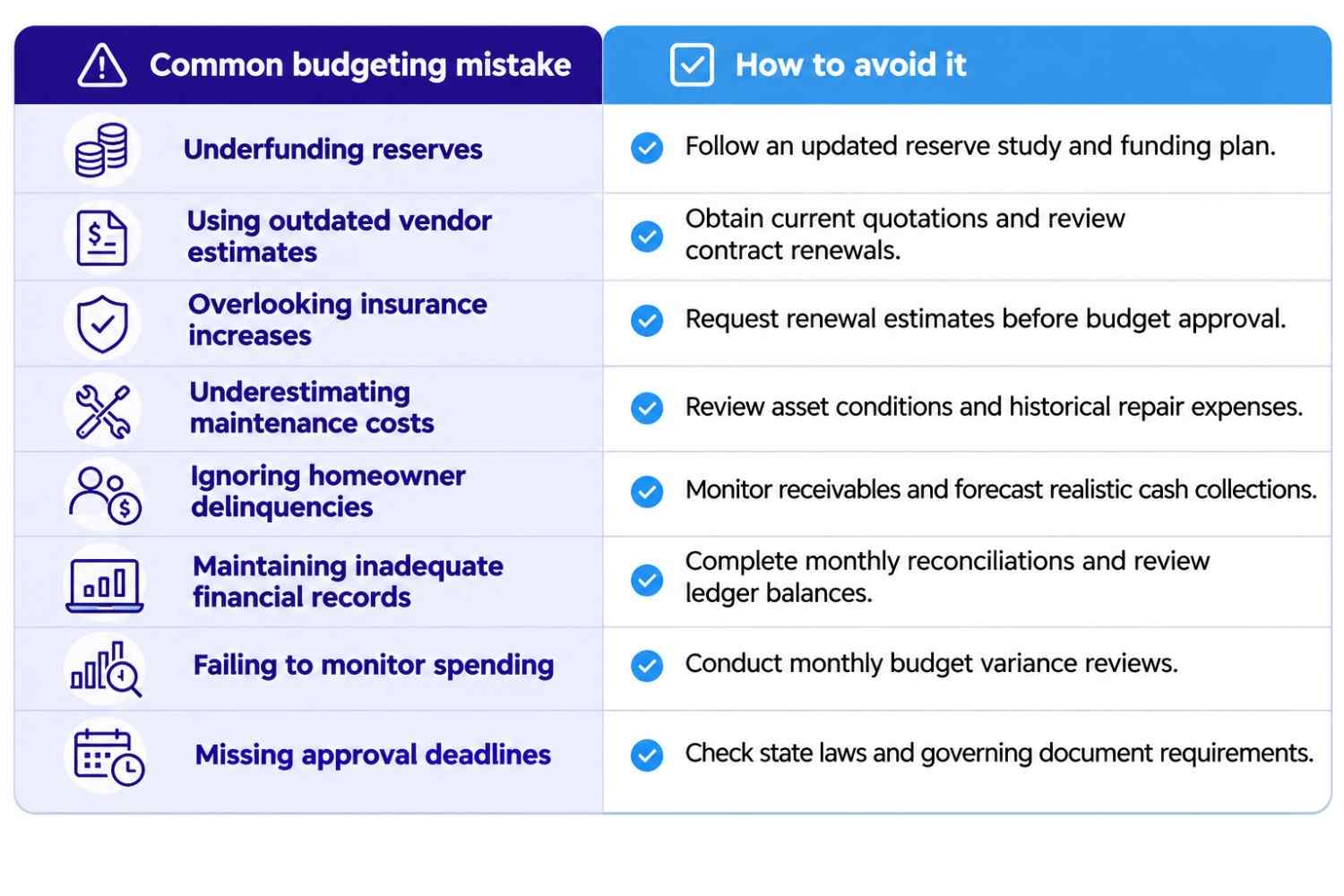
The accuracy of an annual budget depends heavily on the quality of the association’s financial records.
Missing invoices, unreconciled accounts, incorrectly classified expenses, and outdated homeowner balances can distort financial projections and lead to inaccurate assessment calculations.
Experienced HOA accounting firms help community association managers and boards establish reliable financial information before making budgeting decisions.
A specialized HOA accounting service can support associations through:
For community association managers overseeing multiple communities, Property Management Back-Office Services can also support vendor invoice processing, expense tracking, vendor reconciliations, documentation, and administrative workflows.
At OHI, our HOA accounting support focuses on maintaining accurate financial records and providing consistent reporting, so boards and community managers have dependable information when preparing budgets, reviewing expenses, and making financial decisions.
Successful New Year HOA Budget Planning requires more than estimating annual expenses and determining homeowner assessments. It requires an accurate understanding of historical spending, future maintenance obligations, reserve funding needs, and available cash resources.
By reviewing financial records, updating expense forecasts, maintaining appropriate reserves, and monitoring budget performance throughout the year, HOA boards can strengthen financial stability and reduce unexpected financial burdens on homeowners.
A well-managed budget is not simply about keeping assessments low. It is about ensuring that the community has sufficient financial resources to meet its responsibilities today while preparing for tomorrow.