How to Clear Bank Reconciliation Backlogs Without Compromising Financial Controls
- November 19, 2026
- Sanjay Kumar
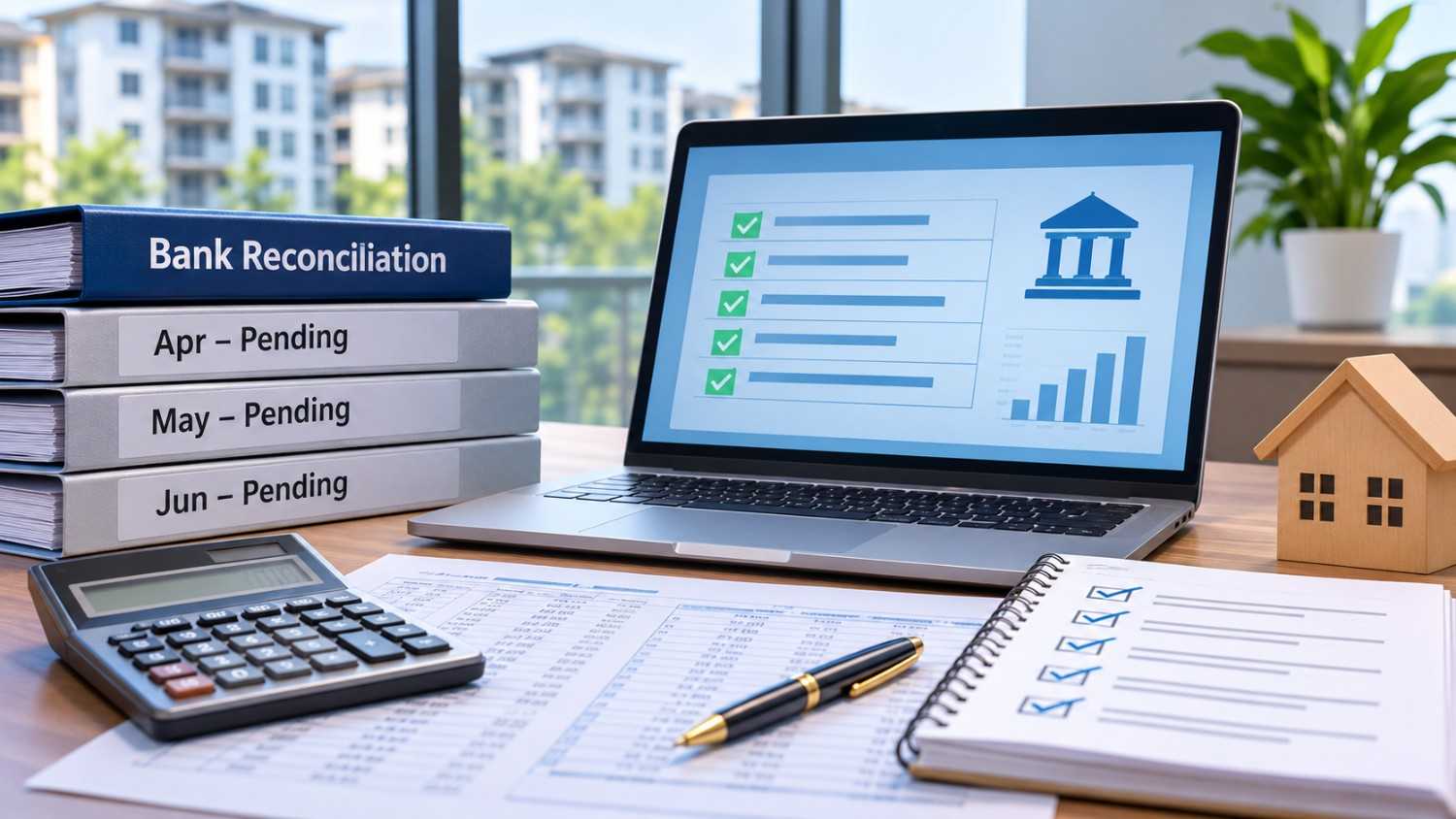
A property management company manages 25 residential properties and discovers that six months of bank reconciliations remain incomplete. Rent collections continue, vendors are being paid, and monthly financial reports are still being prepared. However, the accounting team cannot confidently explain the differences between bank balances and the cash balances recorded in the general ledger.
Some deposits have not been matched to tenant accounts. Several outstanding checks remain unresolved, and transfers between properties need verification.
For the Controller, the challenge is not simply catching up on six months of accounting work. It is restoring confidence in cash balances without disrupting current operations.
Bank reconciliation backlogs require a structured cleanup process that identifies discrepancies, verifies transactions, documents corrections, and preserves financial controls.
Rushing through historical reconciliations may make the backlog appear smaller, but it can leave errors that affect owner distributions, financial reporting, and future accounting periods.
The objective should be straightforward: bring every bank account up to date while maintaining a reliable, reviewable record of how each discrepancy was resolved.
Property management accounting involves numerous transactions across properties, bank accounts, tenants, vendors, and ownership entities.
Even an experienced accounting team can fall behind when transaction volumes increase faster than its reconciliation capacity.
A multifamily operator may process hundreds of rent payments, utility charges, maintenance invoices, and vendor disbursements each month.
When these transactions are spread across operating, reserve, and security deposit accounts, matching bank activity to property-level records becomes increasingly demanding.
Reconciliations are often postponed when accounting teams prioritize rent posting, vendor payments, and monthly reporting.
A single delayed reconciliation can become several months of unresolved activity when no firm completion deadline exists.
Unidentified ACH credits, missing deposit reports, incomplete vendor payment records, and unavailable bank statements can prevent accountants from closing reconciliation differences.
When a property accountant leaves, unresolved items may remain undocumented. The replacement accountant must reconstruct the transaction history while managing ongoing responsibilities.
Duplicate vendor payments, incorrect property coding, omitted bank charges, and entries posted to the wrong cash account can create differences requiring individual investigation.
Without standardized checklists, account ownership, and approval requirements, different accountants may use different methods to handle similar exceptions.
The common problem is not always a lack of accounting activity. It is the absence of a consistent process for verifying that activity against actual bank transactions.
Bank reconciliation compares transactions recorded in the accounting system with activity reported by the financial institution.
A completed reconciliation explains the difference between the bank statement balance and the general ledger cash balance through valid timing items and identified corrections.
When reconciliations remain incomplete, several financial risks emerge.
There is also an internal control concern.
An accountant who clears unexplained differences through unsupported journal entries may make the reconciliation balance mathematically without establishing that the books are accurate.
A reconciliation is not complete simply because the difference is zero. Every material reconciling item must have a valid explanation and appropriate supporting evidence.
A successful bank reconciliation cleanup follows a controlled sequence, starting with verified opening balances and ending with independently reviewed reconciliations.
Prepare a complete list of bank accounts, associated properties, ownership entities, and unreconciled months.
Include operating, reserve, security deposit, and other restricted cash accounts.
Record the last completed reconciliation, assigned accountant, pending periods, and known discrepancies.
This creates a clear picture of the cleanup scope before transaction-level work begins.
Retrieve the most recent approved reconciliation for each account.
Confirm that its reconciled balance agrees with the accounting records and that outstanding deposits and checks were properly carried forward.
For example, if March is the last verified month, begin with April rather than attempting to reconcile September first.
Historical reconciliation work should proceed chronologically because unresolved items often carry into subsequent periods.
If the opening balance is unreliable, investigate it before proceeding.
Obtain complete bank statements, general ledger activity, cash receipt reports, payment registers, and relevant supporting documents.
Compare statement coverage against the pending reconciliation periods to identify missing records.
For a multifamily property, supporting information may include tenant payment batches, lockbox reports, payment processor settlements, and vendor remittance details.
Not every account requires the same level of attention.
Prioritize accounts with substantial unexplained differences, significant transaction volumes, approaching reporting deadlines, or sensitive funds.
Security deposit and restricted cash accounts deserve particular attention because applicable state requirements, account agreements, and ownership restrictions may affect how funds must be maintained and reported.
Prioritization determines where resources are assigned first. It should not replace chronological reconciliation within each account.
Compare bank activity with recorded receipts and disbursements using transaction dates, amounts, references, and descriptions.
Suppose a property receives a $12,500 ACH deposit representing several tenant payments.
If the deposit appears on the bank statement but not in the cash receipts report, the accountant should examine payment processor records and individual tenant ledgers before recording an adjustment.
Similarly, two $3,200 payments to the same contractor require confirmation against invoices, approvals, and bank clearing records before one is classified as a duplicate.
Generate an outstanding check listing and classify items by age.
Determine whether checks were subsequently cashed, voided, replaced, returned, or remain genuinely outstanding.
For unidentified deposits, examine remittance information, deposit images, tenant records, and bank references.
Do not automatically recognize an unidentified deposit as rental income. It could represent a security deposit, owner contribution, insurance proceeds, or transfer.
Follow applicable unclaimed property requirements before removing long-outstanding checks from the records.
Compare the cash account in each property’s general ledger against its bank reconciliation.
Investigate transactions recorded against the wrong property, incorrect bank account, or accounting period.
Where applicable, reconcile tenant subledgers, cash receipt clearing accounts, security deposit liabilities, and intercompany balances.
A reconciliation discrepancy may originate outside the cash account itself, particularly when receipts or transfers have been incorrectly classified.
Every correcting journal entry should have a clear explanation, supporting documentation, transaction reference, and appropriate authorization.
For example, an omitted $85 bank service charge may require a properly dated expense entry.
A $15,000 unexplained difference should not be transferred to miscellaneous income or expense merely to complete the reconciliation.
Adjustments affecting previously closed periods, owner reporting, or restricted cash should receive Controller-level review and, where necessary, consultation with the company’s accounting or audit advisers.
Complete the oldest pending month first, then roll verified outstanding items into the following period.
Each reconciliation package should contain the bank statement, general ledger balance, supporting schedules, adjustment references, and unresolved-item listing.
An independent reviewer should confirm that reconciling items are genuine, calculations are accurate, and significant exceptions have been addressed.
Preserve the original records and an audit trail of approved corrections.
Once the backlog has been cleared, assign every bank account to a preparer and reviewer.
Introduce monthly deadlines, standardized reconciliation templates, and escalation procedures for unresolved exceptions.
Importantly, current-month reconciliations should continue during historical cleanup.
Otherwise, the organization may resolve an old backlog while creating a new one.
A property management company handling multiple properties needs a clear relationship between every bank account and the accounting entity it supports.
Consider a residential management company operating 12 properties, each with a separate operating account. Some also maintain reserve or security deposit accounts.
The accounting team should first create a bank account mapping register containing:
Transactions should then be reconciled to the correct property ledger.
For example, if Property A transfers $20,000 to Property B, the accountants must verify the authorization, bank withdrawals and deposits, and the corresponding due-to/due-from or other appropriate accounting entries.
A transfer recorded on only one side can distort cash reporting and intercompany balances.
Security deposit accounts require separate attention. Cash balances should be compared with relevant tenant deposit obligations, with consideration of applicable state laws and account restrictions.
A centralized reconciliation tracker allows the Controller to monitor completion across the entire portfolio without combining unrelated property balances.
This approach is particularly useful for companies managing multifamily, single-family, and other residential portfolios.
Specialized residential real estate accounting services can also support property-level reconciliations, tenant accounting, and historical cleanup activities.
For condominium and homeowner associations, separate operating and reserve fund requirements should be incorporated into the reconciliation procedures. These needs may be supported through HOA accounting services.
Bank reconciliation backlogs should be resolved through a disciplined accounting process, not a series of balancing adjustments.
Starting with verified opening balances, investigating transactions individually, reviewing property-level records, and documenting approved corrections helps restore reliable cash information.
Maintaining current-month reconciliations during cleanup is equally important.
For property management companies, the objective is not simply to eliminate overdue work. It is to establish accurate cash balances, dependable financial reporting, and stronger monthly accounting controls.
Start with the last completed and approved reconciliation for each bank account. Gather bank statements, general ledger reports, and supporting records. Reconcile the oldest pending month first, verify opening balances, investigate discrepancies, and maintain an exception log to track unresolved transactions throughout the cleanup process.
Assign dedicated accountants to historical reconciliation cleanup while your regular team handles current transactions and monthly closing. Set clear deadlines, maintain a centralized progress tracker, and schedule Controller reviews. This approach helps clear outstanding reconciliations without delaying rent collections, vendor payments, or financial reporting.
Identify pending bank accounts, collect statements, and verify the last completed reconciliation. Match transactions, investigate missing deposits and outstanding checks, and review general ledger balances. Document necessary adjustments, obtain approvals, and reconcile each month sequentially. Establish ongoing monthly controls to prevent future backlogs.
Prioritize unreconciled transactions based on financial risk, value, age, and potential reporting impact. Investigate unexplained withdrawals, missing rent deposits, duplicate vendor payments, and unmatched transfers first. Review aged outstanding checks, maintain an exception tracker, and escalate significant discrepancies for Controller review before making corrections.
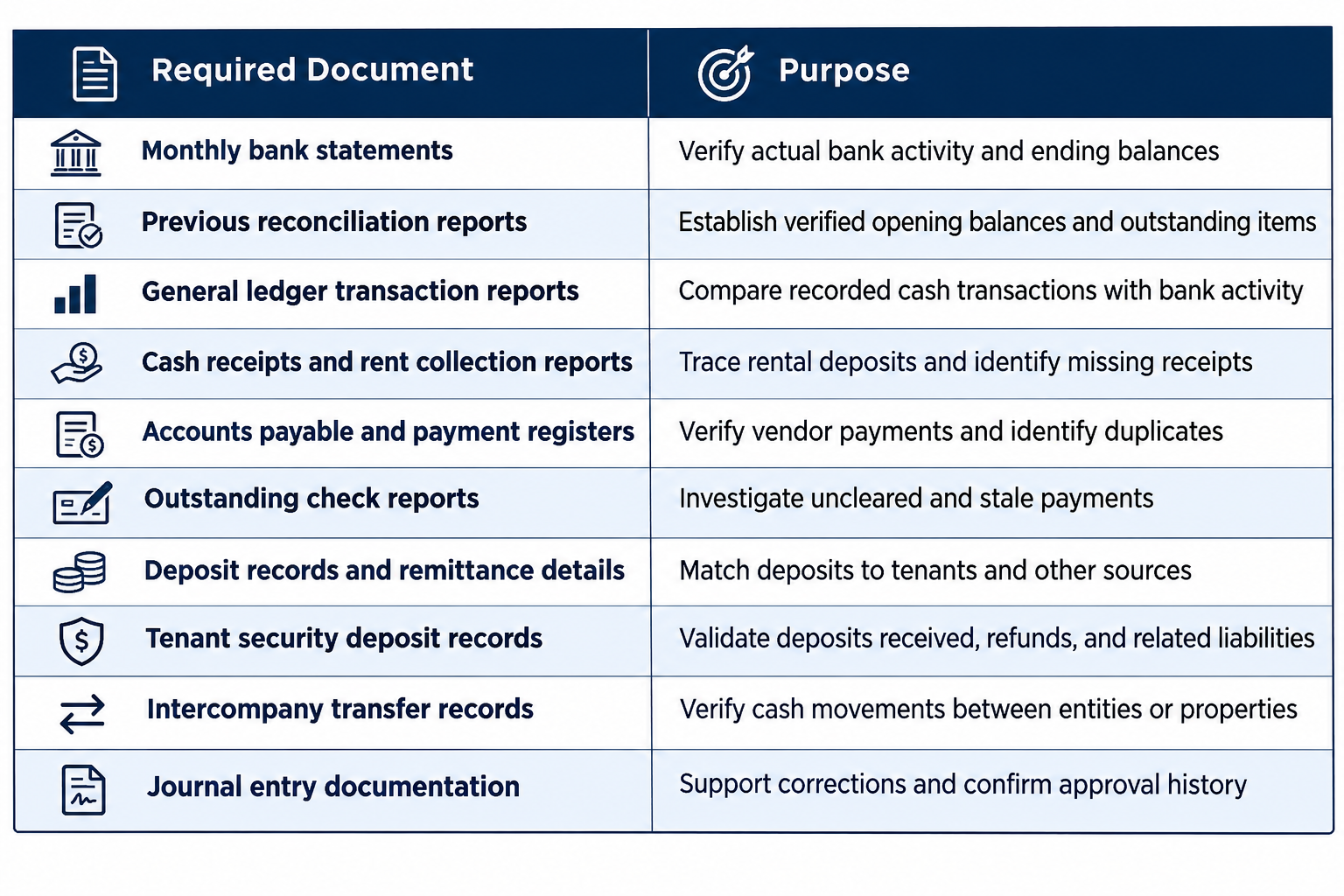
Essential documents include monthly bank statements, previous reconciliation reports, general ledger records, rent collection reports, accounts payable registers, outstanding check schedules, and deposit records. Property accountants should also review security deposit ledgers, intercompany transfers, payment confirmations, and approved journal entries to verify historical transactions accurately.
Compare bank deposits against tenant ledgers, rent collection reports, and payment processor records to identify missing receipts. For duplicate vendor payments, match bank withdrawals with invoice numbers, payment registers, and approval records. Investigate discrepancies and verify supporting documentation before correcting entries or initiating payment recovery.