Real Estate Asset Management: A Complete Guide for Property Owners and Investors
- July 1, 2026
- Amit K. Vatsayan
Real estate asset management is the strategic process of maximizing the value and returns of investment properties throughout their entire lifecycle. Unlike property management, which handles day-to-day operations, asset management focuses on the financial performance, risk mitigation, and long-term growth of real estate portfolios.
Whether you own a single rental property or manage a multi-million-dollar commercial portfolio, understanding how real estate asset management works can be the difference between average returns and exceptional ones.
In this blog, we cover everything you need to know, what asset managers do, how they differ from property managers, the key strategies they use, the metrics that matter most, and when it makes sense to bring in professional real estate asset management services.
Real estate asset management is the ongoing process of analyzing, monitoring, and optimizing real estate investments to maximize returns while minimizing risk. It involves making strategic decisions about acquisitions, operations, capital improvements, financing, and dispositions.
“Asset management is not about managing buildings. It is about managing money that happens to be in buildings.”
The goal is simple: increase the value of the asset and the income it generates over time.
| Function | Description |
|---|---|
| Financial Oversight | Tracking income, expenses, and cash flow to ensure profitability |
| Risk Management | Identifying and mitigating market, financial, and operational risks |
| Strategic Planning | Setting long-term goals and deciding when to buy, hold, or sell |
| Value Enhancement | Implementing improvements that increase property value |
| Performance Reporting | Delivering regular updates to investors and stakeholders |
Real estate asset management services are critical for investors who want to grow their portfolios without getting buried in spreadsheets, market reports, and operational details.
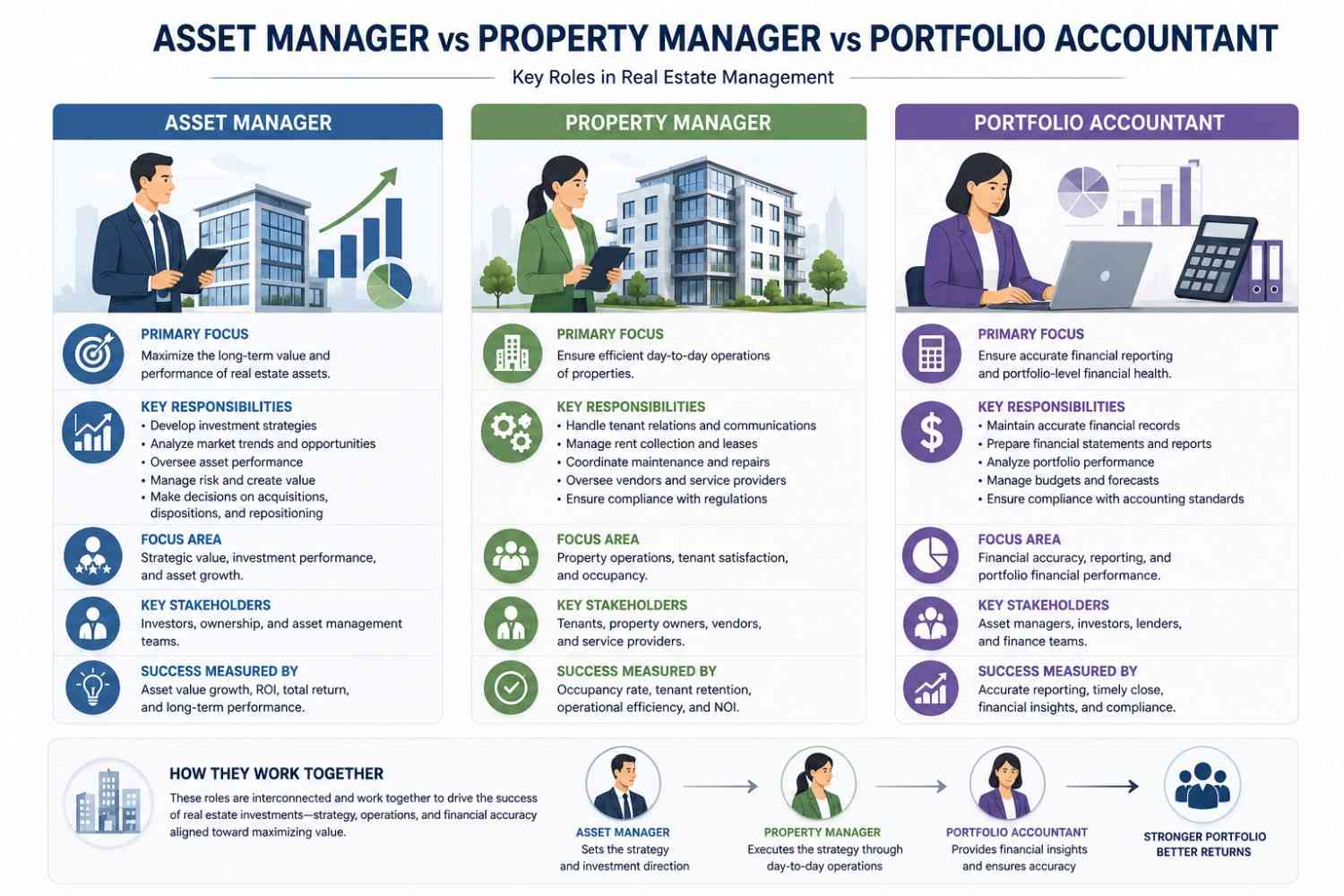
One of the most common questions people ask is: What is the difference between an asset management, property management, and portfolio accounting?
Here is a clear breakdown:
| Factor | Asset Manager | Property Manager | Portfolio Accountant |
|---|---|---|---|
| Primary Focus | Maximize investment returns and long-term value | Day-to-day operations of the property | Financial reporting, reconciliation, and compliance |
| Time Horizon | Strategic, long-term (3-10+ years) | Tactical, short-term (daily/weekly) | Ongoing (monthly/quarterly) |
| Key Responsibilities | Portfolio strategy, financial performance, capital planning, risk management | Leasing, rent collection, maintenance, tenant relations | Bookkeeping, financial statements, tax prep, investor reporting |
| Metrics Tracked | Cash flow, IRR, cap rate, ROI, value growth | Occupancy, rent payments, maintenance costs, tenant satisfaction | NOI accuracy, reconciliation timeliness, compliance rates |
| Typical Stakeholders | Investors, lenders, asset owners | Tenants, vendors, on-site staff | Investors, auditors, tax authorities |
| Goal | Increase returns while managing risk | Keep the property running smoothly | Ensure financial accuracy and compliance |
Asset managers think like investors. They ask: Is this property performing? Should we refinance? Is it time to sell?
Property managers think like operators. They ask: Is the roof leaking? Did the tenant pay rent? When is the lease up for renewal?
Portfolio accountants think like controllers. They ask: Are the books balanced? Did we reconcile last month? Are the investor reports ready?
All three roles are essential. But for investors with multiple properties, the gap between asset management and accounting is where money gets lost. That is why asset management accounting — the integration of strategic oversight with precise financial tracking — is becoming the standard for serious real estate investors.
A real estate asset manager acts as the financial steward of your investment. Their day-to-day work spans analysis, strategy, and execution.
“The best asset managers do not just react to problems. They anticipate them.”
Real estate asset managers also serve as the bridge between investors and the operational teams running the properties. They translate financial goals into action plans — and translate operational realities back into financial decisions.

Every real estate investment moves through five distinct phases. Understanding this lifecycle helps investors and asset managers make better decisions at each stage.
Before buying a property, asset managers conduct thorough analysis:
Once acquired, the focus shifts to stabilizing and optimizing:
Asset managers look for ways to increase value:
Ongoing financial oversight ensures the asset stays on track:
Eventually, every asset is sold or transferred:
“The best time to plan your exit is the day you buy.”
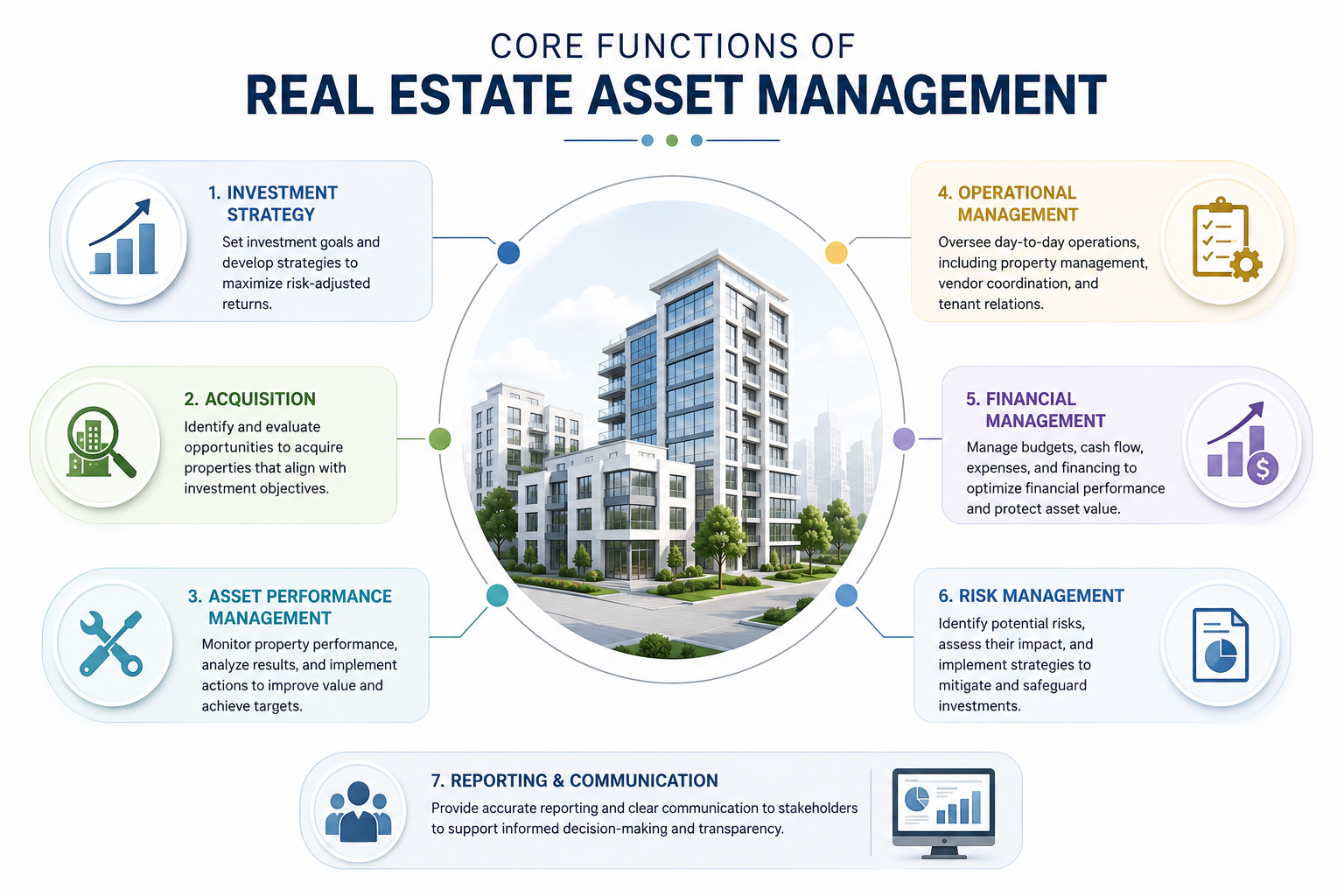
Real estate asset managers wear many hats. Here are the core responsibilities of asset managers:
Asset managers review financial and operational data to identify trends, spot underperforming assets, and inform strategic decisions. This includes:
Asset managers advise on acquisitions, dispositions, and capital allocation to align the portfolio with long-term investor goals. This includes:
Asset managers oversee property managers, vendors, and service providers to ensure operational efficiency without micromanaging daily tasks. This includes:
Asset managers monitor local market conditions, regulatory changes, and tenant trends to anticipate challenges and seize opportunities. This includes:
Asset managers recommend or implement improvements that increase property value and investor returns. This includes:
Not every portfolio needs the same approach. Here is how real estate asset management strategies should evolve as you grow:
| Portfolio Size | Recommended Strategy | Management Approach | Key Focus Areas |
|---|---|---|---|
| 1-5 Properties | Self-manage with advisory | Light-touch asset management | Cash flow tracking, basic reporting, tax compliance |
| 5-25 Properties | Hybrid model | Outsourced asset management + in-house property management | Portfolio optimization, expense benchmarking, refinancing |
| 25-100 Properties | Fully outsourced | Dedicated asset management team + integrated accounting | Strategic planning, investor reporting, value enhancement |
| 100+ Properties | Institutional | In-house asset management + fund administration | Capital markets, institutional reporting, ESG compliance |
With 1-5 properties, you can probably handle asset management yourself — with some help from a bookkeeper and a good CPA.
With 5-25 properties, the complexity multiplies. You are juggling multiple loans, leases, vendors, and reporting requirements. This is where real estate asset management services start delivering real value.
With 25+ properties, you need a dedicated team. The financial reporting alone becomes a full-time job. And if you have outside investors, the reporting and compliance requirements become critical.
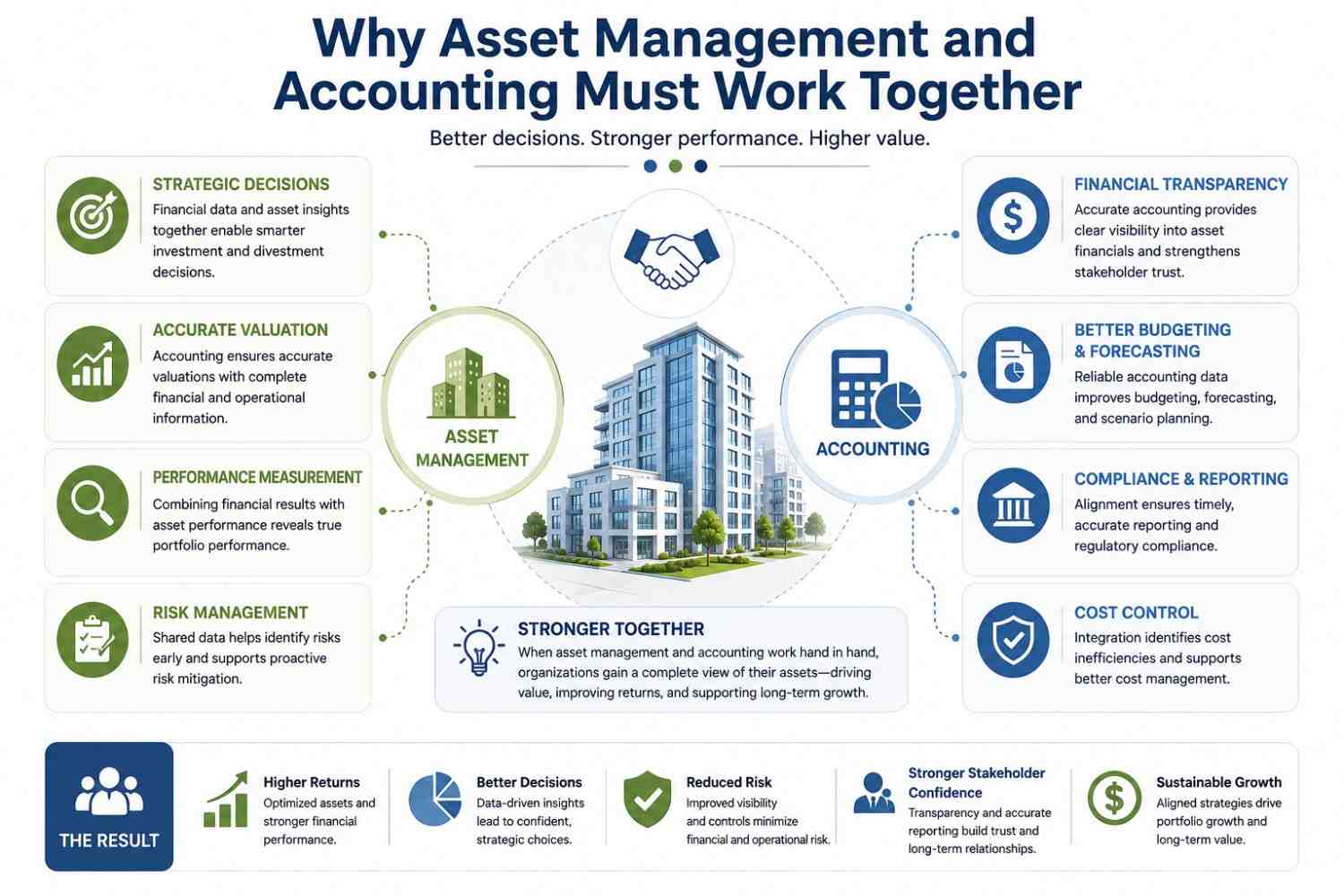
Here is something most guides miss: asset management without accurate accounting is like driving with a broken speedometer.
You might think you are going 60, but you could be going 30 — or 90.
When asset management and accounting operate separately, bad things happen:
| Problem | Impact |
|---|---|
| Delayed financial reporting | Decisions made on stale data |
| Inaccurate NOI calculations | Mispriced assets and poor exit timing |
| Unreconciled accounts | Missed expenses and overstated returns |
| Manual data entry | Errors, delays, and compliance risks |
| Separate investor reports | Conflicting numbers and lost credibility |
When asset management and accounting are integrated, you get:
“The best asset managers do not just track performance. They track it accurately, in real time, with full transparency.”
This is why asset management accounting is not a nice-to-have. It is a competitive advantage.
For real estate funds, family offices, and institutional investors, integrated asset management and accounting is the foundation of everything else.
Key Performance Indicators (KPIs) are the scorecard for real estate asset management. Here are the metrics that matter most:
| KPI | What It Measures | How to Calculate | Target Benchmark |
|---|---|---|---|
| Net Operating Income (NOI) | Property profitability | Gross income minus operating expenses | Positive and growing year-over-year |
| Capitalization Rate (Cap Rate) | Return on investment | NOI divided by property value | Market-competitive (varies by market) |
| Cash-on-Cash Return | Annual cash flow vs equity invested | Annual cash flow divided by total equity invested | 8-12% typical |
| Internal Rate of Return (IRR) | Overall investment performance | Discount rate that makes NPV equal zero | Varies by strategy and risk profile |
| Equity Multiple | Total return on invested capital | Total cash distributions divided by total equity invested | 1.5x-2.5x typical for value-add |
| KPI | What It Measures | Target Benchmark |
|---|---|---|
| Occupancy Rate | Tenant demand and revenue stability | 90%+ |
| Tenant Retention Rate | Stability and tenant satisfaction | 75%+ renewal rate |
| Average Days to Lease | Leasing efficiency | Under 30 days |
| Work Order Response Time | Maintenance efficiency | Under 48 hours |
| Tenant Satisfaction Score | Overall tenant experience | 4.0+ out of 5.0 |
| KPI | What It Measures | Target Benchmark |
|---|---|---|
| Debt Service Coverage Ratio (DSCR) | Ability to cover debt payments | 1.25x minimum |
| Loan-to-Value Ratio (LTV) | Leverage and risk exposure | Under 75% |
| Insurance Coverage Adequacy | Risk mitigation | Full replacement cost |
| Environmental Compliance | Regulatory risk | Zero violations |
| KPI | What It Measures | Target Benchmark |
|---|---|---|
| Portfolio Occupancy | Overall revenue stability | 90%+ |
| Weighted Average Lease Term (WALT) | Revenue predictability | 3+ years |
| Geographic Diversification | Concentration risk | No single market over 30% |
| Property Type Diversification | Sector risk | Balanced across asset classes |
“What gets measured gets managed. What gets managed gets improved.”
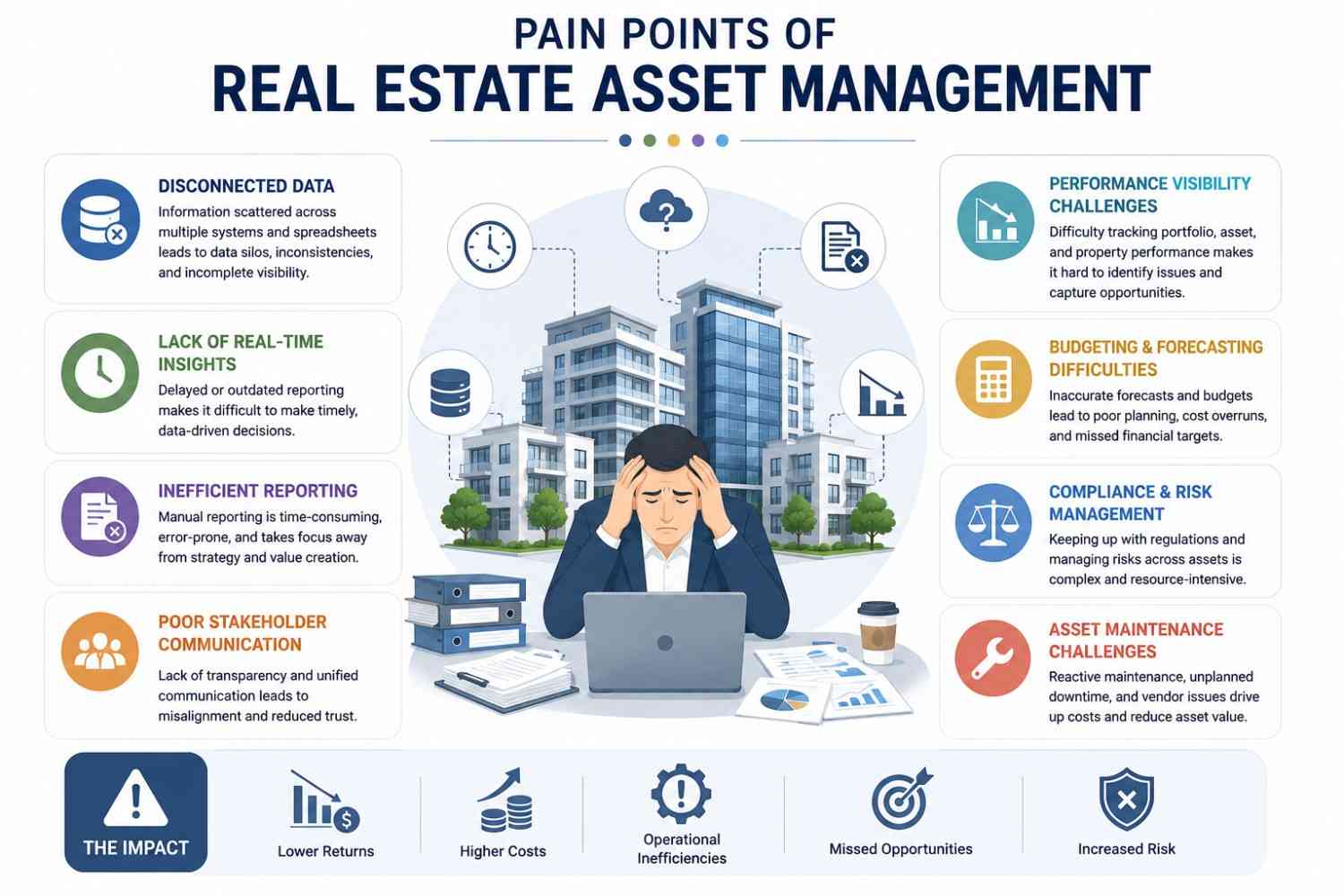
Not every investor needs outsourced asset management. But here are five signs that it is time to bring in professional real estate asset management services:
At this size, the complexity of tracking performance, managing relationships, and making strategic decisions becomes a full-time job. A professional asset manager brings systems, expertise, and bandwidth you do not have.
If your books are consistently behind, your NOI is unclear, or your investor reports are unreliable, you are flying blind. An asset management company with integrated accounting can fix this.
When net operating income starts dropping and you cannot pinpoint why, you need an objective, analytical eye. Asset managers diagnose problems and prescribe solutions.
Your time is valuable. If portfolio management is taking you away from sourcing deals, building relationships, or growing your business, outsource it.
As you bring in partners, lenders, or institutional capital, the reporting bar rises. Professional asset managers deliver institutional-quality reports that satisfy even the most demanding stakeholders.
| Factor | Self-Managed | Outsourced |
|---|---|---|
| Time commitment | 10-20+ hours/week | 1-2 hours/week |
| Expertise level | Limited to your experience | Team of specialists |
| Reporting quality | Variable | Institutional-grade |
| Scalability | Limited | Unlimited |
| Cost | Your time + software | 1-3% of AUM typical |
For most investors with 10+ properties, the cost of outsourcing is easily offset by improved performance, reduced risk, and freed-up time.
Selecting the right real estate asset management company is a critical decision. Here is a checklist to guide your evaluation:
Ask for case studies and references. Have they managed properties like yours? Do they understand your market?
This is non-negotiable. The best asset management companies do not just track performance — they track it accurately, in real time, with full transparency.
Understand exactly what you are paying for. Common fee structures include:
| Fee Type | Typical Range | When Applied |
|---|---|---|
| Asset management fee | 1-3% of gross revenue or AUM | Monthly or quarterly |
| Acquisition fee | 1-3% of purchase price | At closing |
| Disposition fee | 1-3% of sale price | At closing |
| Performance fee | 10-20% of profits above hurdle | Annually or at exit |
Modern asset management requires modern tools. Ask about their software, dashboards, and reporting platforms.
Talk to their current clients. Are they responsive? Do they deliver on promises? Are the reports accurate and timely?
You will be working closely with this team. Make sure their communication style, responsiveness, and values align with yours.

The real estate market in 2026 presents both challenges and opportunities for asset managers and investors.
After years of volatility, interest rates have stabilized but remain elevated compared to the 2010s. This impacts:
Not all property types are performing equally:
| Property Type | 2026 Outlook | Key Driver |
|---|---|---|
| Industrial / Logistics | Strong | E-commerce growth, supply chain modernization |
| Multifamily / Residential | Stable | Housing shortage, demographic demand |
| Single-Family Rental (SFR) | Strong | Millennial preferences, institutional demand |
| Office | Mixed | Hybrid work, flight to quality |
| Retail | Selective | Experiential retail strong, traditional retail weak |
| Life Sciences | Strong | Biotech investment, aging population |
Asset managers are increasingly relying on:
As portfolios grow more complex and investor expectations rise, more owners are turning to professional real estate asset management companies. The trend is clear: specialization wins.
“In 2026, the investors who thrive are the ones who focus on what they do best — and outsource the rest to specialists.”
Technology has transformed real estate asset management. Here are the tools top asset managers use:
| Platform | Best For | Key Features |
|---|---|---|
| Yardi Voyager | Large portfolios | Comprehensive accounting, leasing, and reporting |
| AppFolio Investment Manager | Mid-size portfolios | Performance dashboards, financial analytics |
| Juniper Square | Fund administration | Investor relations, transparent reporting |
| MRI Software | Diverse portfolios | Flexible, customizable platform |
| Tool | Best For | Key Features |
|---|---|---|
| HouseCanary | Valuation and forecasting | Property-level analytics, AI-powered predictions |
| CoStar | Market research | Comprehensive market data and comps |
| Reis (Moody’s) | Market forecasting | Detailed submarket analysis |
| Axiometrics | Multifamily analytics | Rent trends, occupancy forecasts |
The most advanced asset managers do not just use separate tools. They integrate asset management platforms with accounting systems to create a single source of truth.
This integration enables:
Real estate asset management is the strategic oversight of investment properties to maximize returns and minimize risk. It involves financial analysis, strategic planning, operational coordination, and value enhancement across the entire property lifecycle.
A real estate asset manager analyzes property performance, develops investment strategies, oversees property managers, negotiates contracts, manages cash flow, and makes decisions about acquisitions, refinancing, and dispositions on behalf of investors.
Asset management focuses on the financial performance and strategic direction of properties. Property management handles day-to-day operations like leasing, maintenance, and tenant relations. Asset managers think like investors; property managers think like operators.
Asset management fees typically range from 1% to 3% of gross revenue or assets under management. Some firms also charge acquisition fees (1-3%), disposition fees (1-3%), and performance fees (10-20% of profits above a hurdle rate).
Consider hiring a real estate asset management company when your portfolio exceeds 10 properties, financial reporting is delayed or inaccurate, NOI is declining, you are spending too much time on analysis, or investor reporting requirements are increasing.
Asset management accounting is the integration of strategic asset oversight with precise financial tracking and reporting. It ensures that asset managers make decisions based on accurate, real-time financial data — not outdated or incomplete reports.
The most important KPIs include Net Operating Income (NOI), capitalization rate, cash-on-cash return, internal rate of return (IRR), occupancy rate, debt service coverage ratio (DSCR), and tenant retention rate.
The five phases are: (1) Acquisition and Due Diligence, (2) Holding and Operational Oversight, (3) Value Enhancement and Repositioning, (4) Performance Monitoring and Financial Management, and (5) Disposition and Exit Strategy.
Technology enables real-time portfolio tracking, AI-powered market analytics, automated reporting, predictive maintenance, and faster transaction processing. Integrated platforms connect asset management with accounting for a single source of truth.
Look for proven experience in your property type, integrated accounting capabilities, transparent fees, modern technology, strong references, and a communication style that fits your needs.
Real estate asset management is the difference between owning properties and building wealth. It is not just about collecting rent or fixing leaks. It is about making strategic decisions that compound over time.
Whether you manage your own portfolio or partner with a professional real estate asset management company, the principles are the same:
In 2026, the investors who thrive will be the ones who treat asset management not as an afterthought, but as a core discipline.